The STAR Ballot — and every legal way to fill it out
Level: 101 · for voters
One ballot, scored 0–5. This page shows what a STAR ballot actually looks like, then the gallery of legal ways to fill it out — from a plain choose-one vote to a fully expressive spread — and what each one says to the count. There is no wrong way to fill out a STAR ballot. Thirteen named styles here; the ballot itself allows 4,650.
What the ballot looks like
STAR uses a 5-star ballot: you give every candidate an independent score from 0 to 5, exactly like rating movies or restaurants. Here is a finished one — this voter gave their favorite (Andre) a 5, their last choice (Ella) a 0, and scored everyone else honestly in between:
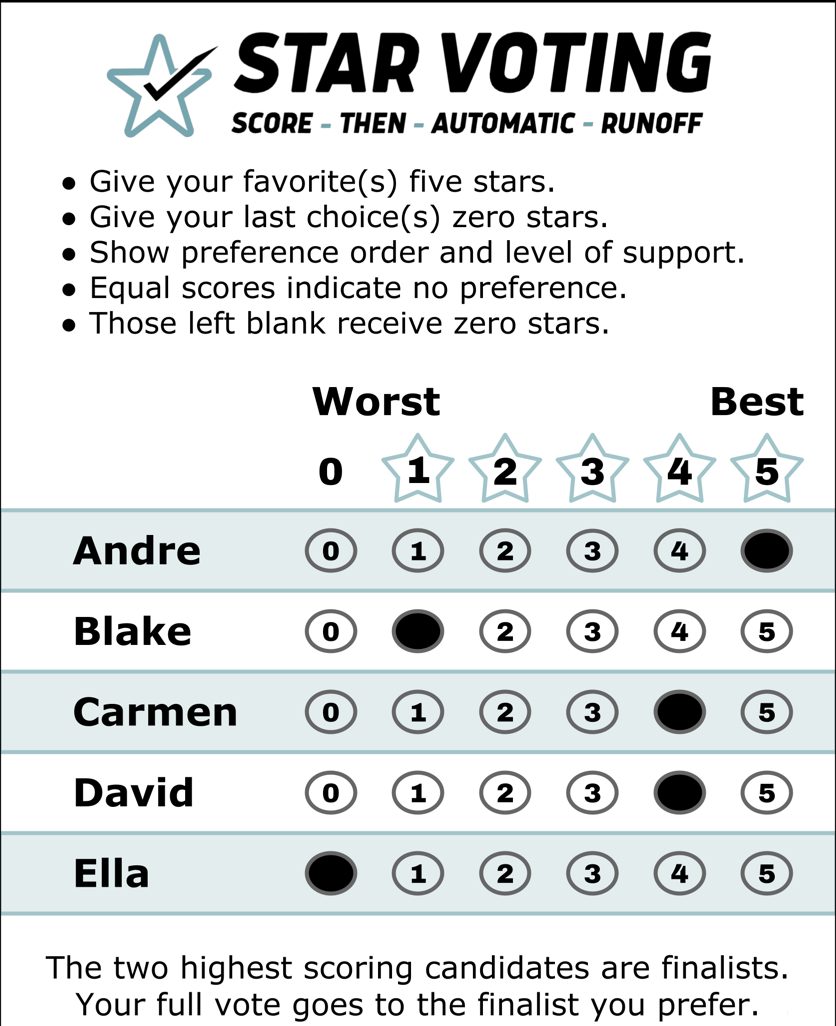
The instructions printed on it are the whole method:
- Give your favorite(s) five stars.
- Give your last choice(s) zero stars — or just leave them blank.
- Show preference order and level of support — order and strength, on one ballot.
- Equal scores indicate no preference.
- Those left blank receive zero stars.
Two of those rules do most of the work on this page:
- Equal scores are allowed. Two candidates can both get a 5 (or a 0). You're never forced to invent a difference you don't feel.
- Skipping is allowed. A candidate you leave blank simply counts as 0 — skipping can't spoil anything. On a digital ballot there is no way to mis-mark at all, since each row takes one score. On paper exactly one error is possible: marking two bubbles in the same row, which spoils that candidate's score (counted 0) — not the ballot. Even then the damage is contained to one candidate, where a ranked-ballot overvote can stop the count for the whole ballot from that rank on. See running a paper-ballot demo.
Because each score stands alone, filling the ballot out is quick: give your favorite a 5, your least favorite a 0, then place everyone else relative to those two. You never have to hold the whole field in your head at once — even in a 20-candidate race you're only ever comparing a candidate against your two anchors. (Contrast a ranked ballot, where each slot means re-scanning everyone you haven't ranked yet.)
The style gallery — thirteen voters, thirteen legal ballots
Thirteen ways people fill out that same ballot — same five candidates, every one legal, every one counted. They're ordered so that styles you might mistake for each other sit side by side: a bullet vote next to the partial ballot that looks identical, a slate next to the threshold that marks the same bubbles, the full range next to the compressed one. Click any style for its own page: what the ballot says, when it fits, the honest trade-off, and how that exact ballot fared in a real election.
| Ballot | Style | What the voter is saying |
|---|---|---|
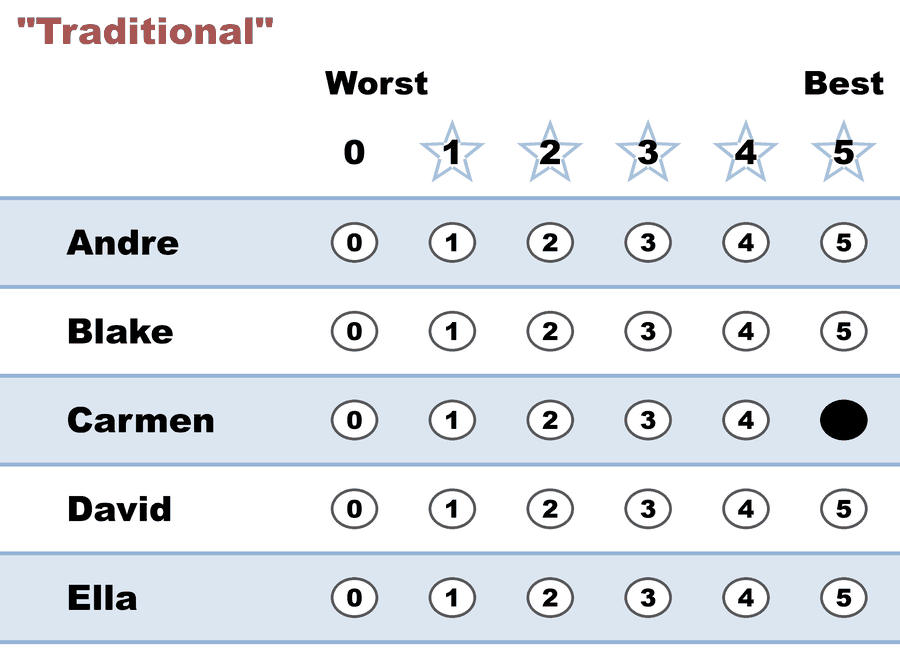 |
Traditional | "Carmen. Period." — the familiar single-choice vote, transplanted. |
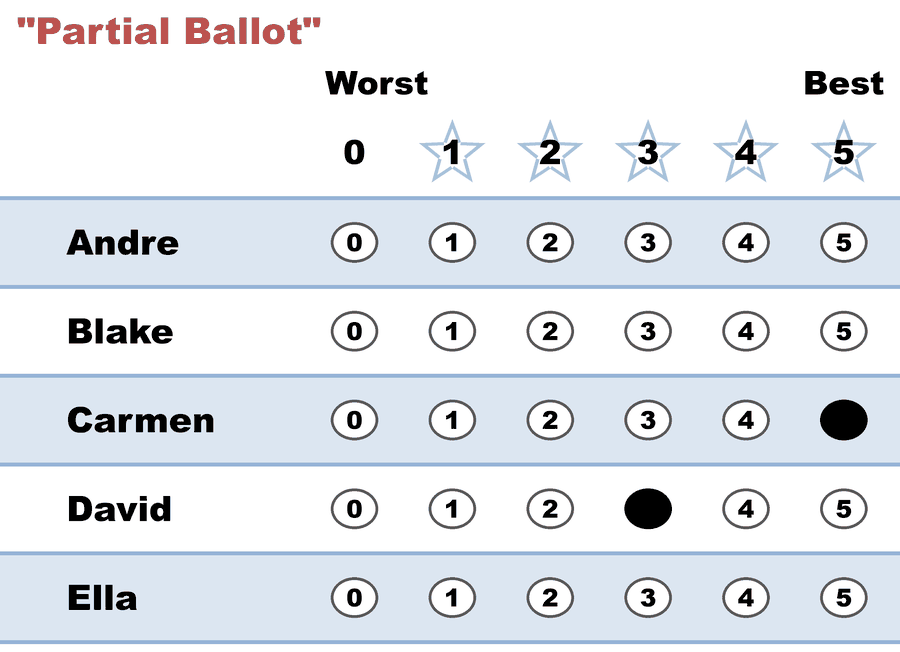 |
Partial Ballot | "I know these two. I've never heard of the other three." |
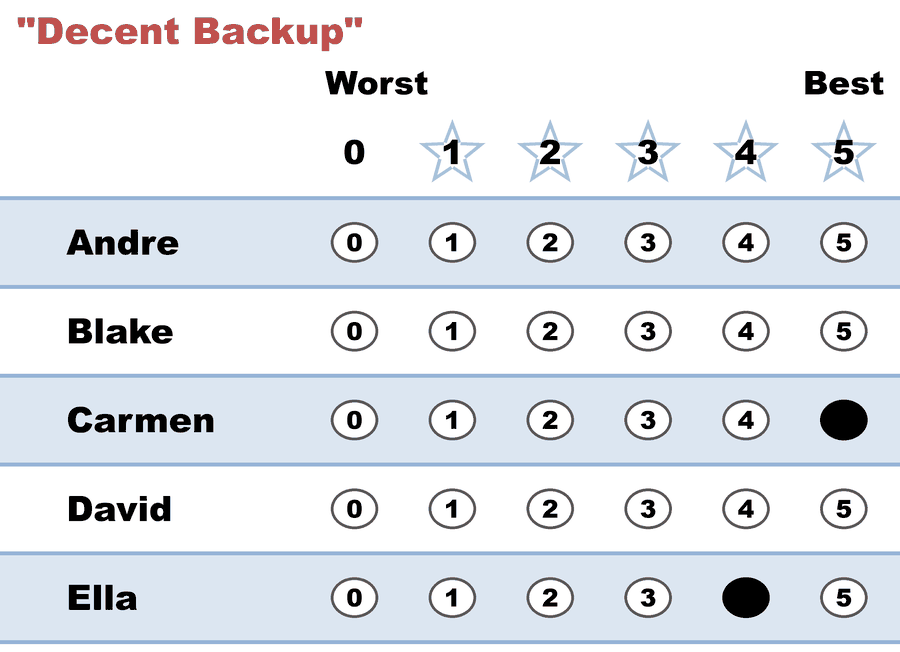 |
Decent Backup | "Carmen — and if not her, Ella is nearly as good." |
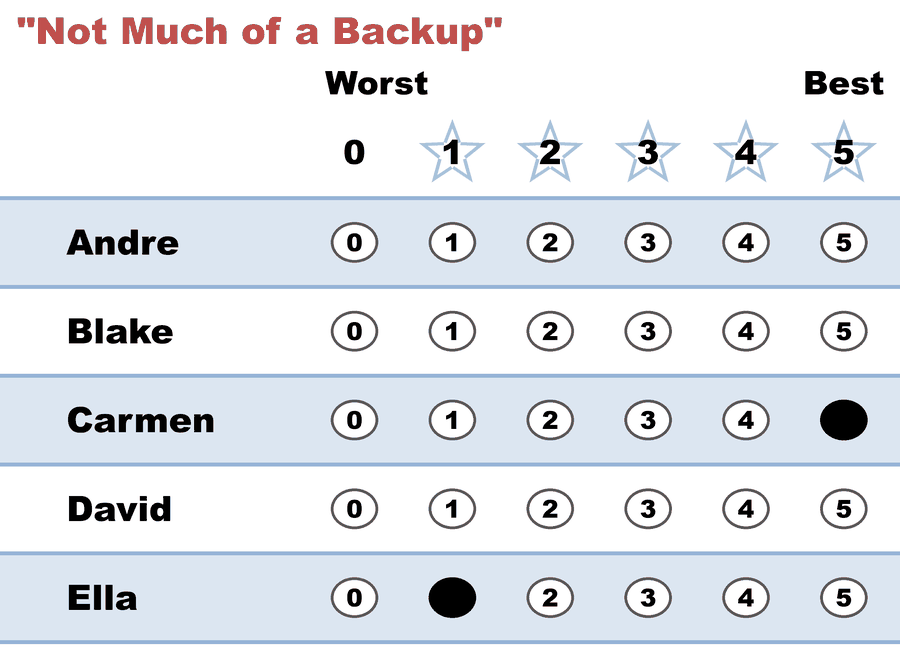 |
Not Much of a Backup | "Carmen — and Ella only over the rest, reluctantly." |
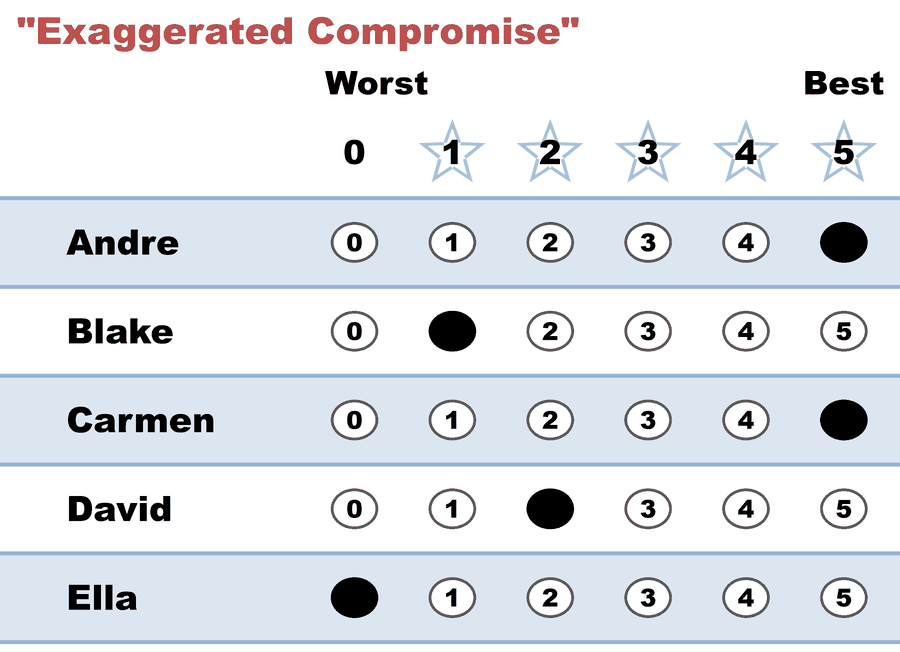 |
Exaggerated Compromise | "Carmen's my favorite — but the front-runner gets a 5 too, just in case." |
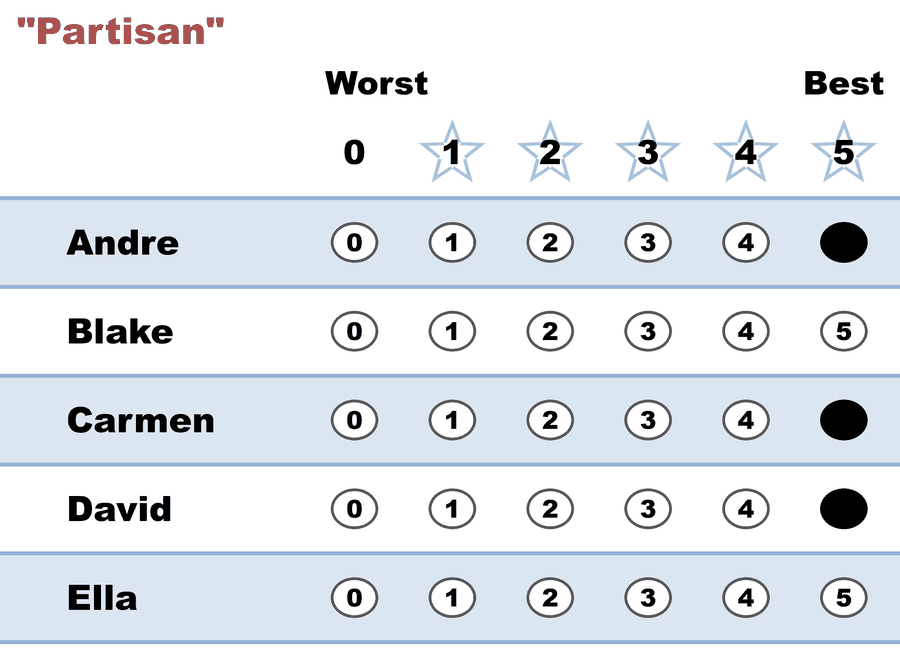 |
Partisan | "My side's three, full support; nobody else." |
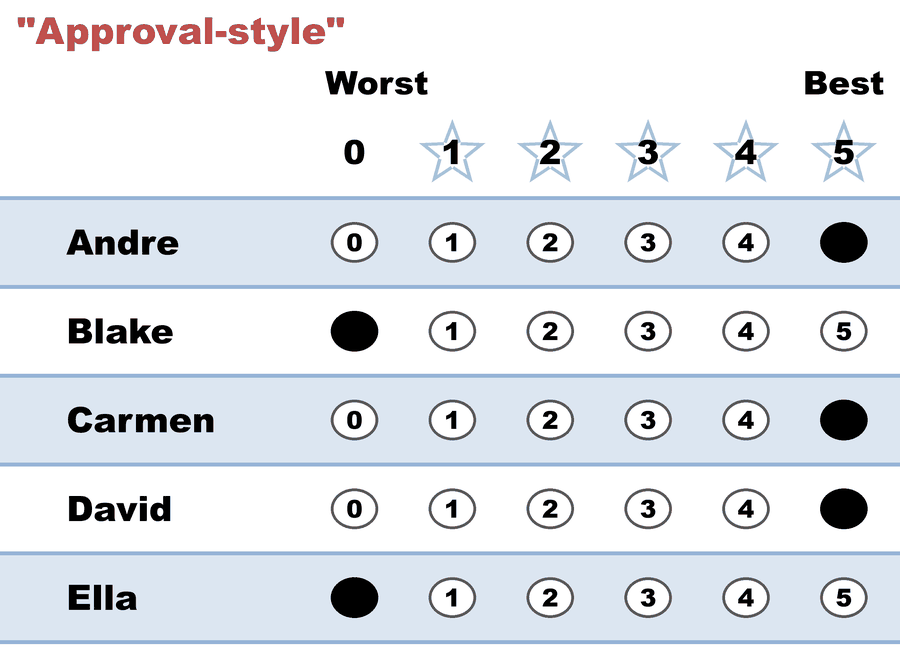 |
Approval-style | "These three are acceptable; those two aren't." — only 0s and 5s, no middle. |
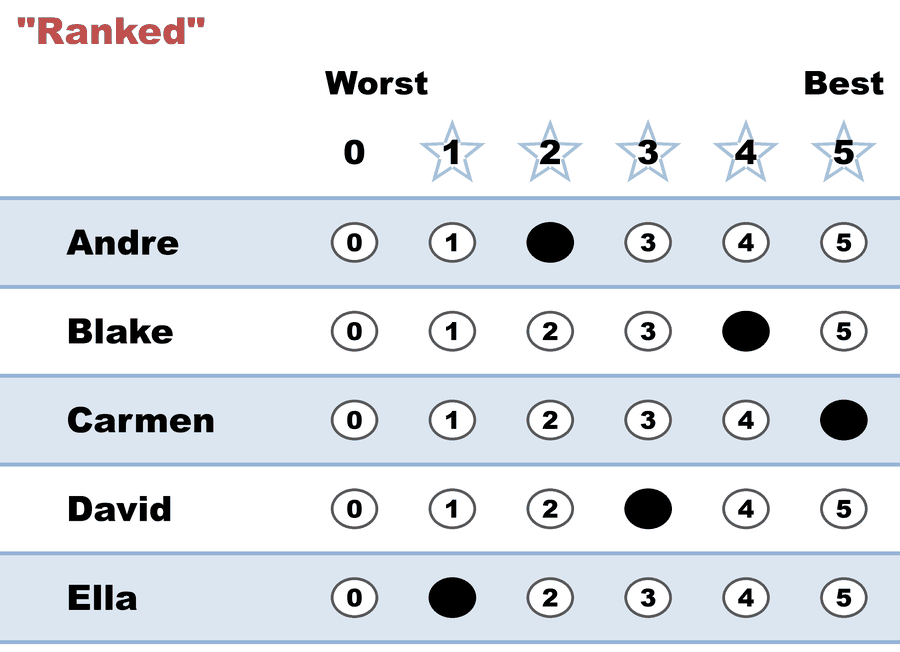 |
Ranked | "I'll use each score once, like a ranking: Carmen > Blake > David > Andre > Ella." |
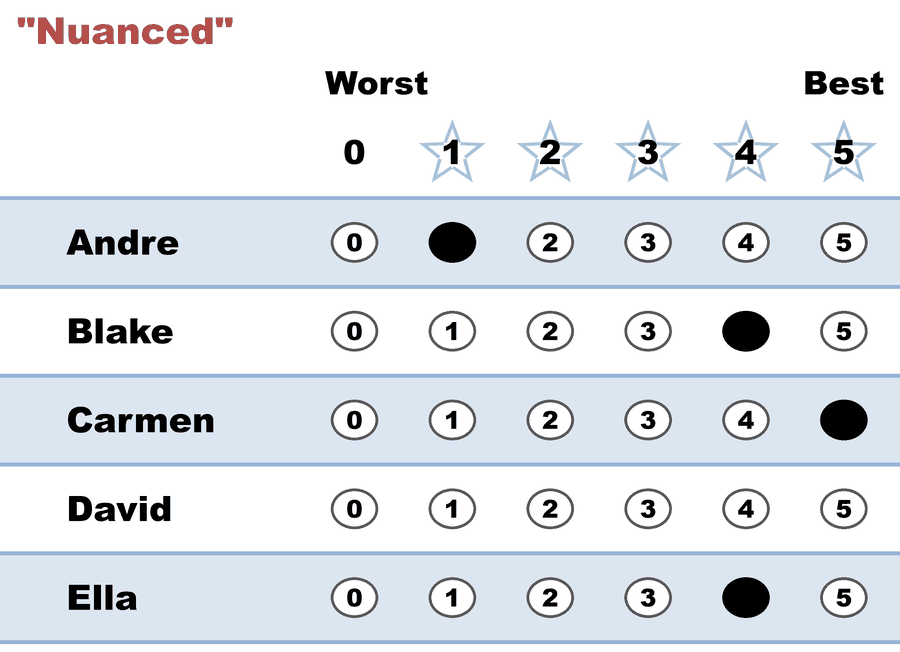 |
Nuanced | "Full range — and Blake = Ella because I truly can't split them." |
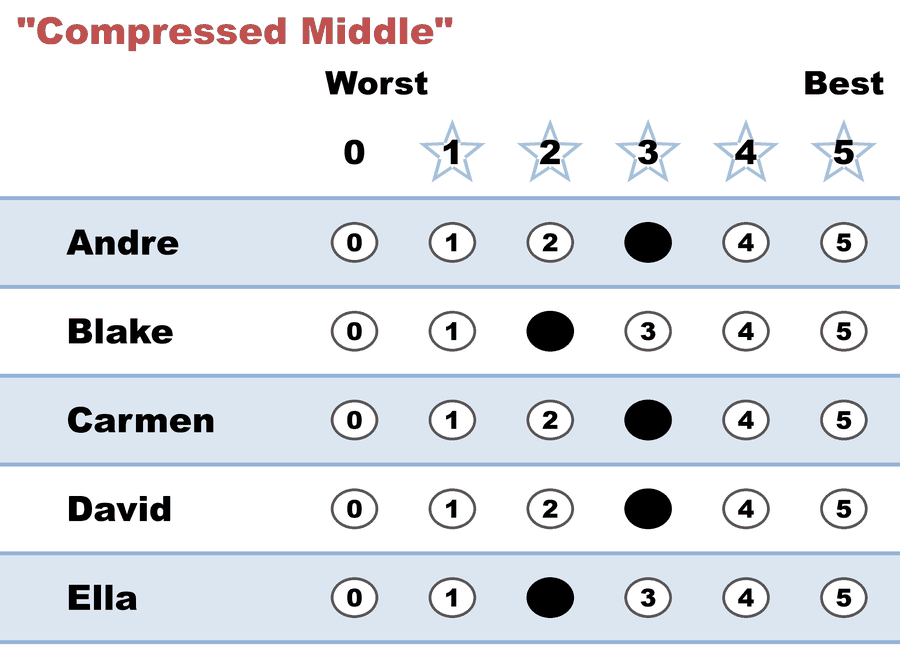 |
Compressed Middle | "They're all roughly fine — mild preferences, nothing extreme." |
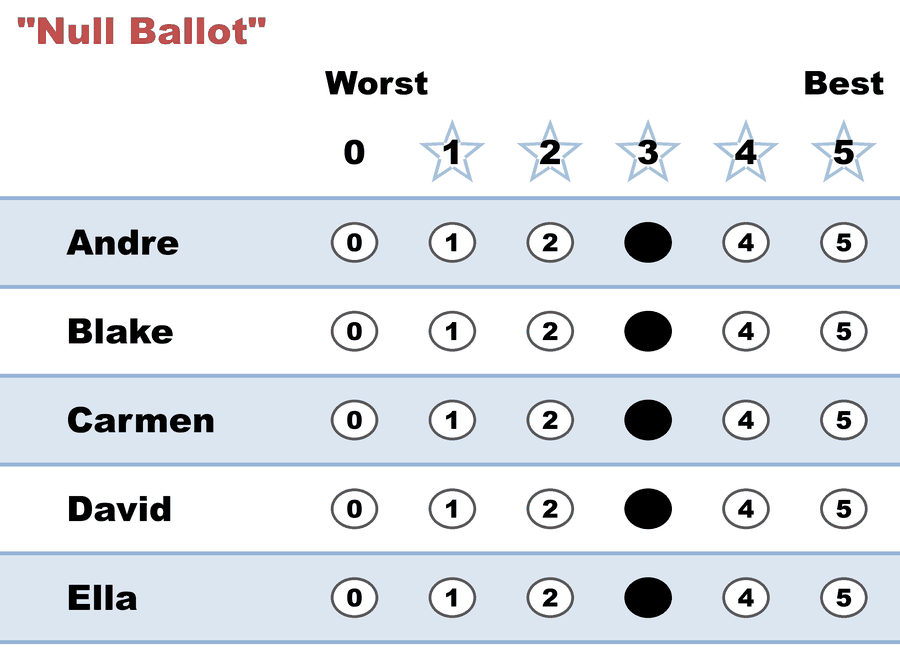 |
Null Ballot | Nothing at all — legal, counted, and provably without effect. |
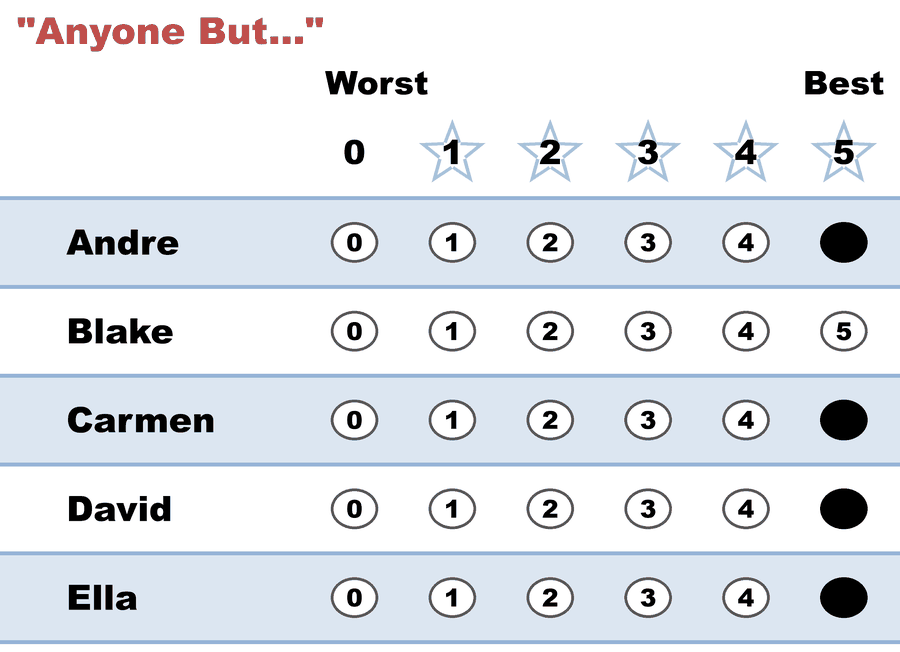 |
Anyone But… | "Anyone but Blake." |
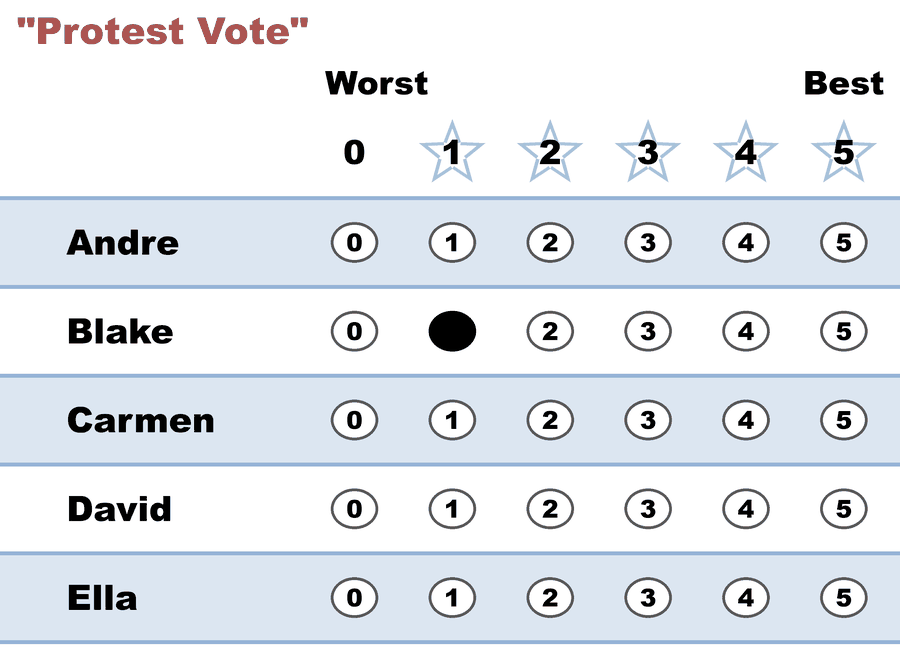 |
Protest Vote | "I dislike them all; Blake is the least bad." |
Every one of these is legal, none can spoil the ballot, and none carries secret extra weight. Four things are worth knowing before you pick one:
- A backup score can never hurt your favorite. The 4 you give your second choice does nothing to your favorite's 5 in the scoring round, so honest rating is also the smart rating — you never have to exaggerate or hold back.
- Scoring both finalists the same forfeits the runoff. That ballot lands as Equal Support — it still helped choose the finalists, it just voices no preference between them. It's the price the Exaggerated Compromise pays for its insurance, and the standing risk in Approval-style and Partisan ballots. The fix is one mark: favorite 5, next-best 4.
- A blank is a zero, not an abstention. A Partial Ballot's empty rows count against candidates the voter may simply never have heard of. Score an unknown candidate in the middle if that's what you actually mean.
- A ballot with no gaps has no voice. Give everyone the same score and you've cast the Null Ballot — the one style here that cannot affect any election, ever.
None of that makes any of them wrong ballots; it makes them ballots whose consequences are worth knowing before you cast one. The per-style pages hold the full discussion: the fine print on backups, where equal scores land, why the ranked style volunteers a constraint the ballot doesn't impose, and how quiet a protest vote really is.
The gallery, run as real elections
The styles above aren't hypothetical — they're two tabulatable elections, split so each one keeps a single cast of candidates. The first eight styles run together below; the last five have their own race, linked at the end of this section.
One ballot per style, six candidates (Allen, Bianca, Chris, Desi, Edith, Frank): reader page · 03c_c6_b8_style-gallery.yaml.
| Style | Allen | Bianca | Chris | Desi | Edith | Frank |
|---|---|---|---|---|---|---|
| Traditional | 0 | 5 | 0 | 0 | 0 | 0 |
| Decent Backup | 0 | 5 | 0 | 0 | 0 | 4 |
| Not Much of a Backup | 0 | 5 | 0 | 0 | 0 | 1 |
| Partisan | 5 | 5 | 0 | 0 | 0 | 5 |
| Ranked | 2 | 5 | 0 | 3 | 1 | 4 |
| Nuanced | 3 | 4 | 0 | 3 | 1 | 5 |
| Anyone But… | 5 | 5 | 0 | 5 | 5 | 5 |
| Protest Vote | 0 | 0 | 0 | 0 | 0 | 1 |
Bianca and Frank reach the runoff on scores; Bianca wins it 4–2, with the Partisan and Anyone-But voters counted as Equal Support (they scored both finalists 5):
--- STAR Voting Method (single winner) ---

[STAR Voting]
 Tabulating 8 ballots.
Allen,Bianca,Chris,Desi,Edith,Frank
    0,     5,    0,   0,    0,    0
    0,     5,    0,   0,    0,    4
    0,     5,    0,   0,    0,    1
    5,     5,    0,   0,    0,    5
    2,     5,    0,   3,    1,    4
    3,     4,    0,   3,    1,    5
    5,     5,    0,   5,    5,    5
    0,     0,    0,   0,    0,    1

[STAR Voting: Scoring Round]
 The two highest-scoring candidates advance to the next round.
   Bianca        -- 34 -- First place
   Frank         -- 25 -- Second place
   Allen         -- 15
   Desi          -- 11
   Edith         --  7
   Chris         --  0
 Bianca and Frank advance.

[STAR Voting: Automatic Runoff Round]
 The candidate preferred in the most head-to-head matchups wins.
   Bianca        -- 4 -- First place
   Frank         -- 2
   Equal Support -- 2
 Bianca wins.
   Runoff math:
     8  ballots cast
   − 2  Equal Support (no preference between the two finalists)
     ─
     6  voters with a preference  (majority = 4)
           Bianca 4 (67%)  ·  Frank 2 (33%)

[STAR Voting: Winner — STAR Voting Method (single winner)]
 Bianca
Full report: 03c_c6_b8_style-gallery_tabulated.txt.
The other five styles — Partial Ballot, Exaggerated Compromise, Approval-style, Compressed Middle, Null Ballot — run as their own race, five candidates (Alice, Bruno, Clara, Diego, Erin): reader page · 03d_c5_b5_style-gallery-five-more.yaml. It's the awkward counterpart to the one above: three of its five ballots land as Equal Support, so the race is settled by the two voters who left themselves something to say — and deleting the null ballot entirely changes the finalists, the winner and both runoff tallies not at all.
Is that all of them?
No — and it isn't close. Thirteen is a gallery of recognizable habits, not an inventory of the possibilities.
Count the actual space. Five candidates, each scored 0–5 independently, gives 6⁵ = 7,776 legal ballots. Many of those are the same vote wearing different numbers, though: adding the same amount to every row raises every candidate's total equally, so it changes no ranking in the scoring round, and it moves no gap, so it changes nothing in the runoff either. Only the differences between your scores do any work. Collapse each ballot to its differences — slide it down until your lowest score is 0 — and the count of genuinely distinct ballots is
6⁵ − 5⁵ = 7,776 − 3,125 = 4,651
and one of those is the Null Ballot, which says nothing. So a five-candidate STAR ballot has 4,650 meaningfully different things it can say — each of which differs from every other in at least one election.
from itertools import product
ballots = list(product(range(6), repeat=5))            # 7776
distinct = {tuple(s - min(b) for s in b) for b in ballots}
print(len(ballots), len(distinct), len(distinct) - 1)  # 7776 4651 4650
Two things follow, and they pull in opposite directions in a way worth sitting with.
The space is enormous, so any list of styles is a teaching device, not a taxonomy — the thirteen here were chosen because voters recognize themselves in them, not because they partition anything. Several overlap in their marks and differ only in the voter's reason: Partisan and Approval-style can produce the identical ballot from a team loyalty and a quality threshold; Traditional and the Partial Ballot can be the same marks made by decision and by ignorance. The count cannot tell those apart, which is the honest reason the styles are described by intent rather than by pattern.
And yet the ballot is small enough to hold in your head. The instructions printed on it — favorite 5, last choice 0, equal scores allowed, blanks are zeros — reach all 4,650 of those ballots without a single extra rule, and the Equally Weighted Vote means no corner of that space out-muscles another. You are never picking a style. You are just answering, five times, how much you like someone.
Blanks, and what they mean
Leaving a candidate's line blank counts as 0 — always, with no penalty to the rest of the ballot. In this library's YAML files a blank is written -, and there are markers for the other real-world cases (race abstention ~, candidate abstention &, spoiled ?, spoiled-and-reissued %) — all tabulate as 0 but are reported honestly. See Ballot & Terminology Basics and the GLOSSARY.
Contrast RCV-IRV: skipped or repeated rankings are, in many jurisdictions, ballot errors — one reason reported spoilage runs roughly 4–9% for ranked ballots vs. 0–2% for rated ballots (and 1–4% for the familiar single-mark ballot).[^spoilage] A scored ballot is very hard to fill out wrong.
[^spoilage]: ../Ranges as summarized by rangevoting.org — Ballot spoilage rate summary and BTernaryTau, Why I like STAR voting: the 5-star ballot. Disclose the lean: both are STAR/score-advocacy sources, so treat these as directional — the rated < ranked spoilage gap is well-attested (an overvote spoils a whole ranked ballot but only one score on a rated one), but the exact percentages vary by jurisdiction, ballot design, and how "spoiled" is defined, and no neutral meta-analysis pins them down. Cite the ordering, not the decimals.
Why the 5-star ballot earns its keep
Expressive. A choose-one ballot carries one bit of your opinion; an approval ballot, one yes/no per candidate; a ranked ballot, order but never strength. The 0–5 ballot carries order and strength — "Bianca by a mile" and "Bianca by a hair" are finally different votes. Six levels (0–5) sits near the sweet spot: enough resolution to matter, few enough that every step means something.
Accurate. Research comparing ratings and rankings finds ratings have superior validity — forced full rankings capture noise, differences voters don't actually feel. ("Ratings" is the measurement literature's term for what STAR calls scores — a 0–5 rating is a score; we keep the research word here because that's how the studies name it.) Equal scores let voters express exactly the distinctions that matter to them and no more. (The deep dive: Scores vs. Ranks.)
Equal. Any way you fill out your ballot, someone else can fill theirs out in the equal and opposite way — no style has secret extra weight. That's the Equally Weighted Vote, and it's why the gallery above is safe to publish as a how-to: there is no trick style to teach.
Related concepts in this library
- Scores vs. Ranks — the ballot-design distinction underneath this whole page
- The Score Ballot — this ballot in its family · one voter, three ballot formats
- STAR's Automatic Runoff — where Equal Support ballots land
- Equally Weighted Vote — why no style out-muscles another
- STAR's honest limits — what a backup score does and doesn't risk
- Curriculum 101.3 — How you're allowed to vote — this page's slot in the learning path
- Small demos:
03abullet vote ·03bprotest vote ·03cthe eight-style gallery ·03dthe five more
Learn more
- Equal Vote Coalition — STAR Voting — the official ballot design and marking rules
- Voting Scenarios — traditional, partisan, "ranked" — ballot examples (Adam's source notes for this page)
- Why I like STAR voting: the 5-star ballot — BTernaryTau, Technically Exists (spoilage rates, ratings validity, expressiveness)
- Ballot spoilage rate summary — rangevoting.org
- Back to the five-minute intro: Welcome to STAR Voting