The Score Ballot
One ballot style, several counts. A score ballot asks a different question than a ranking: not "which do you prefer?" but "how much do you like each one?" — every candidate gets an independent value, so the ballot carries your order and your strength. This page is the anatomy of the ballot itself; its twin is the ranked ballot, and the side-by-side comparison is alternate ballot styles.
→ Companions: scores vs. ranks (the core distinction) · filling out the 5-star ballot — the style gallery · the fidelity ladder · scale granularity
What it looks like
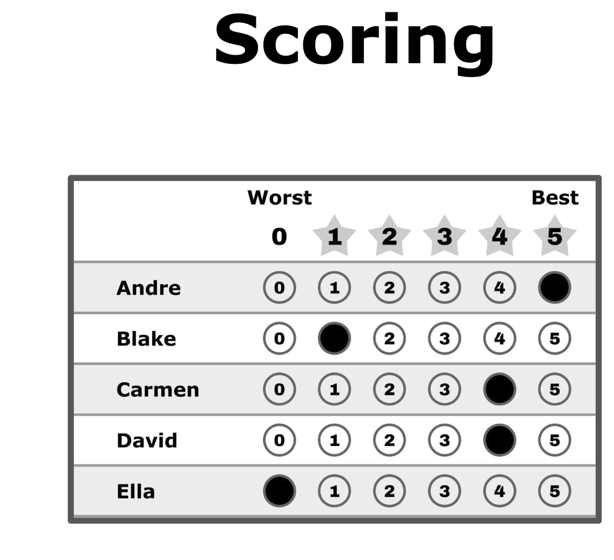
One row per candidate, 0 (worst) to 5 (best) — like rating movies. This voter says: Andre a 5, Carmen and David both a 4, Blake a grudging 1, Ella a 0.
It's the same voter, the same opinion, as on the ranked ballot — line the expressions up and you can see what each style keeps:
| Candidate | Ranking | Yes/No | Score 0–5 (this page) |
|---|---|---|---|
| Andre | 1st | ● | 5 |
| Blake | 4th | ○ | 1 |
| Carmen | 2nd | ● | 4 |
| David | 3rd | ● | 4 |
| Ella | 5th | ○ | 0 |
Note what survived the trip: here Carmen = David is recorded — the ranking had to fake a 2nd-vs-3rd difference, and Yes/No can't tell Andre from David at all. The full side-by-side walk-through is alternate ballot styles.
Writing it down — the grid, and why not to read it by columns
This library writes elections as a text grid (it's what the tabulation engine reads, and it's just a spreadsheet):
A, B, C     ← the header names the candidates (the COLUMNS)
5, 2, 0     ← each following row is ONE voter's whole ballot, read left→right
0, 5, 3
The one thing to get right: rows are voters, columns are candidates. The first data row above is a single voter who gave A = 5, B = 2, C = 0 — not candidate A's three scores read downward. (This is the transpose of the paper ballot up top, which lists one candidate per row; the grid just turns it on its side so a whole ballot fits on one line.) A small square grid like 3 voters × 3 candidates is the easiest to misread — the header is your anchor: whatever a cell sits under is the candidate it scores.
The same single ballot can be written several equivalent ways — all of these say A five, B two, C zero:
| Notation | Example | Where you'll see it |
|---|---|---|
| Grid row (this library) | A, B, C then 5, 2, 0 |
YAML files, case pages, the engine |
| Colon / dict | {A: 5, B: 2, C: 0} |
prose, JSON-ish contexts |
| Equals | A=5, B=2, C=0 |
quick inline notes |
| Bracket | A[5] B[2] C[0] |
occasionally in write-ups |
| ABIF | A/5 > B/2 > C/0 |
the ABIF interchange format (slash = rating) |
(A bare slash in running prose still reads ambiguously — "or", or a fraction — so avoid it mid-sentence. But as the last row shows, the slash is standardized as the rating operator in ABIF, where Allie/5 is unambiguous — the one place A/5 is a convention, not a guess.) They're all the same ballot; the grid just happens to be the one a computer counts and a spreadsheet stores.
The marking rules — deliberately hard to get wrong
Every row is independent — there is no grid constraint tying your candidates together, which removes the ranked ballot's failure modes wholesale:
- Equal scores are allowed. Two 5s, three 3s, whatever you feel. You're never forced to invent a preference — and never punished for feeling a tie.
- Blanks count as 0. Skipping a candidate can't spoil anything.
- No skipped-rank traps, and overvotes are contained. Each row is its own question, so there are no cross-candidate overvotes and no skipped-rank rules. On paper you can still mark two bubbles in one row — that spoils that candidate's score (counted 0), not the ballot, where a ranked-ballot overvote can end the count for the whole ballot. Reported spoilage runs roughly 0–2% for rated vs. 4–9% for ranked, though the rated figure is thinly evidenced and comes from an advocacy compilation — see scores vs. ranks.
Filling it out is anchor-based, not field-scanning: give your favorite a 5, your last choice a 0, then place everyone else against those two anchors. Even a 20-candidate race never asks you to hold the whole field in your head — contrast each ranked slot, which means re-scanning everyone you haven't placed yet. The full gallery of legal styles (bullet votes, protest ballots, "anyone but…") is filling out the 5-star ballot.
What it captures — order, strength, and honest ties
A score carries both pieces of information a ballot can collect: the order (5 > 4 > 1 > 0) and the size of the gaps (Andre-to-Carmen is small; David-to-Blake is a cliff). Those are two different things — which you prefer (preference) and how much you back each one (support) — and a rank only records the first: see Preference vs. Support. Downstream methods can always reduce a score to a ranking when they need one — scores → ranks drops information gracefully, while ranks → scores has to fabricate it (the fidelity ladder).
Resolution is a design dial. Yes/No approval is a score ballot at 1-bit resolution; 0–5 is the STAR standard (fine enough to express, coarse enough to read); classic Range ran 0–99. More levels = more expressiveness, and the choice can genuinely matter: scale granularity can flip the winner. The honest cost of coarseness: if you max out two candidates you slightly prefer apart, you've recorded a tie you didn't quite feel — see are equal-score votes "discounted"? for the whole story, including why "show the gap: 5 and 4" is the honest advice.
One score ballot, several tabulations
The same 0–5 grid above can be counted by:
| Count it with | How it reads the ballot | Notes |
|---|---|---|
| Score / Range | add the scores; highest total wins | STAR without the runoff |
| STAR | add the scores, then the top two meet in an automatic runoff | equal scores on the two finalists = Equal Support — counted in round 1, neutral in the tie it had no stake in |
| Approval | as 0/1 (approve or don't) | the 1-bit special case |
| STAR-PR and friends | proportional multi-winner | proportional representation |
Same lesson as the ranked twin, from the other side: the ballot is what you mark; the tabulation decides what happens to it. See what is a voting method? — a ballot and a count.
Related
- The ranked ballot — the twin page: an order instead of independent values
- Alternate ballot styles — the same voter on ranking / Yes-No / scoring, side by side
- Scores vs. ranks — why order and strength are different data
- Preference vs. Support — the vivid case:
1,0,1,0vs5,4,5,4, identical as ranks - Strict vs. weak ranks — the tie-handling story on the ranked side
- Glossary:
score ballot