05_Ranked_Robin — Ranked Robin (RCV-RR / Copeland)
Rank the candidates. Compare every pair head-to-head. Whoever beats the most rivals wins.
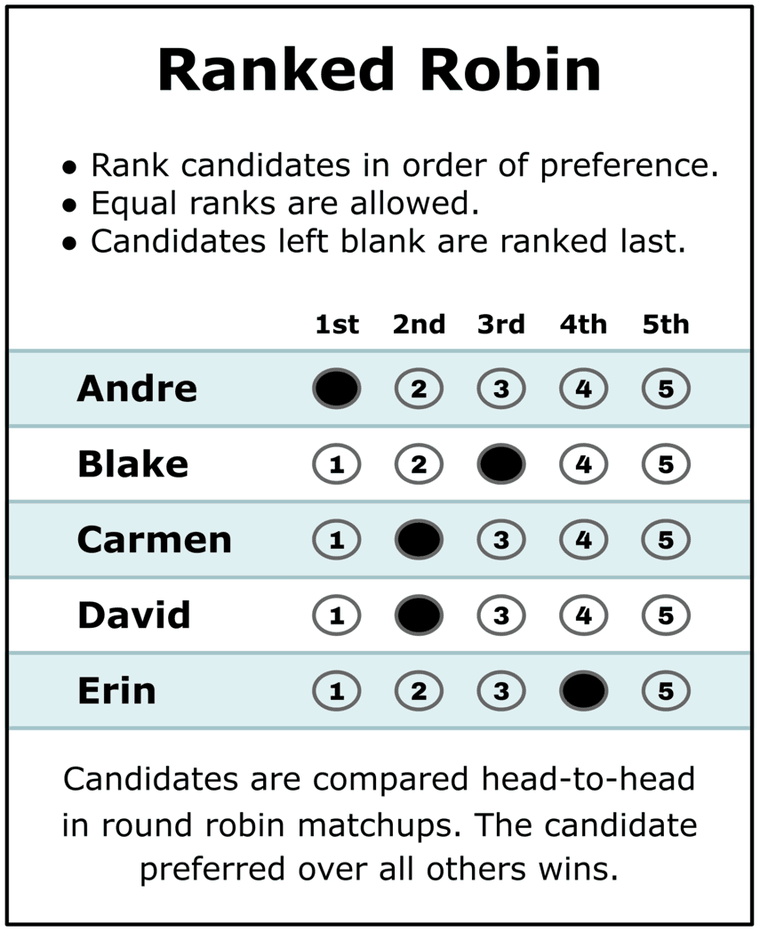
The ballot (Equal Vote) — note Carmen and David share 2nd place: unlike RCV-IRV, Ranked Robin lets you rank candidates equally.
Ranked Robin is a brand name, not a new method. Peel it apart and only one layer is actually new:
| Layer | What it really is | Since | New? |
|---|---|---|---|
| Compare every pair head-to-head; whoever wins the most matchups wins | Copeland's method — the count itself | first described 1299 (Ramon Llull), rediscovered by Condorcet in the 1780s, formalised by Copeland in 1951 | no |
| Ties broken by summing win margins | Copeland//Borda — a standard, long-known construction, proposed as Equal Vote's default by Sass | construction long known; 2021 as the default | no |
| The words "Ranked Robin" | Equal Vote's branding, coined by Sara Wolk | 2021 | yes — the name is the only new part |
What it does is take the same ranked ballot RCV-IRV uses and count it a completely different way. Instead of eliminating candidates round by round, it runs a round robin: every candidate against every other, like a sports league. Because every ballot is read in every matchup, nothing is ever discarded — and whenever some candidate beats all rivals head-to-head (a Condorcet winner), Ranked Robin elects them.
Which name means what — Condorcet the family, Copeland the count, Ranked Robin and Consensus Choice two campaigns' brands for it — has a page of its own: the naming decoder, which also carries where the name came from, what its coiner says it means, and how Equal Vote's own wording has moved. Which one we ought to lead with, argued both ways → What should we call this method?.
This page is the folder's front door: the method, one worked election, and the index of runnable examples below. The full concept treatment lives next door — Ranked Robin — the method (mechanics, names, family), Why Ranked Robin (the positive case), honest limits (where it struggles), and the full concept index.
How it counts — a worked election
Thirteen voters, four candidates on a left→right line: Ada (left), Ben (center-left), Cara (center-right), Dan (right). Each row is a bloc of identical ballots.
4 : Ada > Ben > Cara > Dan
4 : Dan > Cara > Ben > Ada
3 : Ben > Cara > Ada > Dan
2 : Cara > Ben > Dan > Ada
Count first choices and Ada and Dan lead with 4 each; Ben has only 3. Under Choose-One plurality, one of the two poles wins. Now compare every pair head-to-head instead:
Round-Robin — every pair, head-to-head (For – Against):
   Ben   beats Ada    9 – 4
   Cara  beats Ada    9 – 4
   Ada   beats Dan    7 – 6
   Ben   beats Cara   7 – 6
   Ben   beats Dan    9 – 4
   Cara  beats Dan    9 – 4

Win–loss record — Copeland score = wins + ½·ties (highest score wins; ties broken by total margin, then lot order):
    #  Candidate  W–L–T  Copeland  Margin  Beats
    1  Ben        3–0–0         3     +11  Cara, Ada, Dan
    2  Cara       2–1–0         2      +9  Ada, Dan
    3  Ada        1–2–0         1      -9  Dan
    4  Dan        0–3–0         0     -11  —

Winner — Ranked Robin (RCV-RR): Ben
   beats every opponent head-to-head — the Condorcet winner.
Ben wins 3–0. A majority prefers him to each rival, one on one — so he's the Condorcet winner, and Ranked Robin elects him. The lesson: RR elects the consensus candidate, not the largest faction's favorite. Nobody had to be eliminated, and no ballot went uncounted.
(Honest footnote: RCV-IRV elects Ben here too — Cara is eliminated first and her ballots flow to Ben. This election separates Ranked Robin from plurality, not from IRV. For the case where RR and IRV genuinely part ways, see the Tennessee center squeeze in the examples below.)
Want the whole count — the pairwise matrix, the Smith set, the audit trail? → the full report: ranked_robin_consensus_center.md · run it yourself: .yaml
How it differs from RCV-IRV
Same ranked ballot, opposite counting philosophy — read the whole ballot against everyone, or eliminate until someone has a majority of what's left:
| RCV-IRV (Hare) | Ranked Robin (RCV-RR) | |
|---|---|---|
| Ballot | Rank, no equal ranks | Rank, equal ranks allowed |
| How it counts | Eliminate fewest-first-choices, transfer, repeat | Compare every pair; most head-to-head wins |
| Uses your lower ranks? | Only after higher ones are eliminated | Always — every ranking counts against every opponent |
| Elects the Condorcet winner? | Not always (can center-squeeze) | ✅ Yes, when one exists |
| Monotonic? | ❌ No | ✅ Yes |
| Precinct-summable? | ❌ No | ✅ Yes (add pairwise matrices) |
| Exhausted ballots? | Possible | No — every ballot is read in every pairwise contest |
(The canonical, fuller version of this table — plus the cycle question, the naming family, and the sourcing — is on the method page.)
The worked examples
Runnable elections, each isolating one idea. Tabulate any of them yourself.
| Where | What |
|---|---|
| The worked intro — the consensus center wins | the full report for the election above: Ben beats every rival head-to-head and wins 3–0, though Ada and Dan each hold more first choices (folder) |
| Condorcet vs. Ranked Robin — worked examples | a clean Condorcet winner, a genuine cycle (rock/paper/scissors) and how RR resolves it, and a real 0-wins record |
| RR vs. IRV vs. plurality — same ballots | one ranked ballot set, three winners — the Tennessee center-squeeze (BV-backed, triple-checked: LH / BetterVoting / pref_voting) |
| Tiebreaks — dead heat → lot | the Equal Support column, the ½-Copeland credit, and the full ladder to lot order — and where the LH & BetterVoting tiebreaks diverge |
| The Copeland score — a draw is worth half a win | why "most head-to-head wins" is a shorthand and not the rule: a single ½-credit elects a candidate who ties on raw wins and lost a matchup — and puts Copeland alone against every other Condorcet method, which is the C1/C2 divide made visible |
| Most matchups won ≠ Condorcet winner | the claim-check companion: 18 voters, no drawn matchups at all, and the candidate with strictly the most wins still loses a head-to-head. Every margin is 12–6, so Minimax / Ranked Pairs / Schulze / Split Cycle all tie five ways and only Copeland decides — the mirror image of the case above |
| Ranked Robin vs Consensus Choice — two winners, one cycle | the two rival "consensus" brands on identical ballots: Copeland ties all three, and Equal Vote's margins rule elects Ana while Better Choices for Democracy's "Most Wins, Smallest Loss" elects Celia — the entire practical difference between the two proposals, made visible |
| Burial — RR's signature wart, worked | the sincere/buried pair (BV2208/BV2209): fifteen voters rank the Condorcet winner last, manufacture a cycle, and win the record tie — triple-checked, deterministic on both engines |
| STAR vs RR — 30 divergence samples | an auto-generated dump of 30 elections where STAR and RR elect different winners, spread across candidate field (3/5/7/10), electorate size, and grouped-vs-random structure — each YAML states its own cause (cycle vs dark horse), with RCV-IRV / Approval / Plurality on the same ballots (they scatter — no clean alignment). Empirical companion to the simulation |
Same ballot, different count: RCV-IRV (elimination rounds) lives in other methods and inside the comparison sets.
Conversation scripts: the Larry ↔ Adam series (STAR + RCV-IRV) is indexed in Conversation scripts — index.