Strict vs. Weak Ranks — Not All Ranked Ballots Are the Same
Many ranked methods let you mark two candidates equal. RCV-IRV (Hare) does not — and it never compares candidates head-to-head. Most people assume otherwise.
"Ranked voting" is not one ballot rule. Ranked ballots differ along two independent axes, and the differences change both what you can say and who wins:
- Strict vs. weak. A strict ranking forbids ties — every candidate must get a distinct place (1, 2, 3…). A weak ranking allows equal ranks — you can say "I like these two the same." (Formally: a weak order / "order with ties.")
- Complete vs. incomplete. A complete ballot ranks everyone; an incomplete (truncated) ballot ranks only some. Whether you may skip a rank, and what happens if you do, is a per-method rule.
The standard data taxonomy (PrefLib) names the four combinations: SOC/SOI (strict, complete/incomplete) and TOC/TOI (ties allowed, complete/incomplete).
See it on the ballot
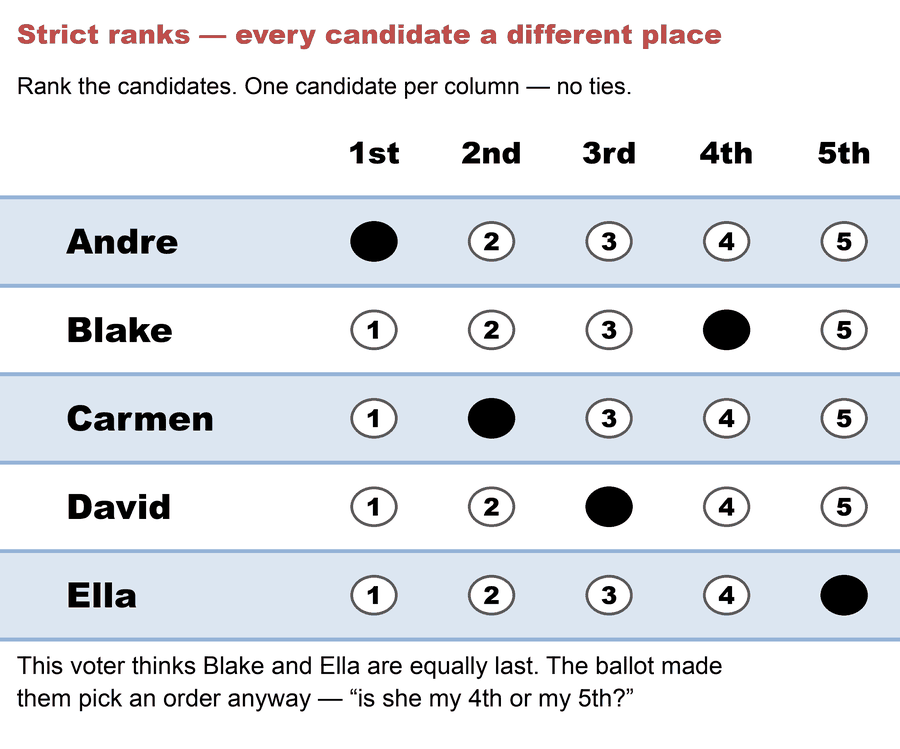
One voter, one opinion — Andre best, then Carmen, then David, and Blake and Ella equally last. Here is that opinion on each kind of paper.
Strict — one bubble per column, so the tie at the bottom is impossible to say. The voter has to pick an order for Blake and Ella they don't actually feel:
Weak — the same ballot with one mark moved. Ella joins Blake at 4th, and the 5th column empties out, because once two candidates share 4th there is no 5th place left to give:
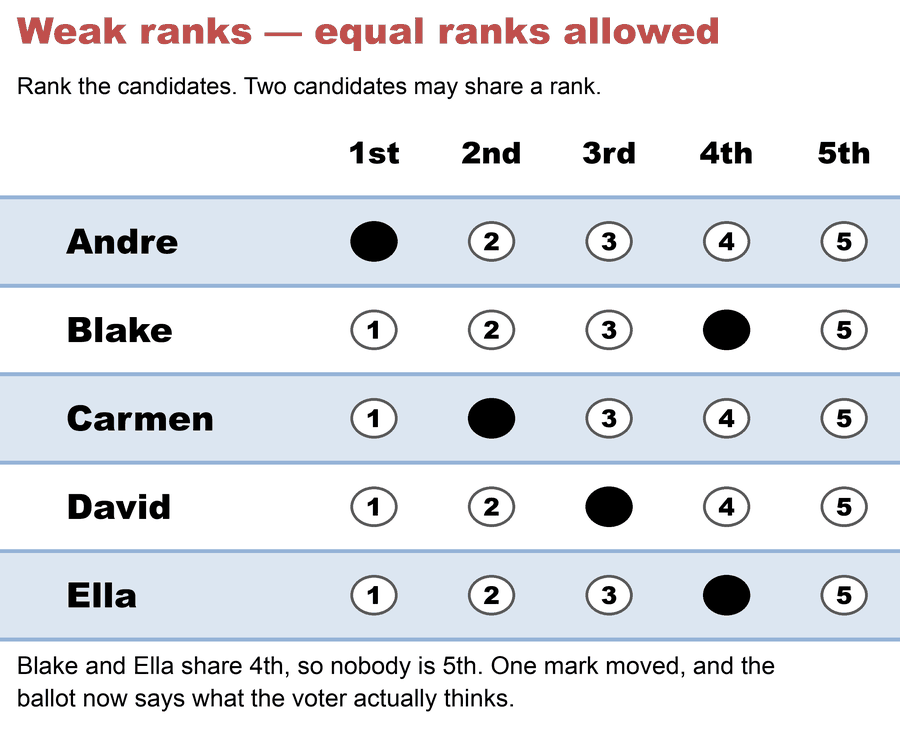
That one bubble is the entire difference between the two ballot rules — and it is not a free choice. Put the weak marks on the strict paper and the ballot doesn't record a tie, it records an error:
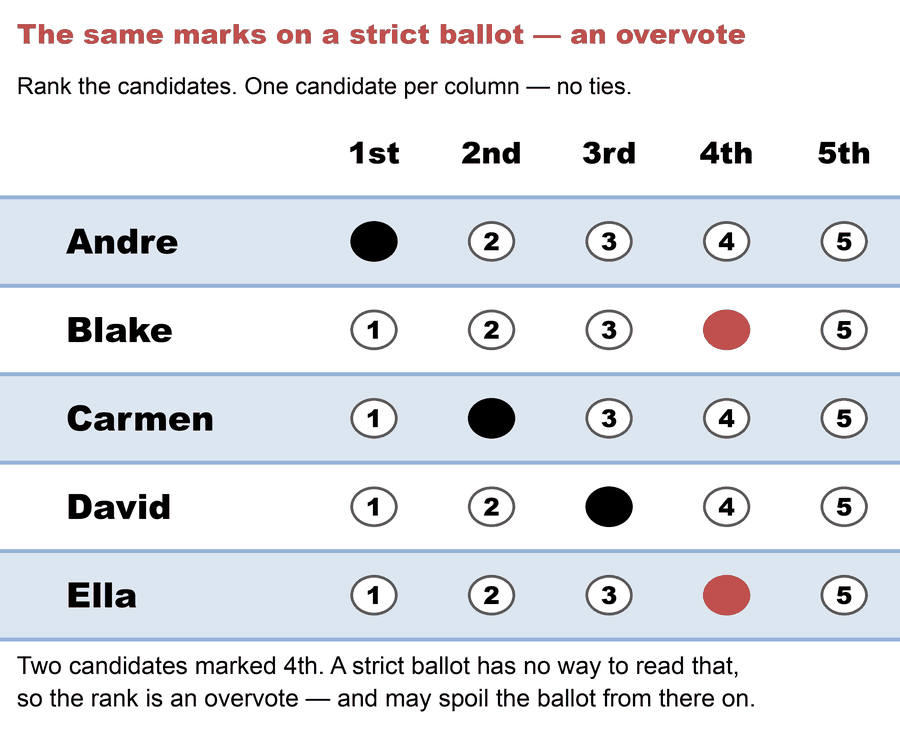
The voter did nothing different in the second and third pictures. Whether that hand movement is a vote or a spoiled rank is decided entirely by which method is counting.
The key point about RCV-IRV (Hare)
RCV-IRV uses strict ranks and is not pairwise. You cannot give two candidates the same rank. And IRV never does head-to-head comparisons — each round it looks only at every ballot's current top choice, eliminates the candidate with the fewest first-place votes, and ignores all the down-ballot detail until a ballot's higher choice is eliminated. That's a plurality-style elimination rule, not a comparison of candidates against each other.
This matters because two of the things people most often assume RCV does — let me mark ties, and compare everyone head-to-head — are exactly what RCV-IRV does not do. Those belong to other ranked methods.
Fine print worth having in a debate, though: "IRV cannot take equal ranks" describes every deployed instant runoff, not the mathematics. The rule generalizes to weak orders in exactly two ways — one full point to each tied top choice, or one point split between them — and the choice is consequential: only the first keeps independence of clones, which is IRV's own headline claim. → RCV-IRV with equal ranks · the cases.
Which ranked methods allow equal ranks? Which are pairwise?
| Method | Equal ranks? | How it counts | Pairwise (head-to-head)? |
|---|---|---|---|
| RCV-IRV (Hare) | ❌ No — strict | Sequential elimination of fewest first-choices | ❌ No |
| STV (multi-winner IRV) | ❌ No — strict | Quota + transfers, round by round | ❌ No |
| Ranked Robin / Condorcet (Schulze, Ranked Pairs, Minimax) | ✅ Yes — weak allowed | Every pair compared; most head-to-head wins | ✅ Yes |
| Borda count | ✅ Usually (ties shareable) | Positional points from rank | ❌ No (positional) |
| Bucklin | ✅ Often | Adds in lower ranks until a majority | ❌ No |
| Scored (STAR, Score, Approval) | ✅ Inherently (not a ranking) | Add scores; STAR adds an automatic runoff | STAR's runoff is one pairwise step |
The headline: allowing equal ranks and using pairwise comparisons are features of other ranked methods — not of the RCV-IRV that's actually on US ballots.
False assumptions people make about RCV ballots
- "I can rank two candidates equally." — Not in RCV-IRV. Equal ranks are an overvote and can spoil that rank. (Ranked Robin and other Condorcet methods do allow it.)
- "All my rankings get counted." — No. IRV only ever counts your highest continuing choice; lower rankings are ignored unless and until higher ones are eliminated, and a ballot can be exhausted with no remaining choice counted.
- "RCV compares the candidates head-to-head." — No. That's Condorcet (e.g., Ranked Robin). IRV only counts top-choice tallies each round.
- "I can skip ranks freely." — Risky. Skipped or repeated rankings are handled differently by jurisdiction and can exhaust the ballot.
- "Ranked = good, so all ranked methods behave alike." — They don't. A weak-ranked Condorcet method reliably finds the candidate closest to the center of opinion; strict-rank IRV can eliminate that very candidate (center squeeze).
Why equal ranks (weak ranking) matter
Forcing a strict order makes voters invent distinctions they don't feel — "is she my 4th or my 5th?" — and studies suggest this adds noise and may raise ballot-spoilage rates (the evidence is real but contested). Allowing equal ranks lets a voter honestly express indifference, and it adds real expressive power: on a strict ballot a second choice "could be as good as your favorite or almost as bad as your last choice," and the ballot can't tell the difference. In reform-advocate simulations (e.g., voter-satisfaction-efficiency work), good weak-ranked Condorcet methods tend to perform on par with good score methods, while strict-rank IRV lags — a finding worth citing as such, not as settled fact.
(Scores go one step further: they carry order and strength. See Scores vs. Ranks — Don't Confuse Ranks and Ratings.)
Related concepts in this library
- Strict ranks and weak ranks — the two on their own pages
- Scores vs. ranks — don't confuse ranks and ratings
- Scoring methods vs. ranked voting
- RCV vs. IRV vs. RCV-IRV — terminology
- Ranked Robin — the Condorcet method that does allow equal ranks and compares pairwise
- Is IRV "just plurality"? — why elimination is a first-choice plurality test (and where that claim overreaches)
- Center squeeze — what strict-rank IRV does to a strong compromise candidate
- Is RCV "simple"? (201)