RCV-IRV with equal ranks — Approval-IRV and Split-IRV¶
Every other page in this folder varies who gets eliminated. This one varies the ballot: what if a voter may mark two candidates equal? Instant runoff has no answer built in — it was defined for strict rankings — so an answer has to be chosen, and there are two.
Level: 301 · deep dive
→ Family: Which RCV-IRV? · the default it extends: RCV-IRV (Hare) · the ballot: weak ranks · the worked cases: equal ranks on an IRV ballot
In one line¶
A ballot's top surviving choices may be a set rather than a single name, and the only question is what that set is worth: Approval-IRV gives each of them a full point, Split-IRV gives them a point between them. Eliminate the lowest, transfer, repeat — everything else about instant runoff is unchanged.
Why this isn't already settled¶
On a US ranked ballot, two candidates in one rank column is an overvote. Depending on the jurisdiction the ballot is rejected outright, or counted until the doubled rank is reached and then set aside. That is not the count declining to handle a tie so much as the rule not having one: Hare's method takes a linear order, and a tie isn't one.
So this variant is not a proposal to count existing ballots differently. It is a proposal to accept a ballot that is currently thrown away — and the case for it is partly operational. In San Francisco's 2019 mayoral election, 899 of 206,117 ballots (0.4%) could be read as a coherent ranking with at least one deliberate tie; in Scotland's 2017 local elections 1.6% of ballots were rejected for multiple top choices. Those ballots are not confused, they are unrepresentable.
How the count works, step by step¶
- Every ballot votes for its highest-ranked candidates who are still standing — possibly more than one.
- Score them: Approval-IRV hands each one a full point; Split-IRV splits one point evenly (three top choices → ⅓ each).
- Eliminate the lowest-scoring candidate.
- Repeat. Ballots whose whole top class is gone drop to their next class.
On a ballot with no ties, every top class has exactly one name and both rules are ordinary Hare IRV. They can only differ once somebody marks a tie.
Which one is right¶
Not a matter of taste — there is a theorem. Delemazure & Peters (EC'24) look at the whole class of "score somehow, drop the lowest, repeat" rules and prove Approval-IRV is the unique one that keeps the properties instant runoff is sold on:
| Approval-IRV | Split-IRV | |
|---|---|---|
| Independence of clones | ✅ | ❌ |
| Respect for cohesive majorities | ✅ | ❌ |
| Indifference monotonicity | ✅ | ❌ |
| Generalized PSC (multi-winner: Approval-STV vs Split-STV) | ✅ | ❌ |
The awkward part is that Split-IRV is the one in the field. It is the natural reading — one voter, one vote, divided — and it is what the John Muir Trust has used for trustee elections since 1998, the London Mathematical Society since 1999, and what R's vote package implements. It descends from the Meek/Warren/Hill construction in Voting Matters, which replaced each tied ballot with weighted copies of every way of breaking the tie; Split-IRV is that idea in polynomial time.
Independence of clones is the expensive loss. It is instant runoff's central claim over Choose-One — that a similar candidate can't spoil the race — and Tideman proved strict-ballot IRV has it. An organization that allows equal ranks the intuitive way has given that up without being told.
Worked example — five voters, and the rules disagree¶
The ballots as marked — the filled bubble is the score given, and the score is the number in its column:
| # | Ballot as marked | Aida | Bram | Chloe | Dante |
|---|---|---|---|---|---|
| 1 | 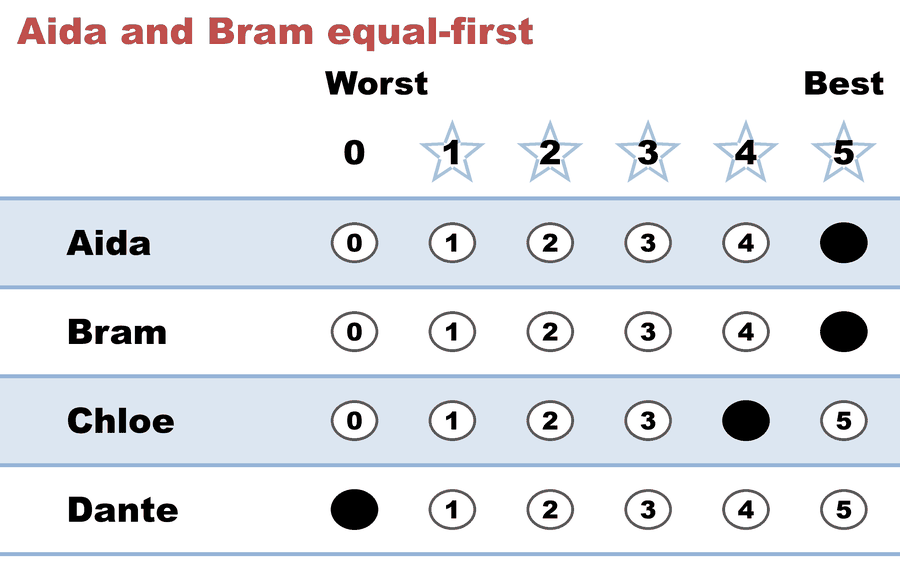 |
5 | 5 | 4 | 0 |
| 2 | 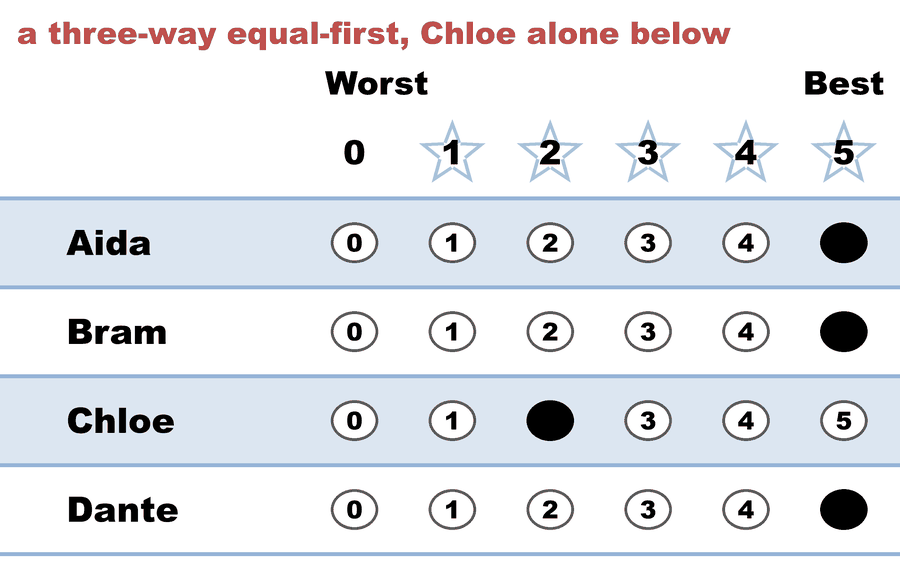 |
5 | 5 | 2 | 5 |
| 3 | 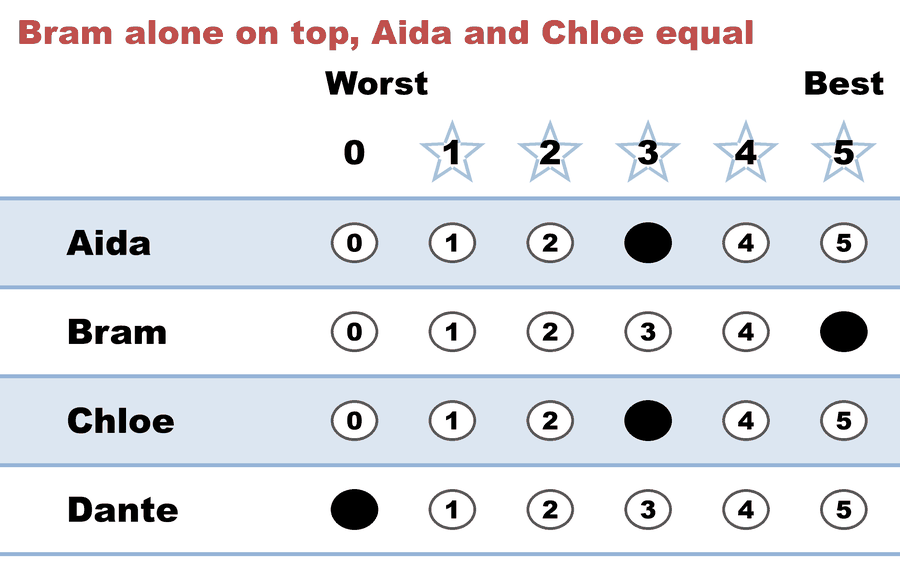 |
3 | 5 | 3 | 0 |
| 4 | 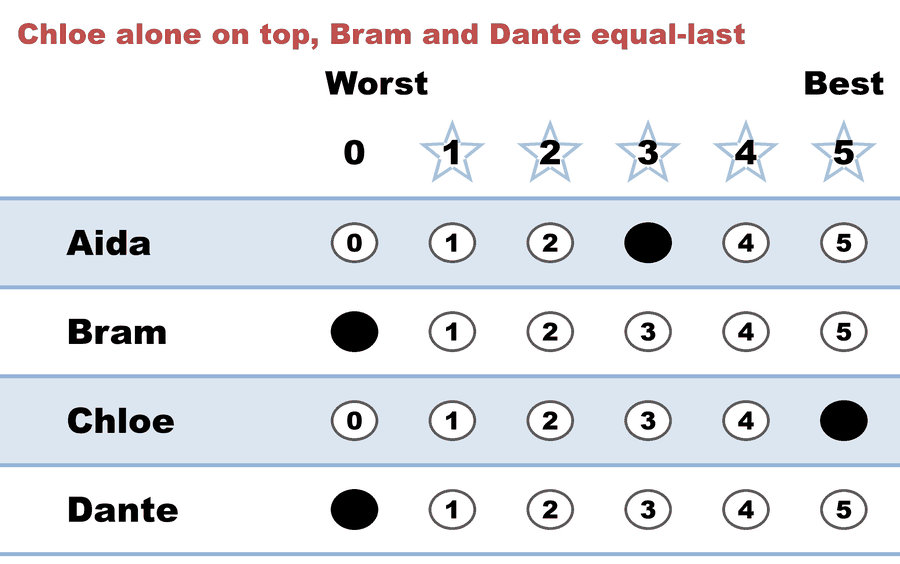 |
3 | 0 | 5 | 0 |
| 5 | 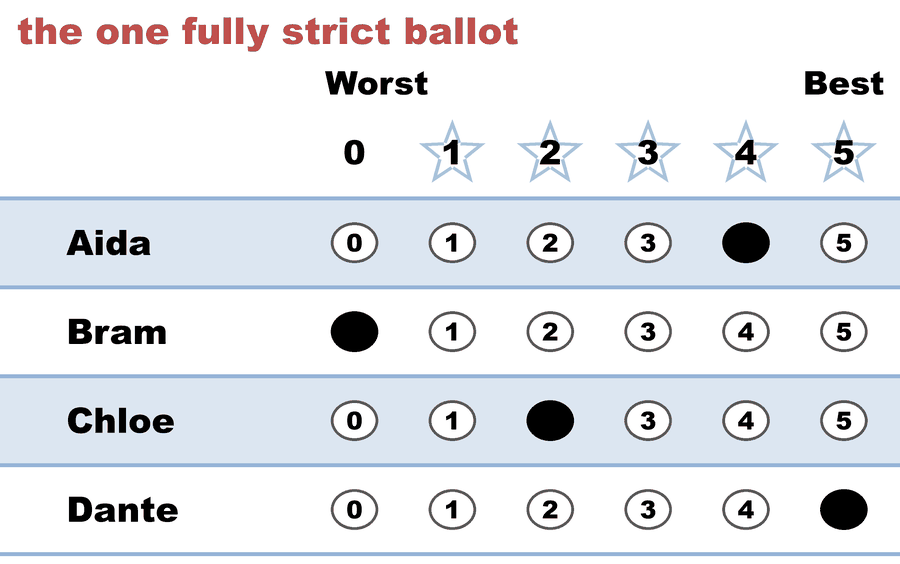 |
4 | 0 | 2 | 5 |
Approval-IRV. Round 1 top-choice counts: Bram 3, Aida 2, Dante 2, Chloe 1 → Chloe out. Then Dante. Then Aida beats Bram head-to-head. Aida wins.
Split-IRV. Aida is a shared first choice on two ballots and an outright first choice on none, so she scores ½ + ⅓ = 0.83 — the lowest in the room — and is eliminated first. Bram wins.
Same five ballots. The only difference is what a tie is worth.
Run it, and the rest of the set:
uv run STARVote_LH_tabulation_engine/tools_adam/pref_voting_tabulation_engine/approval_irv_report.py method_comparisons/equal_rank_irv/cases/equal_rank_five_voters.yaml
What it does and doesn't fix¶
- ✅ Accepts ballots that are currently spoiled — and the spoilage isn't evenly distributed: in San Francisco the weak-order rate correlates negatively with precinct income (r = −0.4).
- ✅ Less work for the voter. Rank a few candidates top, a few bottom, and skip the ones you can't separate — no need to invent an order you don't feel.
- ✅ Partly softens favorite betrayal. Rank your favorite and the front-runner joint-first and your vote is live for both. It doesn't eliminate the incentive, but the paper shows the honest version is safe in a precise sense (Section 4).
- ❌ Fixes the ballot, not the count. Approval-IRV is still non-monotonic, still not Condorcet-consistent, still center-squeezable. Everything this repo says about IRV's tabulation survives intact.
- ❌ More complicated instructions, which is its own source of voter error — possibly giving back some of the spoiled ballots it saves.
Where it's used¶
Approval-IRV: nowhere. It was described by Svante Janson in 2016, from his historical work on Phragmén's 1903 Swedish methods, and discussed sporadically on election-methods mailing lists since 1996 — but it has never been adopted, and the 2024 paper is its first axiomatic study. Split-IRV: in real organizational use, as above.
A note for this repo's readers¶
The problem this variant exists to solve does not arise on a score ballot. A 0-5 ballot has always let a voter rate two candidates the same, and STAR reads that as genuine indifference rather than as a spoiled mark. Worth saying without gloating: this is a serious paper doing serious work to give ranked ballots an expressiveness that most of the world's ranked elections lack — and on the profiles built to separate good behavior from bad, STAR mostly lands where Approval-IRV does. Mostly. The full comparison includes the profile where STAR fails an axiom Approval-IRV keeps.
Related¶
- RCV-IRV (Hare) — the strict-ballot default this generalizes
- Which RCV-IRV? — the family table
- Weak ranks · strict vs. weak ranks
- Equal ranks on an IRV ballot — six runnable cases and the STAR comparison
Sources: Théo Delemazure & Dominik Peters, "Generalizing Instant Runoff Voting to Allow Indifferences" (EC'24; ACM DL) — lean: neutral academic social choice, and explicit that Approval-IRV inherits IRV's known defects. Prior art: Svante Janson, "Phragmén's and Thiele's election methods" (2016), §18.2; Meek, Warren and Hill in Voting Matters (1994–2001) for the Split construction; electowiki for the family definitions.