03_STAR_PR — proportional STAR (multi-winner)
The same 0–5 scoring grid, counted so that seats mirror the electorate. For bodies where representing different viewpoints matters more than finding the single slate most voters prefer.
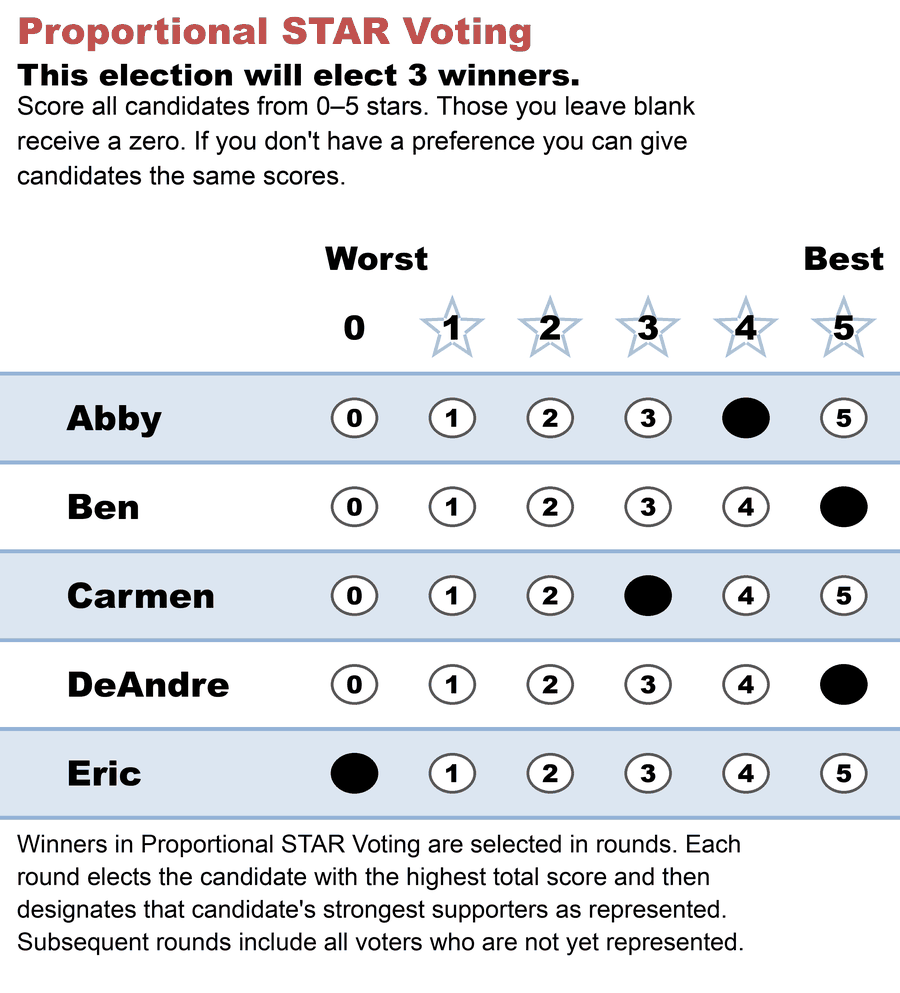
The ballot — drawn from Equal Vote's own Proportional STAR ballot. The scoring grid is identical to single-winner STAR's — 0–5, one row per candidate, nothing rationed, so a voter who can fill in one can fill in the other. What differs is printed above and below it: the seat count, and a footer describing a completely different count — rounds, each electing the highest scorer and then marking that winner's strongest supporters as represented, so later rounds belong to the voters not yet spoken for. The same paper counted majoritarian instead: Bloc STAR.
The same 0–5 score ballot, counted so that seats reflect the electorate's proportions instead of handing every seat to the largest bloc. Three tabulations are represented here, all runnable on the same ballot files by switching voting_method::
First, the bigger decision. Whether you want a majoritarian body at all — "the N best" — or a proportional one that mirrors the electorate, comes before choosing any method on this page: Electing more than one, simply.
New to multi-winner? The concept pages for this method live in 01_Learn/ — start with Proportional Representation, then the math behind proportional STAR. Everything below is the runnable examples.
voting_method |
Counts as | The same 63 ballots, counted this way |
|---|---|---|
allocated |
Allocated Score — each winner "uses up" a quota of their strongest supporters. Equal Vote's recommended STAR-PR (electowiki) | 02a — the count in full |
sss |
Sequentially Spent Score — each voter has a budget of "stars" that elected candidates spend (electowiki) | 02b — the count in full |
rrv |
Reweighted Range Voting — ballots that already elected someone are down-weighted. The one that does not pass the Hare Quota Criterion (electowiki) | 02c — the count in full |
Cases live in 02_Examples/ (the 02a/02b/02c trio in the right-hand column above counts the SAME 63-ballot election three ways — the fastest way to see where the three methods agree and where they part). Majoritarian multi-winner: Bloc STAR. STV, the proportional method for ranked ballots, lives in 06_Other.
Start here
- Proportional to what? (101) — no parties on the ballot, so what is being made proportional? Answer: quotas of voters, with the factions discovered by the ballots instead of declared beforehand.
- STAR-PR — a voter's FAQ (101) — the questions a voter actually asks with a sample ballot in front of them, including "am I being punished for voting for a winner?" and "can I verify the count?"
- What "proportional" actually means — read before advocating for any of this. Exact proportionality is the only unambiguous definition and almost no election meets it; a quota is a guarantee, not a price; and without parties there is no longer an obvious thing to be proportional to.
- Bloc STAR vs Proportional STAR — the same ballots, two councils (101) — two voters, three candidates, two seats. The smallest election in which the majoritarian and proportional counts fill a council differently, checkable in your head.
- STAR-PR — the three methods — quota + reweighting, and how
allocated/sss/rrvdiffer. A page each: Allocated Score (recommended) · SSS · RRV — mechanics, honest properties, and every scenario in this library gathered per method. - When the STAR-PR methods disagree (301) — they usually elect the same slate, so it is easy to assume the choice is academic. Two elections of three voters each split all three apart, and you can check the arithmetic by hand.
- The criteria, as runnable elections (301) — the family's structural properties, each demonstrated in a handful of ballots: the Alabama paradox (the committee grows by a seat and a sitting member loses hers — quota methods are not house-size monotone) · vote unitarity (two bullet voters who spent nothing on the first winner keep their full star budgets, and those budgets decide the second seat).
- Two ways to fill a quota — the count-vs-weight engine divergence (301) — an audit rather than a method property: upstream
starvotefills allocation quotas by ballot count where the published definition (and BetterVoting) use ballot weight, and a three-slate fingerprint election seats different councils under the two accountings — 4-1-0 versus the proportional 3-1-1. Confirmed live against BetterVoting production, reported upstream, and fixed in this library's vendored fork on 2026-08-09 — two library cases had carried the bug's fingerprints for months and were corrected with the patch. - Simulating proportional systems (401) — where the quantitative claims about PR come from, and what to demand of a study before believing one.
Conversation scripts: the Larry ↔ Adam STAR series is indexed in Conversation scripts — index.