Vote unitarity — the bullet voters who kept their stars
Seven voters. Three candidates. Two seats. Two voters spend nothing on the first winner — and vote unitarity says those unspent stars decide the second seat.
Level: 301 · deep dive
→ the method: Sequentially Spent Score · its family: the three STAR-PR methods · the single-winner root of the idea: the equally weighted vote
The idea
Vote unitarity (Keith Edmonds; electowiki, an advocacy-adjacent source, but this is a mechanics question, where it is the clearest) extends the equally weighted vote to multi-winner elections: every voter starts with the same budget of influence, and influence is spent only in exchange for representation gained. Elect a candidate a voter scored highly, and that voter pays; elect a candidate a voter scored 0, and that voter pays nothing — their full budget carries into the next round.
Sequentially Spent Score is the method built on that principle: each voter holds 5 stars, and each seat charges its supporters in proportion to the score they gave. The election below is the smallest known profile where the "pays nothing" half of the principle changes who wins — which makes it both a teaching case and, as it turned out, an engine test.
The election
Seven voters score Amy, Bo and Cy for a two-seat committee (voting_method: sss). Two of them are Amy bullet voters: 5 stars for Amy, nothing for anyone else.
The ballots as marked — the filled bubble is the score given, and the score is the number in its column:
| # | Ballot as marked | Amy | Bo | Cy |
|---|---|---|---|---|
| 1 | 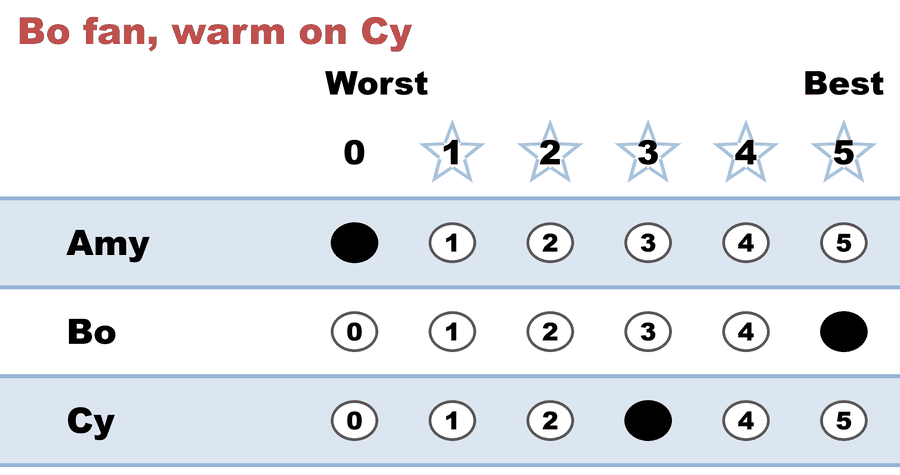 |
0 | 5 | 3 |
| 2 | 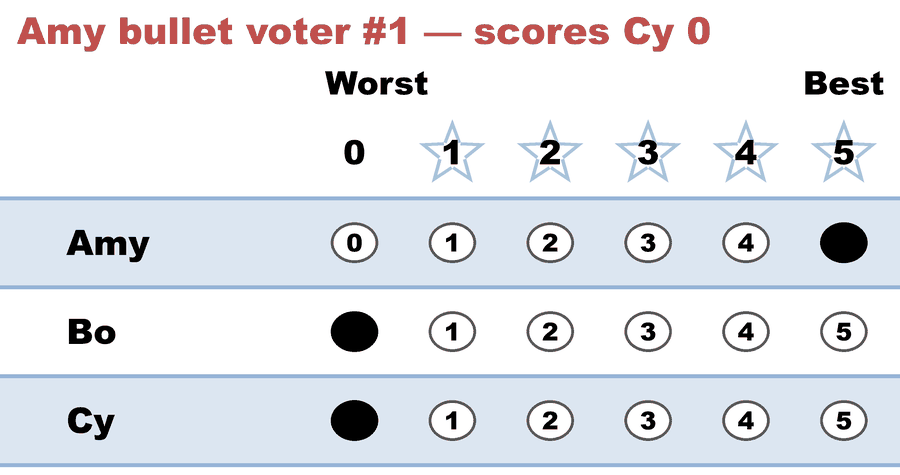 |
5 | 0 | 0 |
| 3 | 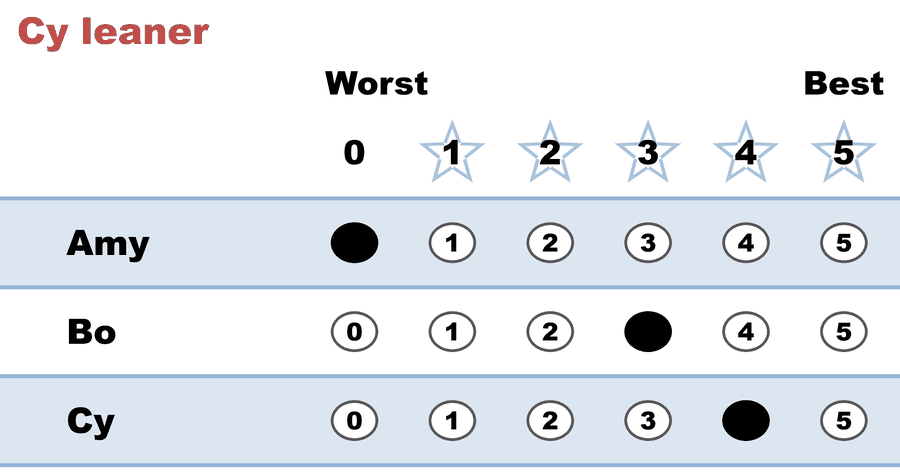 |
0 | 3 | 4 |
| 4 | 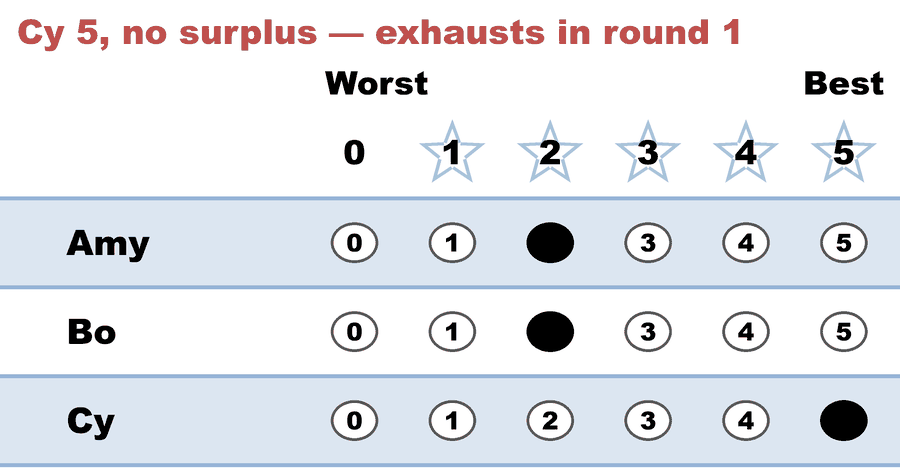 |
2 | 2 | 5 |
| 5 | 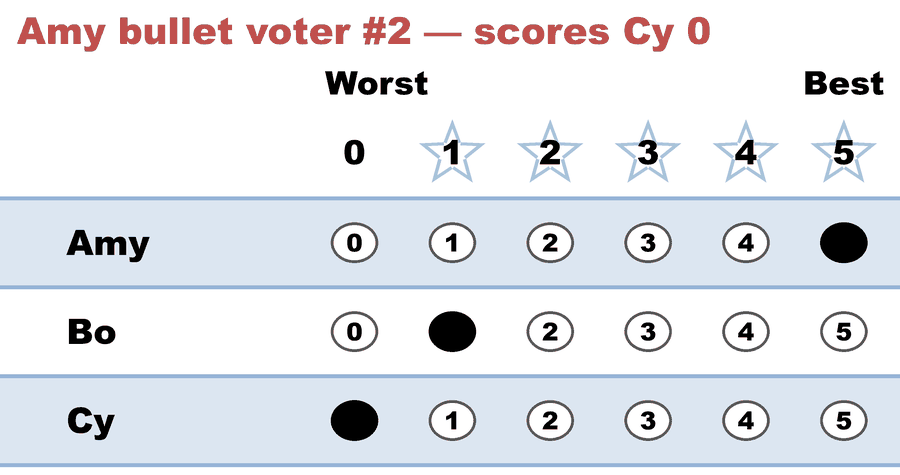 |
5 | 1 | 0 |
| 6 | 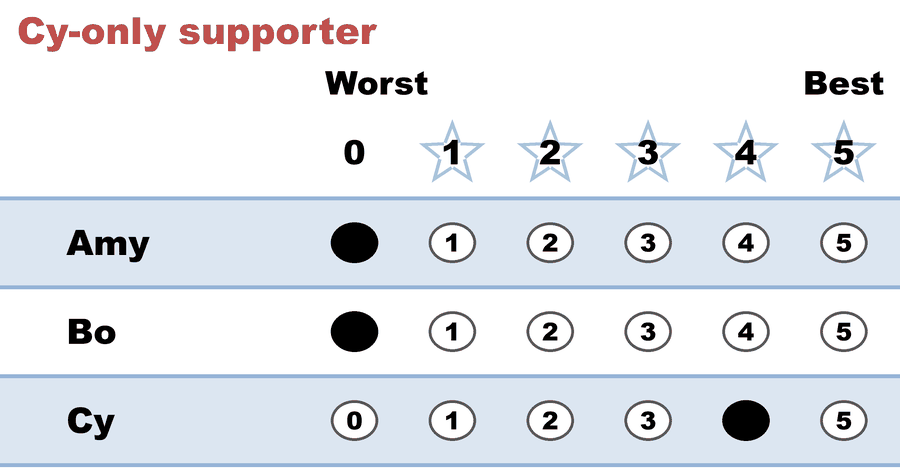 |
0 | 0 | 4 |
| 7 | 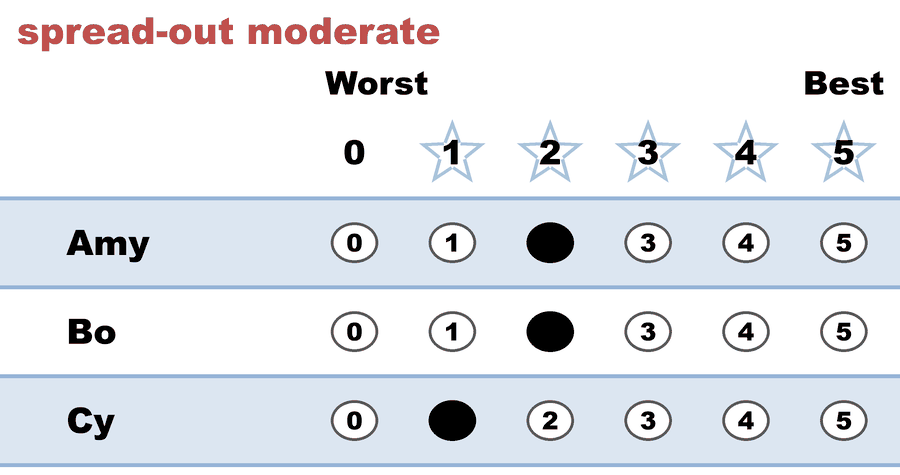 |
2 | 2 | 1 |
(The cast breaks this repo's own naming advice — "Cy" is the house example of a name too short to be sturdy — because the profile is frozen: it is printed verbatim in the fork's bug report and in upstream issue #19, and same cast means same election.)
The count, round by round
Round 1. Cy leads the scoring, 17 against Amy's 14 and Bo's 13, and takes the first seat. The Hare score quota is 7 × 5 ÷ 2 = 17½ — and Cy's 17 falls short of it. No surplus to give back, so every Cy supporter pays their full Cy score out of their 5-star budget:
| Ballot (Amy, Bo, Cy) | Paid for Cy | Stars left |
|---|---|---|
| 0, 5, 3 | 3 | 2 |
| 5, 0, 0 | 0 | 5 — untouched |
| 0, 3, 4 | 4 | 1 |
| 2, 2, 5 | 5 | 0 — exhausted |
| 5, 1, 0 | 0 | 5 — untouched |
| 0, 0, 4 | 4 | 1 |
| 2, 2, 1 | 1 | 4 |
The voter who gave Cy all 5 stars is fully spent and drops out. The two bullet voters gave Cy 0, paid 0, and keep everything.
Round 2. Each surviving ballot's scores now count at its remaining fraction of a full budget. The two bullet voters still count at full strength, and they are worth 5 points of Amy each:
Amy 11⅗ — Bo 5⅕. Amy takes the second seat. Committee: Amy and Cy.
That is vote unitarity doing real work. The bullet voters declined to help elect Cy, so the method did not charge them for Cy — and their preserved budget is exactly what carries Amy past Bo, whose support came mostly from voters already partly spent on the first winner.
[Divergence from STAR]
  STAR                   = Cy
  Choose-One (Plurality) = Amy   (differs from STAR)

--- Sequentially Spent Score Voting Method (2 winners) ---

[Sequentially Spent Score]
 Tabulating 7 ballots to fill 2 seats.
Amy,Bo,Cy
  0, 5, 3
  5, 0, 0
  0, 3, 4
  2, 2, 5
  5, 1, 0
  0, 0, 4
  2, 2, 1

[Sequentially Spent Score: Round 1]
 The highest-scoring candidate wins a seat.
   Cy            -- 17 -- First place
   Amy           -- 14
   Bo            -- 13
 Cy wins a seat.

[Sequentially Spent Score: Round 1: Ballot allocation round]
 Total score is 17, Hare score quota is 17+1/2, no surplus to give back.
 Reducing each ballot's stars by their vote.
 Allocated 1 ballot.
 Reweighted 4 ballots:
    2 ballots voted 4, stars reduced from 5 to 1, reweighted to 1/5.
    1 ballot voted 3, stars reduced from 5 to 2, reweighted to 2/5.
    1 ballot voted 1, stars reduced from 5 to 4, reweighted to 4/5.

[Sequentially Spent Score: Round 2]
 The highest-scoring candidate wins a seat.
   Amy           -- 11+3/5 -- First place
   Bo            --  5+1/5
 Amy wins a seat.

[Sequentially Spent Score: Winners — Sequentially Spent Score Voting Method (2 winners)]
 Amy
 Cy
The engine bug this election caught
This profile is not just a classroom example — it is the reproduction case for a real tabulation defect, found in the 2026-08-08 STAR-PR sprint census and documented in BUG_sss_zero_score_ballots.md (filed upstream as larryhastings/starvote#19, fixed in this fork 2026-08-09).
The defect: in any SSS round where at least one supporter exhausts, the engine rebuilt its remaining-ballots list from supporters only — so every ballot that scored the winner 0 was silently discarded with its full unspent budget. On this profile, the exhausting 2, 2, 5 ballot triggers the rebuild, the two bullet voters vanish, and round 2 becomes Bo 4⅕ against Amy's leftover 1⅗: the buggy committee is Bo and Cy. Two voters lose their say for the crime of not supporting a winner — the precise thing vote unitarity forbids. In census sampling the discard flipped the committee in ~1.4% of tie-free random 2-seat profiles: rare, systematic, and biased against the blocs SSS exists to protect into later rounds.
The fork now counts this file correctly, and tests/test_sss_zero_score_ballots.py pins the profile at every verbosity so the fix cannot regress. A method's defining principle, stated as a runnable election: if an engine ever elects Bo here, it is not counting SSS.
Run it yourself
.venv/bin/python STARVote_LH_tabulation_engine/starvote_larry_hastings.py 03_STAR_PR/03_Criteria/vote_unitarity/cases/two_bullet_voters_sss.yaml
| Case | Seats | Elects | File |
|---|---|---|---|
| Two bullet voters | 2 | Amy, Cy | page · yaml |
See also
- Sequentially Spent Score — the method this criterion motivates, with its honest standing
- The equally weighted vote — the single-winner principle vote unitarity extends
- The Alabama paradox in Proportional STAR — the other structural property of quota methods demonstrated in this folder
- When the STAR-PR methods disagree — how SSS's proportional spending separates it from Allocated Score and RRV
BUG_sss_zero_score_ballots.md— the full defect write-up: hand-trace, census rates, upstream interplay