The Equally Weighted Vote — the Equal Vote Criterion & the Test of Balance
Level: 201 · deep dive
One line: a method gives an equally weighted vote if, however you fill out your ballot, someone else can fill out the exact opposite ballot and the two together change nothing. STAR passes this (so do Score and Approval); Choose-One and RCV-IRV do not — and that failure is precisely what causes vote-splitting and the spoiler effect.
→ Curriculum: 301.5 — honest limits & theory (the "Test of Balance"). Glossary: Equally Weighted Vote. The narrow leftover STAR doesn't erase: residual vote-splitting. Why RCV-IRV fails the same test: RCV-IRV fails the Equal Vote.
The Test of Balance
Equal weight has been tested the same way since antiquity: balance. Two objects weigh the same if they balance on opposite pans of a scale. The Equal Vote Coalition's founder, Mark Frohnmayer, applied that to ballots — a method treats votes as equal only if, for any ballot one voter casts, another voter can cast one that "you should be able to vote in an equal and opposite fashion." If an election were tied and one ballot came in, there must always be a single ballot that brings it back to a tie.
Pass that Test of Balance and you satisfy the Equal Vote Criterion (a.k.a. the Equality Criterion, or Frohnmayer balance). Fail it and some voters' ballots are worth more than others'.
The picture: two exactly opposite ballots
Two voters who disagree on every candidate, on a 0–5 ballot. Here are their two actual ballots — the filled bubble is the score given. Voter 2's ballot is the mirror of Voter 1's: wherever one marks s, the other marks 5 − s.
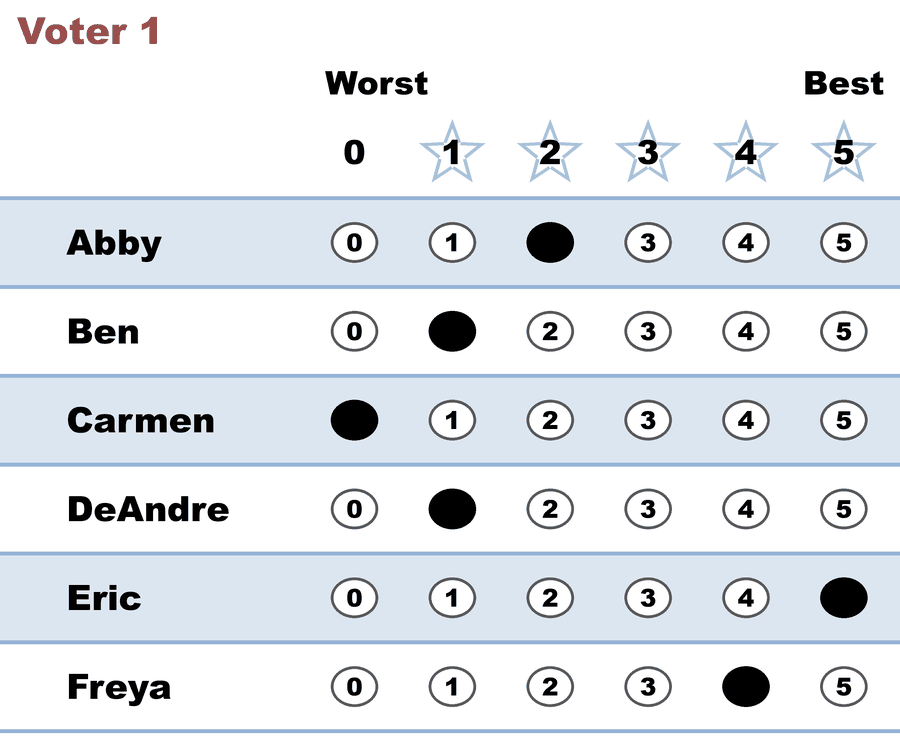
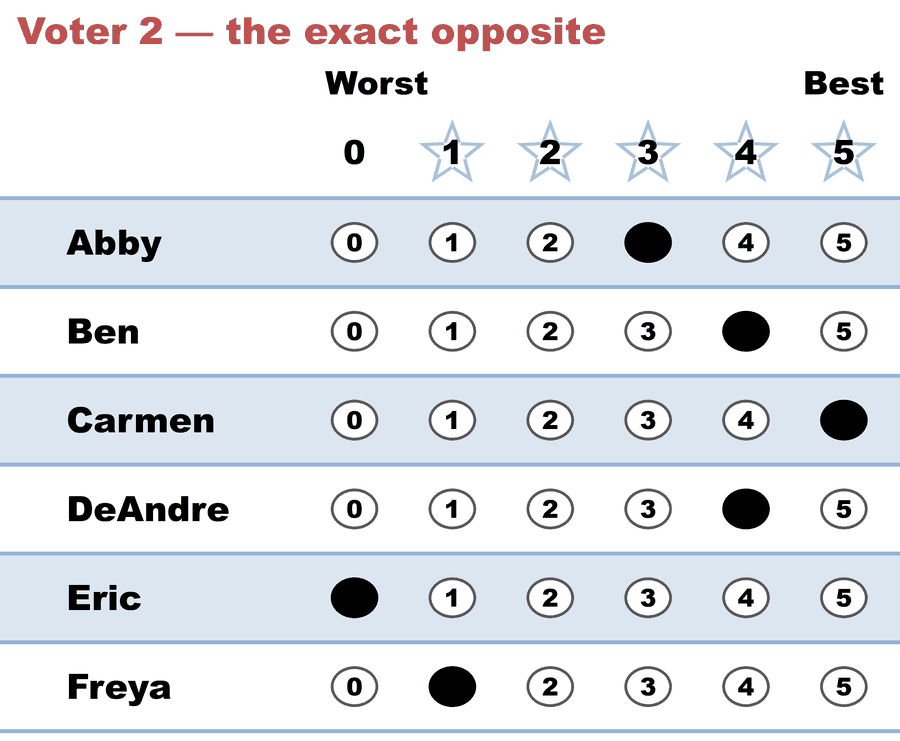
Line them up and every row sums to 5 (an opposite score is 5 − s):
| Candidate | Voter 1 | Voter 2 | Sum |
|---|---|---|---|
| Abby | 2 | 3 | 5 |
| Ben | 1 | 4 | 5 |
| Carmen | 0 | 5 | 5 |
| DeAndre | 1 | 4 | 5 |
| Eric | 5 | 0 | 5 |
| Freya | 4 | 1 | 5 |
Add both ballots to any election and nothing moves:
- Scoring round: every candidate gains exactly 5 stars (Voter 1 + Voter 2 = 5 for each). Everyone rises by the same amount, so the ordering is untouched.
- Automatic runoff: whichever finalist Voter 1 prefers, Voter 2 prefers the other by the same margin — they cancel 1–1.
So if the race was tied before these two ballots, it is still tied after. Neither ballot outweighed the other. That is an equally weighted vote, demonstrated.
Run it: the equal & opposite case makes this tabulatable — a base election with a decisive winner, then the same election with two mirror ballots added, and STAR elects the same candidate either way (every score total just rises by 5, and the runoff cancels 1–1).
Why this is the root of vote-splitting
Choose-One (plurality) fails the Test of Balance. If you vote for A, there is no ballot anyone can cast to cancel it — a Choose-One ballot can only add a mark to some candidate, never subtract from A. With no balancing vote available, a cluster of similar candidates splits its shared supporters and a less-preferred candidate can slip through. Vote-splitting and the spoiler effect are not separate bugs; they are the visible symptom of an unequal vote. STAR ends forced vote-splitting for exactly one reason: every ballot can be perfectly cancelled, so adding a similar candidate can't dilute anyone. (Watch it happen across methods: the split-voting set; the narrow residue STAR doesn't erase: residual vote-splitting.)
Which methods pass, which fail
| Method | Equal Vote / Test of Balance |
|---|---|
| STAR, Score, Approval | ✅ pass — every ballot has an exact opposite that cancels (see the pass vs. guarantee note below) |
| Condorcet methods that allow equal ranks and read every rank (e.g. Ranked Robin) | ✅ generally pass |
| Ranked STAR (ranked ballot, added up) | ✅ passes |
| Choose-One plurality | ❌ fails whenever there are 3+ candidates — the structural source of vote-splitting |
| RCV-IRV | ❌ fails — opposite ballots don't reliably cancel under sequential elimination (why) |
One caveat both sides agree on: with only two candidates, every method passes — the equal-vote problem only appears once there are three or more.
Pass vs. guarantee — a distinction worth keeping
Passing the Test of Balance and guaranteeing every cast ballot equal weight are two different bars, and STAR clears both.
Score passes balance — a ballot scoring Abby 2 / Ben 3 has an exact opposite (3 / 2) that cancels it. But influence still varies with how you score: that voter moved the Abby-vs-Ben margin by 1 point, while a voter scoring 0 / 5 moved it by 5. Both ballots are cancellable; they are not equally weighted. Score only guarantees an equal vote if ballots are normalized — every voter actually using the minimum and maximum.
STAR guarantees it without asking anything of the voter: the automatic runoff is binary, so a 2-vs-3 ballot and a 0-vs-5 ballot each count exactly 1–0 in the deciding round. Your honest, moderate scores carry the same final weight as someone else's maxed-out ones. Approval guarantees it too (a mark is a mark). This is one of the substantive reasons to prefer STAR over pure Score — and it's the flip side of residual vote-splitting, where the scoring round does still reward exaggeration.
One person, one vote (the legal thread)
→ The full disentangling — the legal principle (which every method passes) vs. this balance criterion — is its own page: One person, one vote.
The equal-vote idea is the mathematical face of "one person, one vote." In Wesberry v. Sanders (1964) the U.S. Supreme Court held that the weight and worth of each citizen's vote must, as nearly as is practicable, be the same. Choose-One honors that only in a two-candidate race; with more candidates, voters who have several candidates "on their side" are systematically disadvantaged, which is why voters are pushed toward the "lesser of two evils" and third parties get blamed as spoilers. Advocates argue an equal vote is therefore not just a nicety but the constitutional standard, and that vote-splitting (unlike gerrymandering) is fully solvable.
The other side, fairly stated: RCV-IRV advocates (e.g. FairVote) argue RCV-IRV upholds one-person-one-vote better than Choose-One. That debate — and why the equal-vote camp says RCV-IRV still fails the balance test in competitive races — is on the companion page, RCV-IRV fails the Equal Vote.
The formal criterion (deep 301)
The informal Test of Balance has been formalized two ways (BTernaryTau):
- Cancellation criterion — for every ballot there exists some other ballot such that adding both never changes the result.
- Opposite cancellation criterion — stronger: that other ballot must be the literal opposite set of preferences (the picture above). It implies the plain cancellation criterion, and it rules out ballot formats where no true opposite exists.
Keep this distinct from reversal symmetry, a different criterion (if every voter flips their preferences, the winner should flip). Equality/balance is about one ballot having an equal-and-opposite partner; reversal symmetry is about flipping the whole electorate.
For multi-winner elections the equal-vote idea extends to Vote Unitarity (Keith Edmonds) — an equal vote plus proportionate spending — which motivates proportional score methods like Sequentially Spent Score (SSS). See proportional: STV vs STAR-PR for that thread, and the two bullet voters for the seven-voter election where the principle visibly decides a seat.
Sources
- Equal Vote Coalition — the Equal Vote / Equally Weighted Vote: https://www.equal.vote/equalvote
- Mark Frohnmayer — Frohnmayer balance / the Test of Balance (Equal Vote Coalition).
- electowiki — Equal Vote Criterion · Vote unitarity
- BTernaryTau — cancellation criterion · opposite cancellation criterion
- Wesberry v. Sanders, 372 U.S. 1 (1964) — "one person, one vote."
- FairVote (the contrasting view): How RCV survives the one-person-one-vote challenge