Welcome to STAR Voting 👋
Level: 101 · for voters
New here? You're in exactly the right place. No background needed, about five minutes, and nothing partisan. By the end you'll know what STAR Voting is — and feel why it picks winners people actually like.
And here's the whole thing on paper — one voter's finished STAR ballot:
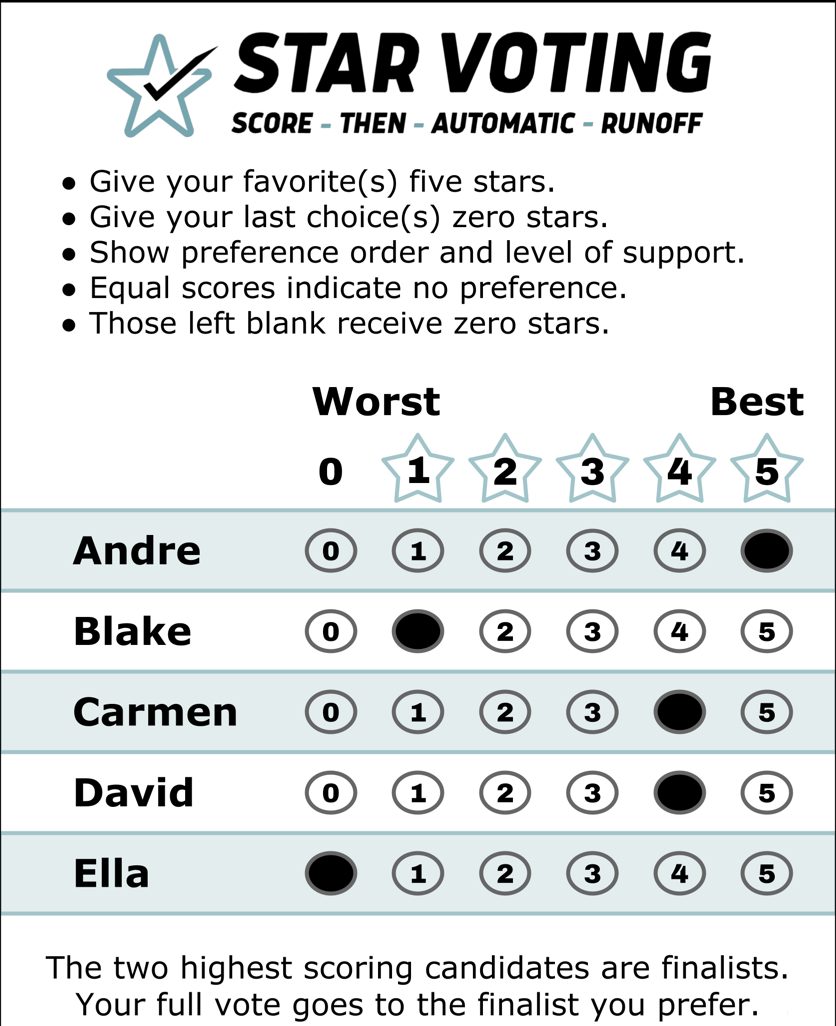
Score every candidate 0 to 5 — order and strength, at a glance. That's the ballot; the rest of this page is what happens to it.
Here's the plan: a small, familiar problem, then that ballot's two rules, then the count — and at the end, for contrast, what the usual way of voting does with the very same five people. That's it. Ready?
The problem: the team lunch
Five coworkers are picking lunch. Two of them love Sushi, two love Tacos, one likes Pizza best — and everyone, every single person, is perfectly happy with Pizza.
Who should win? Hold that question for a minute — because the answer turns out to depend almost entirely on what the ballot lets people say.
Meet STAR — in one breath
STAR asks for a little more, using two things you already know:
- Score every option 0 to 5 stars — exactly like a star rating on Yelp or Amazon. (Give your favorite 5, something you can't stand 0, and everything else wherever it honestly lands.)
- Then the two highest-scoring options have a final runoff — head-to-head, like a championship.
That's the name: Score Then Automatic Runoff. One ballot; the "runoff" happens automatically in the count.
Two sound-alike words — keep them straight: here you rate, you don't rank. Rating and scoring are the same thing (that's the "Score" in STAR's name — and it's the word this library uses): each option judged on its own, so two favorites can honestly both earn a 5. A ranking only lines options up, 1st-2nd-3rd, and says nothing about how much you like any of them. People swap the words all the time, but the ballots behave very differently → Scores vs. ranks — don't confuse them.
The official Equal Vote Coalition rules — the instructions printed on the ballot up top, in plain language:
- Give your favorite 5 stars.
- Give your last choice 0 (or just leave it blank).
- Equal scores are allowed — you're never forced to invent a preference you don't feel.
- Score everyone else wherever they honestly land, 0 to 5.
→ Every legal way to fill it out — bullet votes, backups, equal scores, "anyone but…", protest votes, eight styles with a worked election: The STAR ballot & voting styles.
Watch STAR count the lunch
Same five people, same feelings — now each of them scores all three (5 = love it, 3 = fine, 0 = no):
Run it yourself: bv2184_fyy886_lunch_vote.yaml · reader page · see it live on BetterVoting ↗.
                  Sushi   Tacos   Pizza
  Sushi-lover       5       0       3
  Sushi-lover       5       0       3
  Taco-lover        0       5       3
  Taco-lover        0       5       3
  Pizza-fan         3       1       5

  Round 1 — add the stars:  Pizza 17 · Sushi 13 · Tacos 11   → Pizza & Sushi advance
  Round 2 — the final two:  Pizza 3  vs  Sushi 2             → Pizza wins
Here's that exact election counted on real software — the same two rounds, live on BetterVoting:
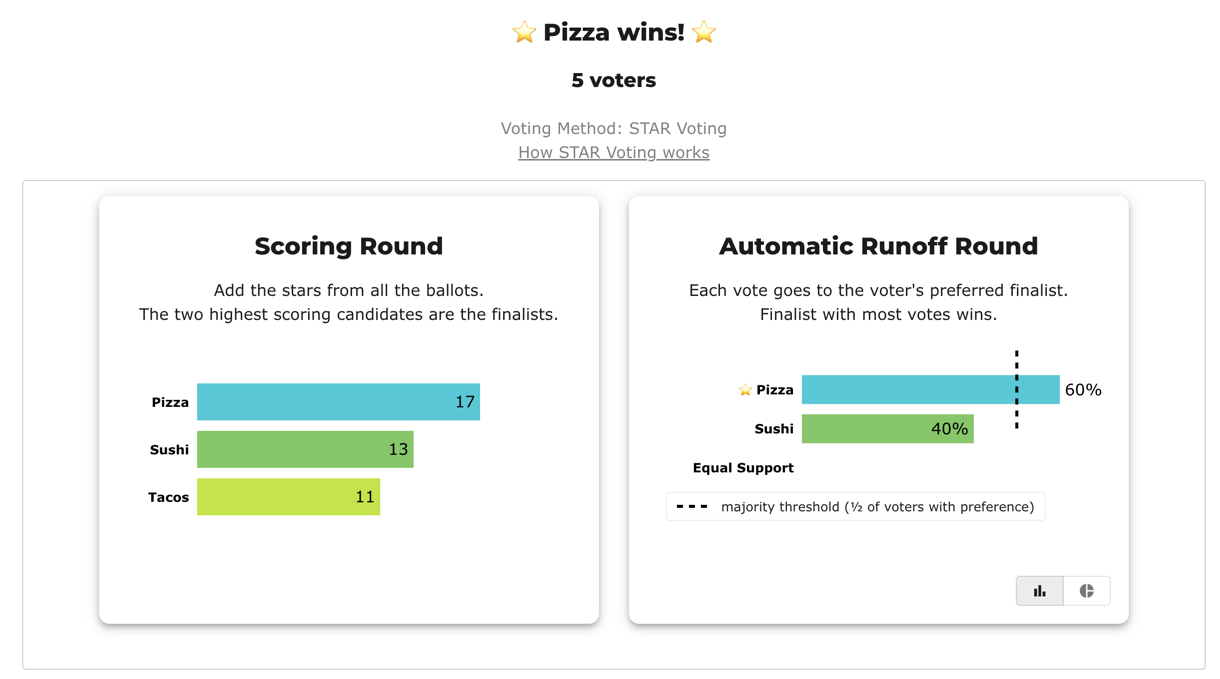
(The runoff bars read 60% vs 40% — that's the same 3 of the 5 people vs 2 from Round 2, just shown as a share. BetterVoting can flip those bars to raw counts, a pie, or audit tables — the tour of the runoff's displays, and which to reach for when, is Reading the Runoff Percentages.)
In plain English:
- Round 1 just adds up the stars. Pizza collects 17 (a 3 or a 5 from everyone), the most — so Pizza and Sushi become the two finalists, and Tacos is out.
- Round 2 is a simple head-to-head between those two finalists. Each person's ballot counts as one vote, for whichever finalist they scored higher. Three people scored Pizza above Sushi; two scored Sushi above Pizza. So Pizza wins the final, 3 to 2 — an actual majority.
Pizza wins — the option everyone was happy with. It was only one person's outright favorite; because STAR reads the whole ballot, that broad, quiet support shows up anyway. Nobody had to vote strategically, and nobody's stuck with a 0.
The one idea worth pausing on: why two rounds?
Because the two rounds measure two different things:
- The Scoring Round measures how much support — add up the stars, and the two strongest options become finalists.
- The Automatic Runoff measures how many supporters — each ballot goes to whichever finalist it scored higher; the finalist more people preferred wins.
Strength of support finds the real contenders → number of supporters decides between them.
The part that takes a moment to click is what happens to your ballot in the second round. Follow one voter's ballot all the way through — Sofia, one of the two Sushi-lovers from the lunch:
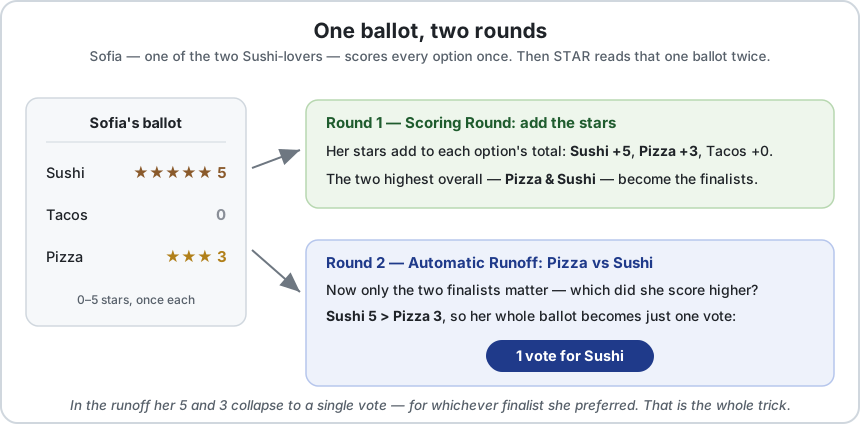
So your scores do two jobs: their size helps pick the two finalists, and then, in the runoff, they shrink to a single vote for whichever finalist you scored higher. A 5-vs-3 and a 5-vs-0 count exactly the same in that final step — one vote each. Once that lands, STAR makes sense.
And notice how Sofia's story ends: her runoff vote went to Sushi, and Sushi still lost the final, 2 to 3. She wasn't cheated — she was outvoted, fair and square. Meanwhile the 3 stars she gave Pizza had already done real work in Round 1, helping the option she was happy with reach the final at all. That's an honest ballot doing exactly what it should: full say in who the finalists are, one equal vote between them.
Why not just add up the stars and stop? Because then you'd be tempted to game it — give your favorite 5 and everyone else 0, so your ballot "shouts" loudest. The runoff quietly removes that temptation: in the final, your big scores and small scores count the same (one vote for whichever finalist you preferred). So an honest score is also the smart score — you never have to exaggerate or hold back.
One nuance you can now name: if you score the two finalists the same, your ballot counts as "no preference" between them (this tool calls it Equal Support) — a 5/5 means "either is great," a 0/0 means "I dislike both equally." Either way your scores still counted fully in Round 1, where they helped choose the finalists.
So why not just pick one?
Now the promised contrast. Same five coworkers, same feelings — but the usual ballot, the one you've filled out your whole life: name a single favorite.
                  Sushi   Tacos   Pizza
  Sushi-lover       X       -       -
  Sushi-lover       X       -       -
  Taco-lover        -       X       -
  Taco-lover        -       X       -
  Pizza-fan         -       -       X

  Count the marks:  Sushi 2 · Tacos 2 · Pizza 1
The two adventurous camps split, so lunch comes down to a coin flip between Sushi and Tacos — and Pizza, the one option nobody objected to, finishes last. Half the team ends up with something they didn't want. Nothing changed but the ballot.
That method has a name — Choose-One, also called plurality or First-Past-The-Post — and so does its failure: vote splitting, whose better-known cousin is the spoiler effect, where an option that can't win still decides who does. It's the same machinery that pushes people toward the "lesser evil" instead of who they actually like.
The trouble isn't the voters. It's the ballot: "pick one" throws away everything except your single favorite — every dash in that grid is a real opinion the ballot never asked about. STAR asked about all of them, which is the whole difference.
(And it isn't only Choose-One: RCV-IRV picks Sushi here too, for its own reasons. Same voters, same feelings — the method decides.)
What this means for you
- You can be honest. Score your favorite a 5 and a backup a 4 — you never split your own vote.
- No "wasted" votes. Supporting someone who can't win no longer helps elect someone you dislike — the spoiler effect, gone.
- It's one ballot, not a separate primary and general election.
→ Sold already? The quick, exciting wins: The benefits of STAR Voting.
Thinking "wait, but isn't it just averaging? / a wasted 0? / a second election?" — the honest, plain-language answers: Common misunderstandings.
Where to go next
You've seen the two rounds turn once. Now watch them on more elections, smallest first:
| Step | Read in order | What you'll see |
|---|---|---|
| Three candidates | one ballot · two ballots | A third option, and the winner becomes the broad compromise — the lunch, formalized in the smallest possible way. |
| Ways to vote | the eight-style gallery · five more | Bullet votes, equal scores, "anyone but…" — then the awkward ones: approval-style, a partial ballot, and a ballot that says nothing. |
| The classic | Tennessee capital | The textbook example, with the same shape as the lunch. |
| Do it yourself | Count a STAR election by hand | Tally the lunch with pencil and paper — proof that STAR is genuinely simple to count. |
Then, when you're ready: the two rounds in depth (Scoring Round · Automatic Runoff), the full learning path (101 / 201 / 301), and — if you want the political case — two-party dominance and Why STAR Voting.
Try it for real: cast a STAR ballot or run your own election at bettervoting.com.
Sources
- Equal Vote Coalition — STAR Voting overview
- "How Does STAR Voting Work?" (short video)
- bettervoting.com · help, FAQ & hand-count guides
- More explainers, videos & guides: STAR Voting — resources & further watching
Up: Start Here (all methods, method-neutral) · more STAR concept pages.