The benefits of STAR Voting
Level: 101 · for voters
One better ballot, and a whole list of election problems just… go away. You score each candidate 0–5 — like a five-star review — and the count does the rest. Here's the quick, exciting version of what that buys you.
→ Want the complete case, with every objection answered? That's Why STAR Voting. Just want the mechanics? STAR — start here.
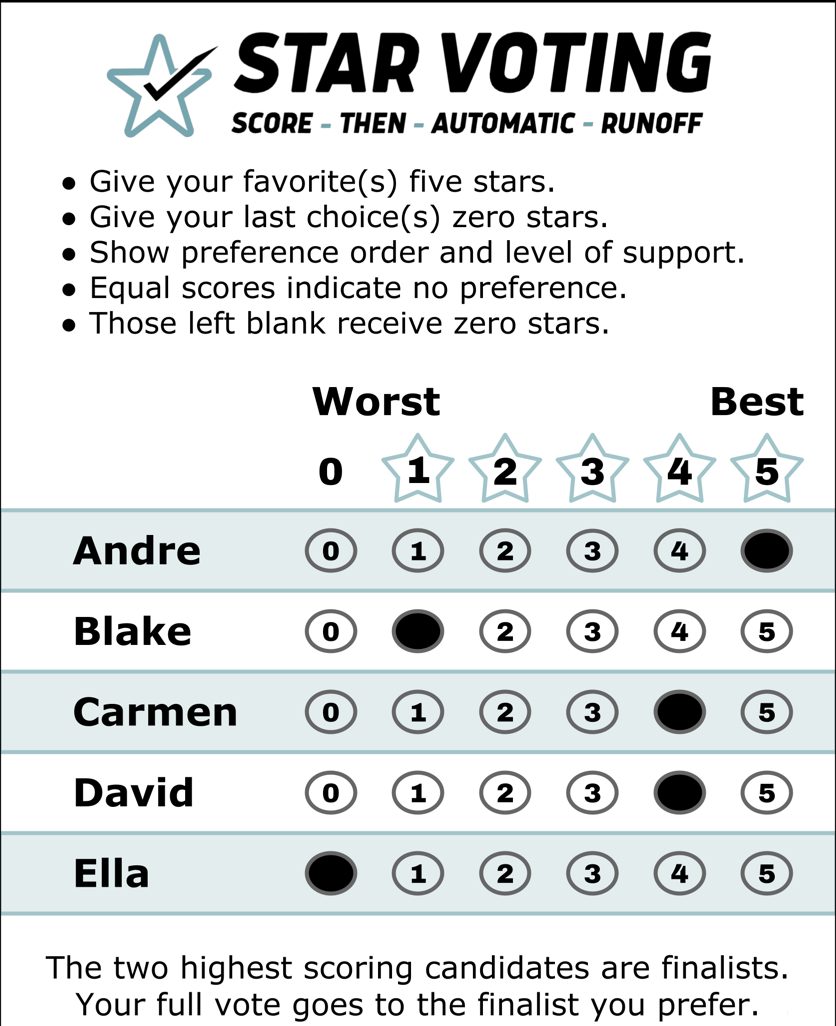
Rate each candidate 0–5 — equal scores allowed, blanks count as zero. That's the whole ballot. Everything below is what it gets you.
Vote your heart
Give the candidate you actually love a 5 and the front-runner you also like a 4 — both, at once. Scoring both high doesn't split your own side, so you never have to abandon a favorite or hold your nose for the "lesser evil." Honesty is your best ballot.
No more spoilers
Because you rate every candidate on their own, a newcomer entering the race can't bleed support away from someone you already like. Vote-splitting — the reason a third candidate gets blamed for "spoiling" an election — stops happening, so new voices can run on their merits. → the spoiler effect
The winner really has majority support
STAR ends with an automatic runoff between the top two, so whoever takes office actually beat the runner-up among voters who had a preference. No more 30%-winners the other 70% opposed.
A ballot you already know
It's the five-star rating you use for movies and rideshares — rate them 0–5, done. Equal scores are fine, blanks are fine, and you can't accidentally spoil it, so error rates are low and nothing gets thrown away. → filling out the ballot
One election, not two
The runoff is built into the count — there's no separate second election. Where a place runs a primary-plus-general or two rounds today, STAR delivers the runoff for free, in one election: less cost, no second trip to the polls, and the whole electorate decides (second rounds usually draw far lower turnout).
Anyone can check the count
STAR is summable: each precinct posts its score totals and a small head-to-head tally, and those numbers add up — by hand — to the final result. No shipping every ballot to one central computer. Transparent and auditable by design.
Campaigns get nicer
To win, you need decent scores from your opponents' supporters too — so trashing a rival backfires when their voters can score you down. The rewarded move is outreach, not mudslinging, and the tendency is toward broadly-liked winners.
One method for one seat or many
The same 0–5 ballot fills a single office, elects a slate (Bloc STAR), or fills a whole body proportionally (Proportional STAR). One ballot everyone already knows, across the entire ticket.
Try it in 30 seconds
Cast a STAR ballot right now at BetterVoting.com — then bring it to your next club, board, or HOA vote. Small real elections are how STAR spreads, and the Equal Vote Coalition is the place to get involved.
And we mean all of it honestly. STAR is a big improvement, not a magic wand: it reduces spoilers rather than eliminating them, it usually (not always) elects the head-to-head winner, and no method is un-gameable — that's a theorem, not a dodge. Every limit is laid out plainly in STAR's honest limits, because a reform that's square about its edges is one you can trust on everything else.
Go deeper
- How it works: STAR — start here · STAR's hybrid nature
- The complete case + every objection answered: Why STAR Voting
- Narrated, for presenting: What's so good about STAR
- External: Equal Vote Coalition — STAR overview