What makes a "good" winner? — the correct winner, the consensus candidate, and why there's no single ideal
When we say a voting method "gets it right" or "elects the wrong winner," what do we actually mean? There is no single correct winner handed down from on high — "good winner" is a design choice about what we value. This page lays out the competing ideals, shows them disagreeing on real elections in this repo, and pins down the vocabulary (consensus candidate, strong candidate, utilitarian winner) so the rest of the docs can use it precisely.
→ Level: 201 · deep dive — Curriculum 201.6 (deeper theory — VSE, Arrow — at 301). Related topic hubs: Condorcet efficiency · Center squeeze · Majority criterion · Why STAR · STAR's honest limits.
The trap: "the winner should have won"
Surprisingly, once more than two candidates are involved, there is no single universally-accepted definition of who should win. It's tempting to say a method failed because "obviously candidate X should have won" — but obviously by what standard? Almost every argument about voting methods is really an argument about which of a few different, reasonable ideals of a good winner you're using. They usually agree — and when they don't, that disagreement is the whole subject.
This isn't a gap waiting to be filled; it's a theorem. Arrow's impossibility theorem shows no ranked method can satisfy a short list of obviously-reasonable fairness conditions at once, and majority preference can even cycle (A beats B beats C beats A), so "the candidate a majority prefers" need not exist. Every method augments majority rule with some extra rule to always name a winner — and that choice is where methods differ.
Four ideals of a "good" winner (single-winner)
| Ideal | The winner is… | Also called | The criterion |
|---|---|---|---|
| Most first choices | whoever leads the first-preference count | the plurality leader / front-runner | (plurality) |
| Majority's choice | someone a majority ranks first / prefers | the majority winner | Majority criterion |
| Beats everyone head-to-head | who wins every one-on-one matchup | the consensus candidate / Condorcet winner / a "strong" candidate | Condorcet criterion |
| Highest overall support | who the electorate rates highest in total | the utilitarian / best-liked winner | (utilitarian efficiency) |
These are different questions. "Who has the most passionate first-choice base?" is not "who could beat any rival in a runoff?" is not "who is rated highest by everyone?" A polarizing front-runner can lead first choices while losing every head-to-head; a consensus candidate can be almost nobody's favorite yet everybody's acceptable second choice and beat all rivals one-on-one.
The key words
- Consensus candidate — broadly acceptable; the compromise a majority would take over any single rival. Formally, when one exists, this is the Condorcet winner (beats every opponent head-to-head). Often few first choices but wide second-choice support.
- Strong candidate — loosely, one who holds up under scrutiny: wins pairwise matchups, or has deep and wide support. The Condorcet winner is the strongest in the pairwise sense.
- Utilitarian winner — maximizes total voter satisfaction (e.g. the highest score sum). The strongest in the "greatest overall happiness" sense.
- Spoiler / vote-split victim — a good winner who loses only because similar candidates divided the vote (see spoiler effect).
They disagree — on real elections in this repo
Tennessee (BV2131). One ballot set, three "good winners":
- Plurality → Memphis (most first choices — but 58% rank it last).
- RCV-IRV → Knoxville (last one standing after eliminations).
- Ranked Robin / Condorcet → Nashville — the consensus candidate, beats every city head-to-head, yet holds few first choices.
Which is "correct"? Memphis is the plurality answer; Nashville is the consensus answer. The center-squeeze critique of IRV is precisely that it discards the consensus candidate — but that critique only bites if you value the consensus candidate.
Pet poll II (BV2133). Four methods, four different winners on the same 32 voters: Dog (plurality front-runner), Fish (IRV), Bird (broadly approved), Cat (STAR / the consensus Condorcet winner). Each is the "right" winner under some ideal.
A real one — Alaska's 2022 special U.S. House election. Begich was the Condorcet winner: head-to-head he beat Palin (101,217 to 63,618) and Peltola (87,859 to 79,451) — he'd have won a runoff against either. But RCV-IRV eliminated Begich in an earlier round (too few first choices — the center squeeze) and elected Peltola. That's a Condorcet failure: a real election with a consensus candidate the method didn't pick (Graham-Squire & McCune, arXiv:2301.12075). Whether you call it a "failure" depends entirely on whether you hold the consensus-candidate ideal — which is the point of this page.
Burlington, VT 2009 mayor (IRV, later repealed). Three viable candidates; the Democrat was the Condorcet winner (preferred head-to-head over both rivals) but was eliminated early for too few first choices, and the Progressive won — a Condorcet failure, and the city repealed IRV soon after. Note the honest nuance: with only rankings we can't tell whether the Republican voters who preferred the Democrat were nearly-indifferent between Democrat and Progressive or strongly preferred the Democrat — which is exactly the case for wanting level-of-support data, not just order.
The deepest split: majoritarian vs. utilitarian
The two ideals that most often pull apart are the majoritarian winner (whom a majority prefers, e.g. the Condorcet/pairwise winner) and the utilitarian winner (electowiki — who maximizes total voter satisfaction). A candidate loved intensely by 51% and hated by 49% can be the majoritarian winner while a broadly-liked compromise is the utilitarian winner.
A tiny illustration — Range Voting's "three brothers split one fruit," which circulates as a table of utilities on an arbitrary 0–11 happiness scale. Rescaled ×5/11 onto a real 0–5 ballot it becomes a runnable election (bv2279_qywq7d_star.yaml — the original utilities and the mapping are recorded in the file), preserving every relation the example turns on: the ordering of the totals, and all three head-to-heads. It is also live on BetterVoting as BV2279 ↗, where the same three voters count under three methods.
The ballots as marked — the filled bubble is the score given, and the score is the number in its column:
| # | Ballot as marked | Apple | Orange | Banana |
|---|---|---|---|---|
| 1 | 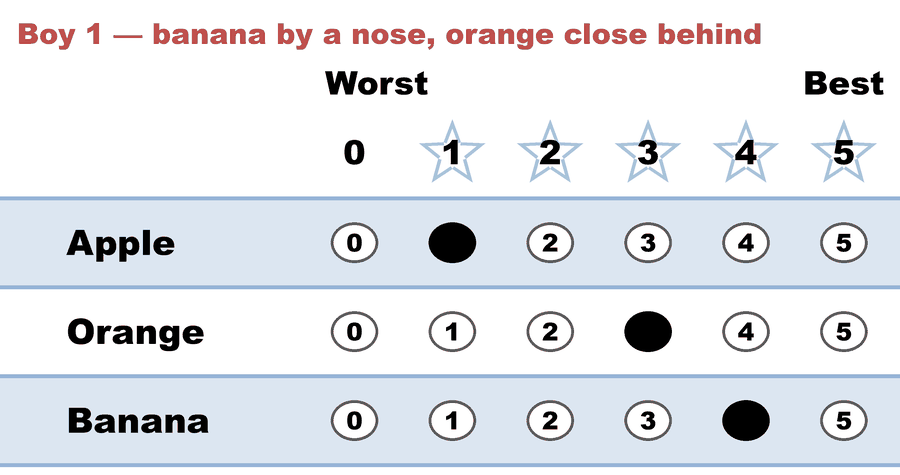 |
1 | 3 | 4 |
| 2 | 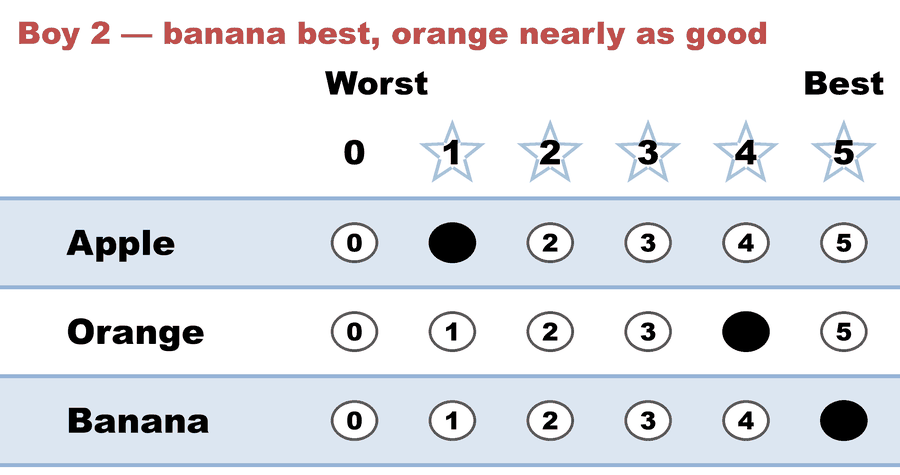 |
1 | 4 | 5 |
| 3 | 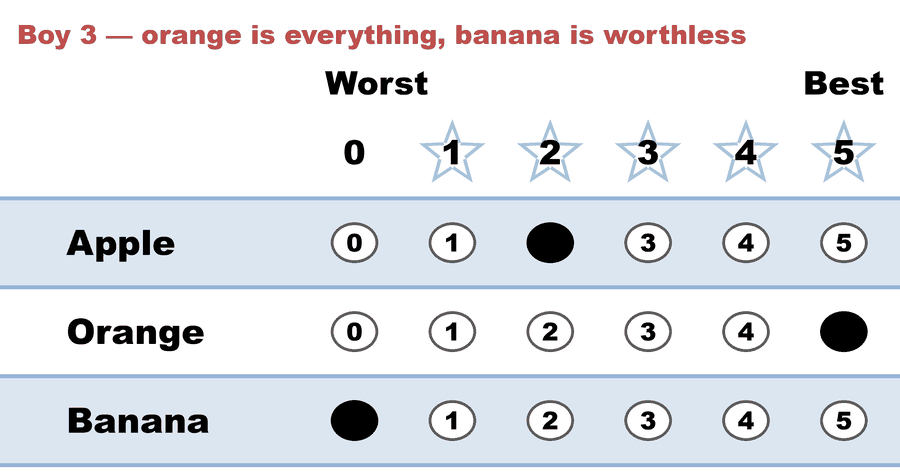 |
2 | 5 | 0 |
A majority (boys 1 & 2) put banana top → the majoritarian winner is banana, and it beats every rival head-to-head, so it is also the Condorcet winner. But orange maximizes total satisfaction (12 to banana's 9) because banana is worthless to boy 3 → the utilitarian winner is orange. Neither is "wrong"; they optimize different things.
Watch STAR chase one ideal per round — the scoring round is the utilitarian count, the automatic runoff is the majoritarian check, and here the check reverses the count:
[Divergence from STAR]
  STAR     = Banana
  Approval = Orange   (differs from STAR)

[Runoff Reversal]
 - Score Round Winner(s) = (Orange)
 - Runoff Round Winner   = (Banana)
  Candidate Orange earned the highest total score, but
  Candidate Banana won the automatic runoff — not a malfunction,
  STAR working as designed: the runoff elects the finalist preferred
  by the majority (of voters with a preference).

--- STAR Voting Method (single winner) ---

[STAR Voting]
 Tabulating 3 ballots.
Apple,Orange,Banana
    1,     3,     4
    1,     4,     5
    2,     5,     0

[STAR Voting: Scoring Round]
 The two highest-scoring candidates advance to the next round.
   Orange        -- 12 -- First place
   Banana        --  9 -- Second place
   Apple         --  4
 Orange and Banana advance.

[STAR Voting: Automatic Runoff Round]
 The candidate preferred in the most head-to-head matchups wins.
   Banana        -- 2 -- First place
   Orange        -- 1
   Equal Support -- 0
 Banana wins.
   Runoff math:
     3  ballots cast
   − 0  Equal Support (no preference between the two finalists)
     ─
     3  voters with a preference  (majority = 2)
           Banana 2 (67%)  ·  Orange 1 (33%)

[STAR Voting: Winner — STAR Voting Method (single winner)]
 Banana
So STAR elects banana, the majoritarian winner, walking past the utilitarian optimum it just printed — by design, not by accident. Score voting and Approval elect orange; STAR, Ranked Robin, RCV-IRV and Plurality all elect banana.
The tempting reading is that this is the cardinal/ordinal line, but it isn't — Approval is a rated ballot and Ranked Robin is purely ordinal, and they land on opposite sides. The line that actually divides them is procedural: every method here that finishes with a head-to-head elects banana, and the two that never take a majority vote elect orange. Reading intensity is what lets a method reach the utilitarian answer — ranked methods can only see order, preference, not support, so they can only ever chase the majoritarian ideal — but reading it is not enough to keep that answer. STAR reads the intensity, names orange, and then overrules itself. The value on offer isn't the "right" answer — it's that both answers are on screen and the report says which one it acted on. (Full write-up, and all three races: Majoritarian vs. utilitarian.)
In practice the Condorcet and utilitarian (VSE) answers usually agree; they diverge only in close elections — where Condorcet favors the majority's first choice and VSE the broadest compromise. And a Condorcet winner is only as trustworthy as the ballots: with rankings you can't tell honest from strategic votes, or see how much a voter liked each candidate — which is the argument for an expressive (scored) ballot.
So is there a "best" method / an ideal winner?
No method optimizes all four ideals at once — that's not a bug in any particular method, it's a theorem. When a Condorcet winner exists, most well-regarded methods elect them and the ideals line up; the disagreements happen exactly when majority-rule, consensus, and total-support pull apart (cycles, center squeezes, polarized electorates). Different methods make a considered choice about what to prioritize:
- Ranked Robin / Condorcet methods target the beats-everyone ideal (the consensus candidate), and name someone even when a cycle means none strictly exists.
- STAR targets high, broad support (score) and then confirms it against majority preference (the automatic runoff) — a blend of the utilitarian and majority ideals.
- Approval rewards broad acceptability.
- Plurality / IRV center on first-choice support (all at once, or round by round), which is why they can miss the consensus candidate.
(Which ideal one should prioritize is a values question — this page deliberately doesn't pick a favorite. It gives you the vocabulary and the worked cases to reason about the trade-off yourself. For the case that STAR strikes a good balance, see Why STAR; for where STAR itself doesn't elect the Condorcet winner, see STAR's honest limits.)
A theorist's "best": the candidate at the center
The ideals above are values choices — but there's one framing where theory does pin down a single "best" candidate, independent of any voting rule (which matters, because "whoever the rule elects" is circular — rules disagree as the field changes; that's Arrow). It's the spatial model: place every voter's ideal at a point in issue-space. Then "best," per Tideman & Plassmann ("Which voting rule is most likely to choose the 'best' candidate?", Public Choice 158 (2014): 331–357), has two natural readings — and they agree:
- Voters as disinterested judges (each estimating what's best for society): the best candidate is the one closest to the mean of all the ideal points — the electorate's center of gravity.
- Voters as self-interested advocates: the best candidate minimizes the total distance to every voter — the smallest aggregate compromise, the utilitarian least-unhappiness pick.
As the electorate grows, these two definitions converge: the minimize-total-distance candidate is the one at the mean. So a procedure-independent "best" exists after all — the candidate nearest the center of the electorate — even if no voting rule is guaranteed to elect them. That candidate is precisely the "optimal winner" the VSE score below measures methods against, and the operational cousin of the utilitarian ideal. And it's no accident that this is where STAR and Ranked Robin aim — scores and head-to-heads both pull toward the center — and the candidate Choose-One and IRV can eliminate for lacking first-choice support (the center squeeze; Alaska's Begich is a real one).
Measuring it empirically: VSE / Bayesian Regret
If there's no single definition of the correct winner, how do reformers compare methods? By simulation. Voter Satisfaction Efficiency (VSE) — the modern form of what earlier work called Bayesian Regret — models an electorate (usually a spatial model: voters and candidates as points, closer = more preferred), runs thousands of simulated elections, and scores each method by how satisfied the average voter is with the winner it produces — 100% = the utility-maximizing winner every time, 0% = a random winner.
This sidesteps the "which winner is correct?" argument by asking a measurable question: which method makes the most voters happiest, most often, across many plausible electorates? The score is a normalized ratio — the older "Voter Satisfaction Index" writes it (U − R) ÷ (O − R), where U = utility of the method's winner, R = utility of a random winner (0%), O = utility of the optimal winner (100%). Random draw = 0%; the utilitarian best = 100%; a method can even score negative (worse than a coin flip).
In these studies the ordering is consistently roughly STAR ≳ Approval > RCV-IRV > Plurality, plurality falls sharply as the field grows past two candidates, and STAR's edge is largest in big, competitive fields (score-plus-runoff was in fact predicted to top the list by Bayesian-Regret work around 2000). Caveats that keep it honest: the result depends on the voter model and on how strategic voters are (honest vs. fully strategic reshuffles the middle of the pack; STAR stays near the top across both), and every simulation is only as good as its assumptions. VSE is the closest thing to an objective score, but it's why "STAR tops the accuracy charts" is a claim about simulated voter satisfaction under a model, not a claim that its winner is metaphysically "correct."
VSE has an academic sibling worth knowing about: distortion. Same premise — voter utility is what an election is trying to find, and a ballot is a lossy channel — but proved instead of simulated, and worst-case instead of average-case. That matters when someone waves VSE away as reform-movement math: the peer-reviewed computer-science literature (AAAI/IJCAI/FOCS, fifteen-plus years) made the identical modeling choice and derived bounds. It also supplies results the simulations can't: Copeland/Ranked Robin is within a constant factor of the welfare optimum however large the field, while STV/IRV's bound grows with it — and a ranking plus a few intensity questions provably collapses the worst case from quadratic to constant.
The simulator is public, so the assumptions behind any VSE number are checkable rather than arguable — the electorate it was run on, what its "strategic" voters actually do, and how good their polls are all live in one readable codebase: vse-sim, read from source.
VSE measures only accuracy. Its companion metric, PVSI (Pivotal Voter Strategic Incentive), measures the other axis — how much a method rewards voting dishonestly — and the two are judged together, since a method that invites strategy erodes its own accuracy in practice.
(Related: the "Yee diagram" visualizes the same idea in 2-D — for a given method, it colors each point of a policy space by who would win if the electorate centered there; good methods elect near the center of the voters, and the pictures show where plurality/IRV veer away. How these synthetic electorates are generated — Impartial Culture, spatial, Mallows, urn models — and why the results depend on that choice: Election simulation models.)
Multi-winner: "good" changes meaning
For a body of seats, "good winner" becomes "good body," and a new ideal appears: proportionality — the winners should mirror the electorate's factions, not just repeat its majority. See the Pets Governance set: the same voters give a majority sweep under Bloc STAR/Approval but minority representation under STAR-PR and STV. Neither is "wrong" — they answer different questions ("who does the majority want?" vs. "does everyone get represented?").
Takeaway
"Good winner," "correct winner," "the candidate who should have won" are never absolute — they're shorthand for one of a few reasonable ideals: most first choices, the majority's choice, the consensus (Condorcet) candidate, or the highest-support (utilitarian) candidate — plus proportionality for multi-winner. Methods differ because they weigh these differently, and the interesting elections are exactly the ones where the ideals disagree. The test cases in this repo exist to make those disagreements concrete.
The other half of the question
A good winner is only half of it. The rest is whether the method is practical: simple to vote and count, transparent and auditable, summable by precinct, resistant to strategy, and good for competition (third parties, no spoilers). And "a perfect election system will never exist" — every method trades these against each other. That's the companion page: What makes a voting method good?.
See also
- What makes a voting method good? (criteria & practicality)
- Condorcet efficiency (topic hub) · Ranked Robin vs. "the Condorcet winner"
- Center squeeze · Majority criterion · Spoiler effect
- Why STAR Voting · STAR's honest limits · Glossary
External references: Utilitarian winner (electowiki) · Condorcet winner criterion (electowiki) · Voter Satisfaction Efficiency · Graham-Squire & McCune, RCV in the US, arXiv:2301.12075 (the Alaska Condorcet failure).