Alternate ballot styles — one voter, three ballots
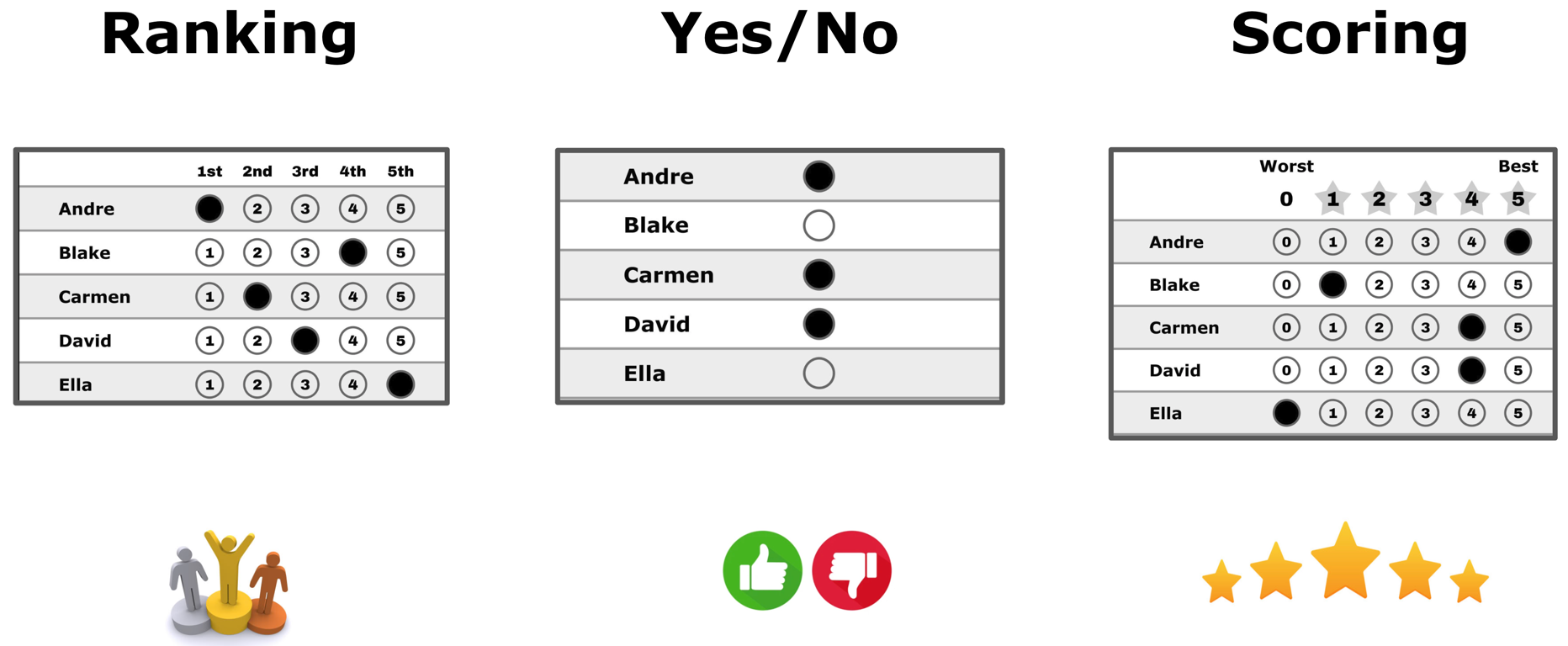
The same voter's opinion, expressed on three different ballots: Ranking, Yes/No (Approval), and Scoring. Seeing them side by side is the clearest way to grasp what each ballot captures and what it throws away.
→ Its method-side twin — the same electorate run through every count, so the winners line up: same opinions, every method. The core distinction — order vs. strength: scores vs. ranks · why Approval & STAR aren't "RCV": scoring methods vs. ranked voting · deep dives, one per ballot: the ranked ballot · the score ballot · Approval
Ballot graphics after the Equal Vote Coalition's ballot designs (the candidate cast matches their materials, so what you see here is what you'll meet on equal.vote and bettervoting.com). Equal Vote is a STAR-advocacy organization — fine for ballot anatomy, which is all this page uses; the method comparisons in this repo rest on its own runnable elections.
The three ballots
Meet one voter deciding among five candidates — Andre, Blake, Carmen, David, Ella. Here is how that same opinion looks on each ballot style (● = the mark the voter made).
Ranking — put the candidates in order, 1st through 5th. One mark per column, one per row. (Deep dive: the ranked ballot — grid rules, strict vs. weak, and the many ways to count it.)
| Candidate | 1st | 2nd | 3rd | 4th | 5th |
|---|---|---|---|---|---|
| Andre | ● | ○ | ○ | ○ | ○ |
| Blake | ○ | ○ | ○ | ● | ○ |
| Carmen | ○ | ● | ○ | ○ | ○ |
| David | ○ | ○ | ● | ○ | ○ |
| Ella | ○ | ○ | ○ | ○ | ● |
Yes/No — approve each candidate, or don't. One bit per candidate. (Deep dive: Approval voting — including its two ballot designs: a single bubble per candidate, or an explicit Yes/No pair, which distinguishes a deliberate "No" from a blank.)
| Candidate | Approve? |
|---|---|
| Andre | ● approve |
| Blake | ○ no |
| Carmen | ● approve |
| David | ● approve |
| Ella | ○ no |
Scoring — rate each candidate from 0 (worst) to 5 (best), independently. Equal scores allowed. (Deep dive: the score ballot — marking rules, resolution, and the counts that read it.)
| Candidate | Score (0–5) |
|---|---|
| Andre | 5 |
| Blake | 1 |
| Carmen | 4 |
| David | 4 |
| Ella | 0 |
The same opinion, three ways
Line them up and the trade-offs jump out:
| Candidate | Ranking | Yes/No | Score 0–5 |
|---|---|---|---|
| Andre | 1st | ● | 5 |
| Blake | 4th | ○ | 1 |
| Carmen | 2nd | ● | 4 |
| David | 3rd | ● | 4 |
| Ella | 5th | ○ | 0 |
- Ranking records order but not distance. It's forced to call Carmen "2nd" and David "3rd" even though the voter rates them the same (both 4) — a distinction the ranked ballot can't express (no equal ranks on a strict ballot). It also spaces every rung equally, so it can't show that the drop from David (3rd) to Blake (4th) is a cliff while 1st→2nd→3rd is a gentle slope.
- Yes/No is a single threshold: one bit per candidate. It cleanly separates the three the voter likes from the two they don't, but it loses all order and strength within each group — Andre and David read identical, and so do Blake and Ella.
- Scoring keeps both order and strength, and allows ties: Carmen = David = 4, Andre a clear 5, Blake a grudging 1, Ella a 0 — and if a tied pair turn out to be the two finalists, that tie counts as Equal Support in STAR's runoff. It's the most expressive of the three, and Yes/No is just scoring at 1-bit resolution (the fidelity ladder: Approval → Range → STAR).
Which methods read which ballot
| Ballot style | Cardinal or ordinal? | Methods that use it |
|---|---|---|
| Ranking | ordinal | RCV-IRV, STV, Condorcet (Ranked Robin), Borda, Bucklin |
| Yes/No | cardinal (1-bit) | Approval |
| Scoring | cardinal (graded, e.g. 0–5) | Score / Range, STAR (a hybrid — score ballot + runoff) |
The ballot is what the voter marks; the tabulation is how it's counted — and the same ballot can be counted more than one way (a ranked ballot by IRV, Ranked Robin, or STV). See ballot vs tabulation and the glossary.