Approval Voting¶
The simplest equal-vote upgrade to Choose-One: mark every candidate you approve (1) and leave the rest (0); the most-approved candidate wins. It's Score voting at one-bit resolution — a big jump in expressiveness over "vote for one," for almost no added ballot complexity.
→ Run it / examples: the 101 case in the Approval examples (approval_101_c3_b5.yaml) · the same five voters counted by Approval vs STAR vs RCV-IRV vs Score in the Black Curtain set (Approval flips the winner in election 1). · Companions: honest limits · in the theory literature · multi-winner Approval · Approval + Top-Two · Curriculum: 301.5.
Approval Voting hands every voter a checklist instead of a single choice. You approve as many candidates as you like — one, three, all of them — and each approval is worth one point. Add up the checkmarks; whoever has the most wins. No ranking, no scores, no runoff: a normal ballot with the "vote for only one" restriction removed.
It has no single inventor: Brams and Fishburn credit five groups who arrived at the idea independently in the 1970s — which is itself a hint that it's a natural rule to land on. How the academic literature argues about it (and what a checkmark is even taken to mean) is a page of its own: Approval in the theory literature.
The ballot¶
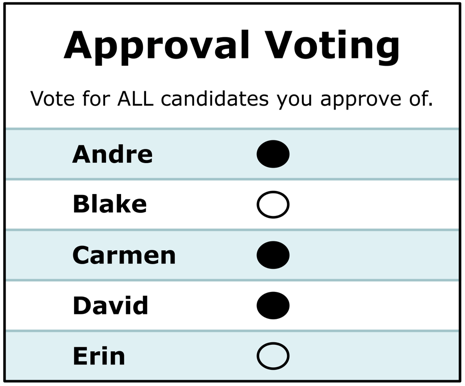
A standard Approval ballot (mockups from the Equal Vote Approval page): one bubble per candidate, mark everyone you approve. It can look identical to a traditional ballot — only the "vote for one" instruction changes.
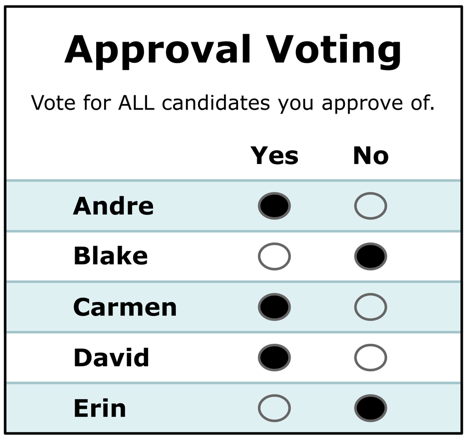
The Yes / No ("double bubble") variant: every candidate gets an explicit Yes and No bubble, so a blank is distinguishable from a deliberate "No." This is the ballot-security hardening discussed in honest limits §6 — with single bubbles, filling in extra bubbles on someone else's ballot would be undetectable.
That one change fixes Choose-One's core failure. Under Choose-One, approving your sincere favorite (a long shot) costs you a vote against the front-runner you'd settle for — the spoiler / vote-splitting trap. Under Approval you simply approve both your favorite and the acceptable compromise, so supporting a new candidate never splits your own side.
The one decision Approval asks of you¶
Because the ballot is binary, Approval forces exactly one genuinely hard call: where to draw the approval line. Approve too few and you can't help a compromise; approve too many and you help a rival beat your favorite. That threshold — and the fact that a checkmark can't say how much you approve — is Approval's central limitation, explored in honest limits.
Approval is Score at 1-bit resolution¶
An Approval ballot is just a Score (0–5) ballot restricted to the two ends, {0, max}. That's the whole relationship: Approval keeps who you'd accept and throws away how much and in what order. It's also why approval-style 0/1 marks are perfectly legal on a STAR ballot — see star_ala_approval.yaml. STAR keeps the full 0–5 scale and adds the automatic runoff precisely to recover the intensity and threshold information Approval discards (the fidelity ladder; scores vs. ranks).
There is one rung in between, and it is worth knowing because it changes what a blank means. Combined Approval Voting adds a third level — For (+1), abstain (0), Against (−1), highest net wins — so a voter can distinguish "I'm not backing them" from "I'm against them." Dan Felsenthal proposed it in 1989. Two things follow that don't from Approval: an unmarked candidate is scored in the middle rather than at the bottom, which can decide an election on its own; and under strategy the method collapses straight back into Approval, since a voter maximising influence never uses the middle option.
Reading an Approval result¶
Take the approval_101 example — 5 voters, candidates Ann/Bob/Cal. Every ballot, as the voter marked the paper and as the count reads it:
The ballots as marked — a filled Yes is a 1 in that candidate's column, a filled No a 0:
| # | Ballot as marked | Ann | Bob | Cal |
|---|---|---|---|---|
| 1 | 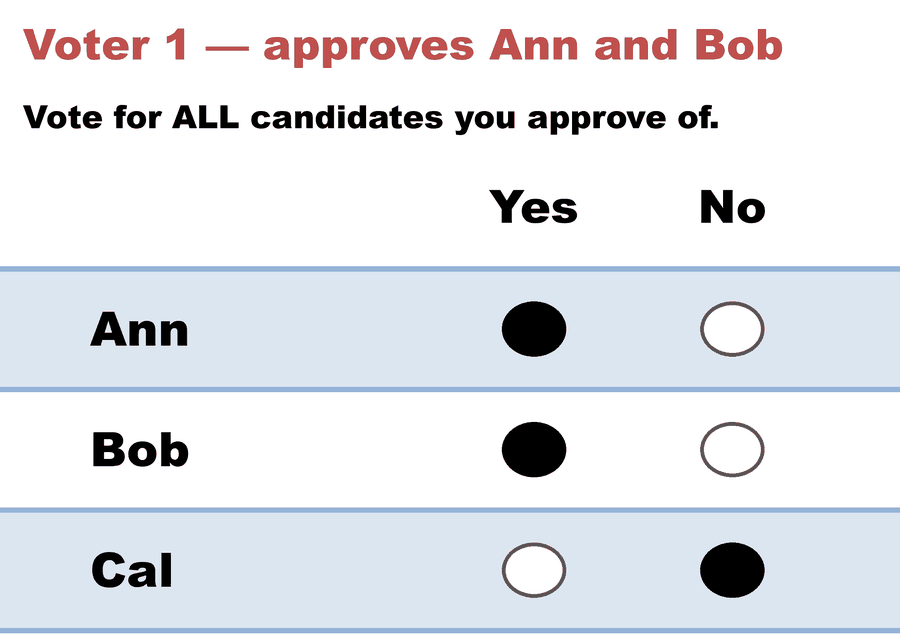 |
1 | 1 | 0 |
| 2 | 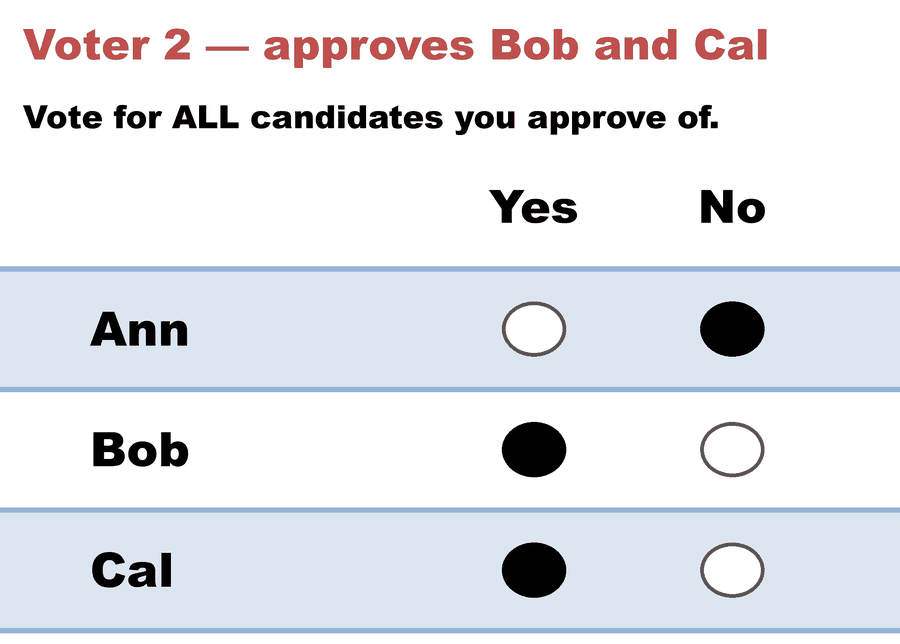 |
0 | 1 | 1 |
| 3 | 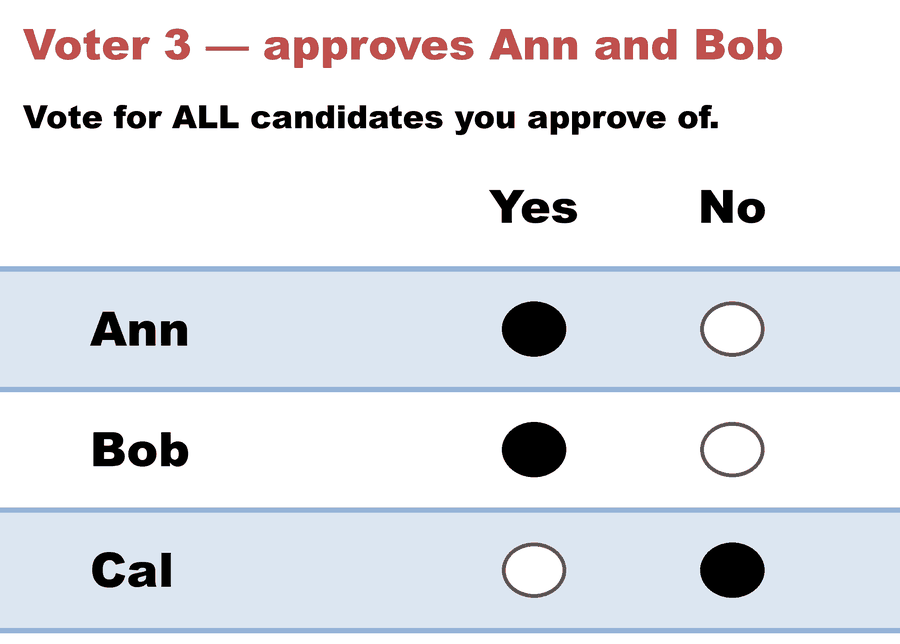 |
1 | 1 | 0 |
| 4 | 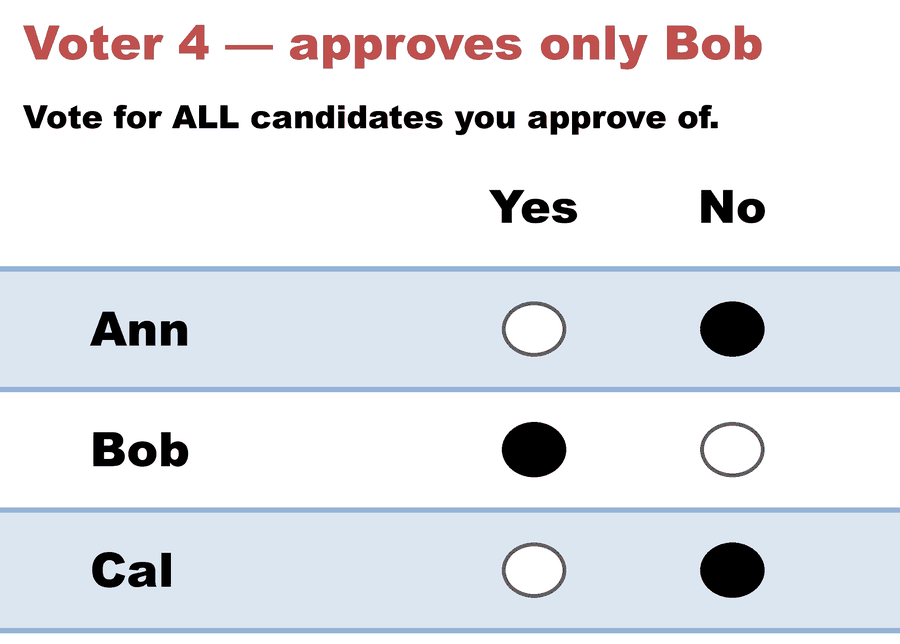 |
0 | 1 | 0 |
| 5 | 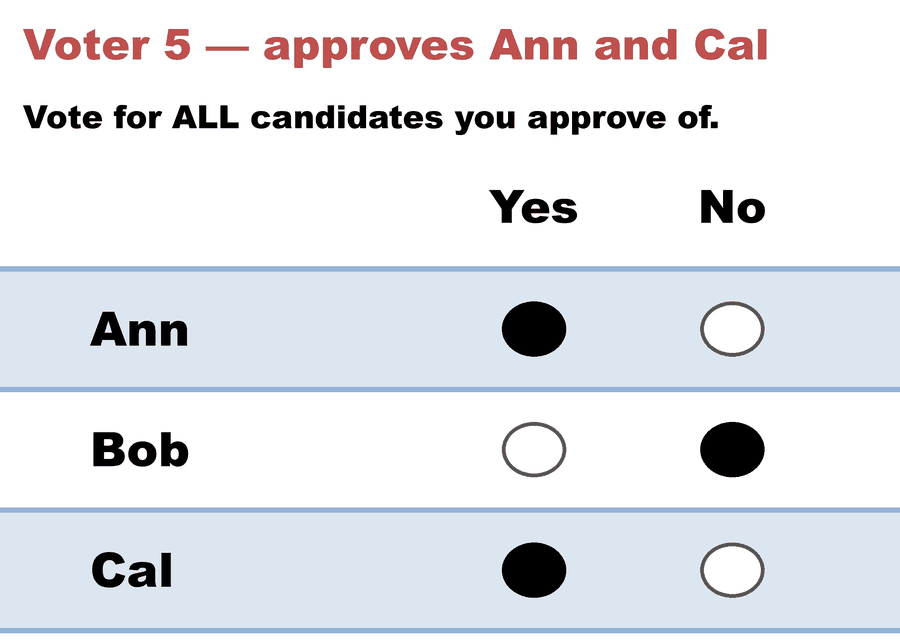 |
1 | 0 | 1 |
An approval count is then more than "who got the most marks." Three numbers tell the story:
   Bob -- 4 (80%) -- Elected
   Ann -- 3 (60%)
   Cal -- 2 (40%)

[Approval Distribution] (how many candidates each ballot approved)
   9 approvals across 5 ballots — average 1.8 of 3 (range 1–2).
     approved 1: 1 ballot
     approved 2: 4 ballots

[Co-Approval Matrix]
 Of the voters who approved the ROW candidate, the % who ALSO approved the COLUMN candidate.
        |  Bob   |  Ann   |  Cal   |
   Bob  |   --   |  50%   |  25%   |
   Ann  |  67%   |   --   |  33%   |
   Cal  |  50%   |  50%   |   --   |
- Count and share. Each candidate's approvals, and that as a percentage of ballots (Bob 4/5 = 80%). The share is the honest headline — "80% of voters approve Bob," not a share of some contested denominator.
- The approval distribution — the strategy signal. How many candidates each ballot approved. If most voters bullet-voted (approved exactly one), the electorate is behaving like Choose-One and the "approve as many as you like" freedom went unused; a healthy spread (here, an average of 1.8 of 3) means voters actually expressed acceptance of more than one option. This is the approval analogue of STAR's score distribution.
- The co-approval matrix — the coalitions. Of the voters who approved A, what fraction also approved B. It exposes structure the totals hide: blocs that move together, and "bridge" candidates approved across camps. (Ann's approvers back Bob 67% of the time; Cal's split evenly.) It's the approval analogue of STAR's preference matrix — coalition shape, not just a winner.
The share and distribution print on every result; the co-approval matrix is opt-in on screen (options: { show_matrix: true }) and always in the full _tabulated mirror. For a visual version of exactly these statistics — bar charts, an approval-distribution histogram, and a co-approval correlation table — the Center for Election Science's polling tool renders them live (an Approval-advocacy site; the numbers are the numbers).
How it compares¶
| Choose-One | Approval | STAR | |
|---|---|---|---|
| Ballot | pick one | approve any number (0/1) | score each 0–5 |
| Approve favorite and compromise? | ❌ | ✅ | ✅ |
| Preference strength? | ❌ | ❌ | ✅ |
| Order among the ones you like? | ❌ | ❌ | ✅ |
| Spoiler / vote-splitting resistant? | ❌ | ✅ largely | ✅ |
| Forces a "where's my line?" decision? | — | ⚠️ yes | no (score each on its own) |
| Precinct-summable? | ✅ | ✅ | ✅ |
Where it fits¶
Approval sits one rung above Choose-One in the equal-vote family, and it passes the Equal Vote / balance test (every ballot has an exact opposite that cancels it). Its virtue is simplicity — zero ballot redesign, trivial hand count — which makes it a strong first step for an organization leaving plurality behind. Its ceiling is the binary ballot: where a group wants to express how strongly or in what order it prefers candidates, STAR is the fuller expression of the same idea. The Black Curtain set makes the trade-off concrete: on identical ballots, Approval elects the broadly-approved consensus candidate while STAR's runoff hands the seat to the majority's favorite — same voters, different question.
Practical strengths (beyond the ballot)¶
Several of Approval's advantages are logistical rather than mathematical — they're what make it the cheapest reform to actually adopt (the Equal Vote Coalition's Approval page makes this case at length):
- Nothing to spoil. There is essentially no way to mis-mark an Approval ballot: no overvotes, no invalid rankings, no skipped-rank rules. Every combination of marks is a valid ballot.
- Works with existing infrastructure. An Approval ballot can look identical to a traditional one, is tallied the same way (add the votes), and is precinct-summable — so it's highly compatible with existing election codes and equipment. RCV-IRV, by contrast, often requires new equipment, central tabulation, or statutory changes.
- Campaign incentives. Because candidates benefit from being acceptable to rivals' supporters, Approval rewards consensus-seeking and positive campaigning over base-only polarization.
- Pairs well with a top-two general. An Approval primary feeding a top-two general election is a minimal-change package that yields notably representative results — the package St. Louis adopted in 2020, and the direct ancestor of STAR. Full page: Approval + Top-Two.
- Scales to multiple seats. The same ballot handles multi-winner races (bloc counting) and can be adapted for proportional representation — see multi-winner Approval.
Where it has actually been used¶
Approval's record is longer and stranger than the reform-campaign framing suggests, and it cuts both ways. The history and the adoption list below are as Wikipedia's Approval voting article records them — the neutral tier, deliberately, since this is where an advocacy source would be weakest.
Before anyone named it. Papal conclaves used a form of it from 1294 to 1621; the Republic of Venice built approval rounds into the Doge's famously baroque election from the 13th to the 18th century; Greece elected legislators by approval from 1864 to 1923 before switching to party-list PR. The UN Security Council still selects a Secretary-General by approve/disapprove straw polls. So the "five independent groups in the 1970s" above rediscovered a rule several republics had already worn in.
Modern jurisdictions — and a reversal. Fargo, North Dakota adopted approval by ballot initiative in 2018, the first US city to do so; St. Louis passed Proposition D with 70% in November 2020, adopting the Approval + Top-Two unified primary. Then, in April 2025, North Dakota's governor signed a bill banning both ranked-choice and approval voting statewide, ending the practice in Fargo. Latvia's parliament uses a modified approval within open-list PR, where a voter may cast a positive vote, a negative vote, or neither on any number of candidates.
Organizations. The Mathematical Association of America (1986), the American Mathematical Society, the American Statistical Association (1987) and the IEEE (1987–2002) all ran internal elections by approval; so do the Libertarian National Committee, several state Green parties and the Czech and German Pirate parties. Two of these are worth remembering because they ended: Dartmouth's Alumni Association dropped approval for traditional runoffs in 2009 by an alumni vote of 82% to 18%, and the Independent Party of Oregon's 2016 presidential preference primary failed to identify a nominee at all — no candidate cleared 32% approval. A method's adoption list is only half the evidence; its repeal list is the other half, and honest limits picks these two up.
The stepping-stone argument¶
Equal Vote's case for Approval is worth stating in its own terms: for a jurisdiction on Choose-One (or a Choose-One primary + top-two runoff), there is little reason not to switch to Approval immediately — the logistical change is near zero and the improvement is real. In their assessment, with expected voter behavior Approval also outperforms RCV-IRV at electing representative winners, especially in large or competitive fields. And because Approval is transparent about what it does and doesn't offer (no strength, no order — see honest limits), voters who live with it learn firsthand that vote-splitting isn't a necessary evil — which builds the appetite to upgrade to a fuller method like STAR later. A good stepping stone is easy to reach, stable in its own right, and on the way to the next step. The counterpoint, which Equal Vote also concedes: education-and-adoption work is expensive even for Approval, so in many places going directly to STAR is the quicker path. Either way, the urgent step is off Choose-One.
See also¶
- Approval — Honest Limits — the critique companion
- Approval in the theory literature — the arguments and criticisms as the academic surveys state them, the three readings of "approve," and Approval = Borda = Condorcet on dichotomous preferences
- Approval + Top-Two — the two-round package (St. Louis; Oregon's Unified Primary) and why its runoff can't be automatic — the gap STAR closes
- Approval — Multi-Winner — bloc counting, SPAV/PAV
- Combined Approval Voting (CAV) — the three-option variant: For / abstain / Against, highest net wins. Runnable, with the pair of elections showing the same twelve voters reversing end-to-end on what a blank is worth
- the Approval examples — the method's example folder
- Criteria at a glance — Approval's pass/fail row beside STAR, Ranked Robin and RCV-IRV, each ✗ linked to a runnable failure (read its caveat first)
- Approval voting — Wikipedia — the neutral reference: pre-modern history, the full adoption and repeal list, and the criteria table this repo cross-checks against. Cited here rather than a campaign page precisely because adoption records and criteria claims are where an advocacy source is weakest
- Equal Vote: Approval Voting — advantages/disadvantages and the stepping-stone case
- Divided We Fall — "Can STAR and Approval Voting Fix Our Elections?" — a joint STAR + Approval essay (authors lead STAR Voting Action and Utah Approves — advocacy lean disclosed); cites the 2021 St. Louis Approval primary
- Black Curtain — Approval vs STAR vs RCV-IRV vs Score
- The fidelity ladder · scores vs. ranks
- Glossary: Approval voting — Glossary — voting methods & criteria