Approval Voting — concept pages¶
Everything explaining Approval (mark every candidate you approve — 1 — leave the rest 0; most approvals wins). New here? Start with Approval Voting — how the ballot and the count work. Approval is Score voting at one-bit resolution: the simplest equal-vote upgrade to Choose-One, and the natural stepping-stone to STAR.
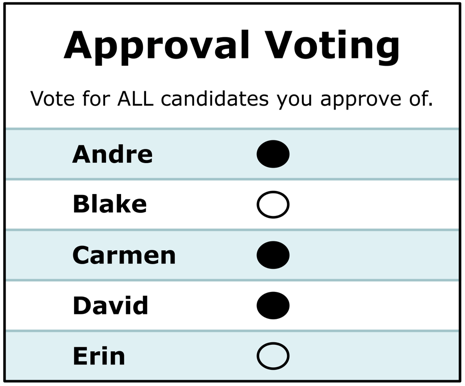
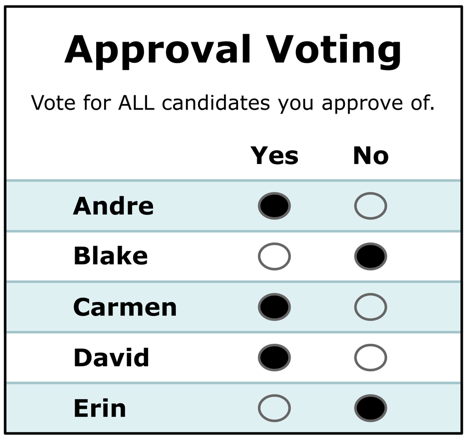
The two Approval ballots (Equal Vote): the plain single bubble — mark everyone you approve — and the Yes / No "double bubble", where a blank is distinguishable from a deliberate No (the ballot-security hardening in honest limits §6). Either way the count is the same: add up the approvals. The repo's own case art draws the Yes/No form — see the ballots on Approval Voting and on the folder front door.
Run it: the 101 case lives in the Approval examples — and the Black Curtain set counts the same five voters by Approval vs STAR vs RCV-IRV vs Score (Approval flips the winner in election 1).
Single-winner Approval¶
- Approval Voting — the ballot, the one decision it asks (where's my approval line?), reading a result, and where it fits in the scored family
- Approval + Top-Two — the reform package (St. Louis): an Approval primary feeding a head-to-head general, and why the runoff must be a second election — the exact package STAR folds into one ballot
- Honest limits — no preference strength or order, and the unavoidable threshold choice (the gap STAR was designed to close)
- Approval in the theory literature (301) — the six arguments and five criticisms as academia states them (two of the five don't survive), the three incompatible readings of what "approve" means and why the strategy argument can't settle until you pick one, and Approval = Borda = Condorcet on dichotomous preferences — with the runnable case that shows why that equivalence doesn't transfer to a real election
- Is Approval's outcome arbitrary? The Saari–Van Newenhizen critique (301) — the sharpest academic attack on Approval (a voter who prefers
a > b > chas no ballot that says so), why the Brams–Fishburn–Merrill defense conceded too much, and Hillinger's inversion — one approval result, two opposite Borda winners, runnable. Plus the popular-press version ("the whole election can become random"), split into the half that holds and the half that doesn't - The case for approval voting — Hamlin & Hua (2023), claim-checked (301) — the Approval camp's own academic case, and the companion article to the STAR paper in the same journal issue. Section 4 answers four critiques (majority criterion, later-no-harm, bullet voting, expressiveness); its §4.1 example is fully runnable, so the page is mostly engine output — including the paper's own utility defence, written down and counted
- The Majority Illusion — CES's plain-English piece, claim-checked (301) — the same organisation writing for a general audience. Its taxonomy of "majority" is the best short one in advocacy writing; its centerpiece example turns out to contain an absolute-majority winner that Approval and Score reject and STAR elects. Also where this library's false majorities page came from
The three-option variant¶
- Combined Approval Voting (CAV) — Approval plus an explicit Against: For (+1) / abstain (0) / Against (−1), highest net wins. Proposed by Dan Felsenthal in 1989 as the answer to the Approval failures his own paradox examples demonstrate. Lives in
06_Other/because it isn't an EVC method, but it belongs to this family — and it carries the sharpest lesson about what a blank means: CAV reads an unmarked row as the middle grade, every other score ballot here reads it as the lowest, and a runnable pair of elections shows the same twelve voters reversing end-to-end on that one word
Multi-winner & committees¶
The same 0/1 ballot fills several seats. See the Multiwinner_Approval/ subfolder:
- Approval — Multi-Winner — bloc (at-large) counting and the proportional adaptations (SPAV, PAV)
- Electing a committee — a gentle intro (101) — "most approved" vs "cover everyone" vs proportional, counting only
- ABC rules & the utilitarian–egalitarian spectrum (301) — the approval-committee formalism (AV / PAV / Chamberlin–Courant / Phragmén), verified with
abcvoting - Thiele methods (301) — AV/PAV/CC as one parameterised family, and where STAR-PR (RRV) fits
- Satisfaction Approval Voting — SAV (301) — Brams & Kilgour's rule: one vote per ballot, split evenly among your marks, so approving four gives each ¼. Their own example elects a committee disjoint from bloc Approval's on identical ballots; it punishes clones where AV rewards them; and the authors prove the cases where it does worse than AV. Used for real in Peoria, Illinois, since 1991 — plus a claim-check of the mangled Wikipedia retelling
Reference¶
- Glossary: Approval terms
- Criteria at a glance — Approval's pass/fail row beside STAR, Ranked Robin and RCV-IRV, with the ✗s linked to runnable elections
- Approval voting — Wikipedia — the neutral reference for the history (papal conclaves, Venice, Greece), the adoption and repeal record, and the criteria table. Where a campaign source would be weakest, this is the one to cite
(Parallel method hub: STAR Voting. Up: the docs hub 00_START_HERE.)