Approval Voting — Honest Limits¶
One line: Approval is the simplest equal-vote method — mark everyone you approve, most approvals wins — and that simplicity is both its strength and its weakness. It throws away preference strength and order, and it hands the voter one hard, unavoidable decision: where to draw the approval line. STAR was designed largely to fix exactly this gap.
→ Overview: Approval Voting (how it works) · the same critiques as the academic literature states them, with the parts that don't survive scrutiny marked: Approval in the theory literature · the sharpest of them, worked in full: is Approval's outcome arbitrary? · Companion critical pages (parity across methods): STAR's limits · Ranked Robin (RCV-RR) limits · RCV-IRV fails the Equal Vote. Approval does pass the Equal Vote. Curriculum: 301.5.
1. No preference strength or order¶
An Approval ballot is binary per candidate: approve or not. You cannot say "I love A but merely tolerate B" — both get the same checkmark. All intensity and all ranking information is discarded. For voters who feel strongly about ordering their approved candidates, that expressiveness is simply gone.
2. The approval-threshold dilemma (the central critique)¶
Because the ballot is binary, the entire strategic burden collapses onto one question: where do I draw my approval line? Two voters with identical honest opinions can rationally approve different sets — one bullet-votes their favorite, the other approves their top three — and those choices can swing the result. There is no honest, obvious threshold; the method makes the voter do the strategic work that STAR's 0–5 scale and runoff absorb.
The academic literature makes this sharper than "voters find it hard." Researchers don't agree on what approving even means — a ranking compressed to two levels, a genuine like/dislike primitive with no hidden ranking underneath, or a ranking plus a meaningful dividing line (a "true zero"). On the middle reading there is exactly one sincere ballot per voter and no incentive to deviate; on the first, if the line has no intrinsic meaning, there is no basis for calling any Approval ballot insincere at all. Which is why the strategy argument never resolves: the three views, and what each does to the strategy question.
3. Strong incentive to bullet-vote (or over-approve)¶
Two opposite pressures pull on every ballot: approve only your favorite (so you don't help a rival you also approve), or approve widely (to block a worse candidate). Both are rational depending on the polls, so Approval outcomes can hinge on how strategically the electorate reads the race rather than on sincere opinion. A related wrinkle: voters whose favorite is a front-runner have little incentive to approve anyone else — and if that behavior is widespread, candidates already seen as "electable" gain a built-in edge.
Two published answers to where should the line go?, both cited in the theory literature page: at your mean utility (Duddy et al., 2013 — it maximizes the separation between the candidates you approve and those you don't), or near the utility you assign to the expected winner (Laslier, 2009 — the strategically best line, and roughly what voters actually do). The second one is this section's polls-dependency, stated as a finding rather than a worry.
4. Can miss a majority favorite (lowest-common-denominator)¶
A broadly inoffensive candidate approved by many can beat a candidate who is the first choice of a majority but polarizing. Sometimes that broad-consensus winner is the right call — but Approval can't distinguish "everyone's warm second choice" from "the majority's passionate first choice," because it never sees the difference. The clearest worked instance is the one the Approval camp published itself — 60% rank A first, B is approved on all 100 ballots and wins: Hamlin & Hua §4.1, counted five ways, with the claim-check of their defence of it. Worked in five ballots, with the Condorcet winner of the underlying opinions lost in the compression — and the pairwise matrix showing exactly where it went: When compression moves the Condorcet winner. The Approval + Top-Two package answers this with a second, head-to-head election between the two most-approved — and the reason it must be a second election (an automatic runoff from 0/1 ballots just echoes the approval count) is the cleanest demonstration of what the checkmark discards.
5. Fails Later-No-Harm¶
Approving a second choice can help that candidate beat your favorite. (STAR and Ranked Robin share this tradeoff; RCV-IRV is the one that keeps Later-No-Harm.)
6. A ballot-security wrinkle¶
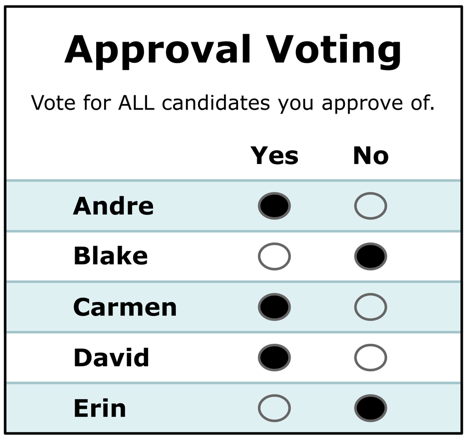
Because every combination of marks is a valid Approval ballot, filling in extra bubbles on someone else's ballot is undetectable — there's no overvote to flag. (On a Choose-One ballot the same tampering voids the ballot, which is at least visible.) Poll workers should never be alone with ballots under any method, but Approval warrants extra chain-of-custody care. A known mitigation, noted on the Equal Vote Approval page: print an explicit Yes / No bubble pair per candidate, so a blank is distinguishable from a deliberate "No" — see the ballot mockups on the overview page (double-bubble image).
7. Two places it under-delivered in practice¶
The bullet-voting worry in §3 is an empirical claim, and the Approval camp answers it with real numbers — 2.3 marks per ballot in Fargo 2020, ~1.6 in St. Louis 2021 (Hamlin & Hua §4.3, claim-checked). Those hold up. But they are the campaigns' own successful elections, so the other half of the record belongs on the page too — both from Wikipedia's Approval voting article, the neutral tier:
- Dartmouth's Alumni Association used approval and voted it out. In 2009, after controversy over trustee elections, alumni replaced it with traditional runoffs by 82% to 18% — a rare case of an electorate that had lived under approval choosing to leave.
- The Independent Party of Oregon's 2016 presidential primary produced no nominee. No candidate cleared 32% approval. With a binary ballot and a fragmented field, "most approvals" can be a number too small to mean anything — there is no runoff, and no second round of information to consult.
Neither is fatal, and neither generalizes on its own: one is a small, contested electorate, the other a minor-party primary. But an adoption list (§Where it has actually been used on the overview page) that omits the repeals is an advertisement, not evidence — and the same standard is what this repo applies to RCV-IRV and to STAR.
Keep it in perspective¶
Approval's limits are the flip side of real strengths: it passes the Equal Vote, is trivially easy to explain and to tabulate (add the approvals; precinct-summable), and it already ends forced vote-splitting. STAR keeps Approval's equal-vote guarantee while adding the missing strength + order (a 0–5 score) and a majority runoff to answer the threshold dilemma — which is precisely the gap the Equal Vote Coalition set out to close when STAR was designed. Every method trades something away (Gibbard); Approval trades expressiveness for simplicity.