Approval Voting — Multi-Winner
The same 0/1 ballot fills more than one seat. The simple version — bloc (at-large) Approval, the seats most-approved candidates win — is exactly as easy as single-winner Approval, and exactly as majoritarian: a cohesive majority can sweep every seat. Proportional adaptations (SPAV, PAV) exist and trade that simplicity for fair minority representation.
→ Run it / examples: multi-winner Approval (approval_bloc_2seats_c4_b6.yaml) · Overview: Approval Voting · The same majoritarian-vs-proportional fork for score ballots: Bloc STAR vs proportional STAR · Concepts: proportional representation.
Many boards, councils, and committees already elect several seats at once from one pool of candidates — usually with "vote for up to N" (block plurality). That rule inherits Choose-One's vote-splitting problem and adds a cap: run more candidates than seats on your side and you split your own votes.
Bloc Approval removes the cap: approve any number of candidates, and the N most-approved win. Within a faction, vote-splitting disappears — you approve your whole slate. Tabulation stays a single addition pass, precinct-summable, trivial to hand-count.
The ballot
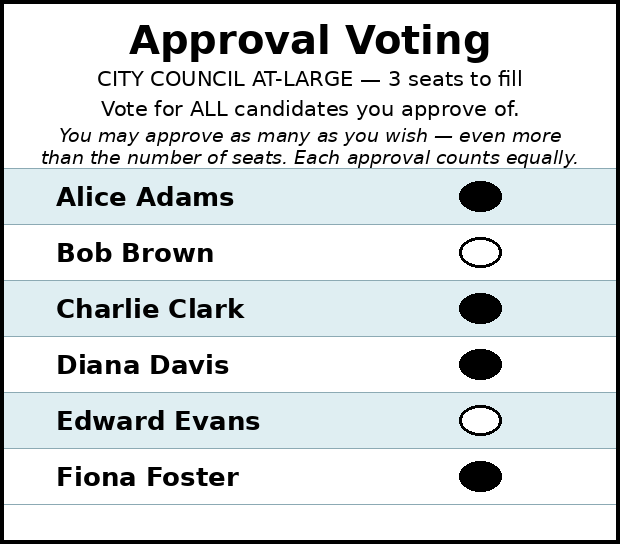
The ballot is the ordinary Approval checklist — the only multi-winner change is the heading. Note the instruction: you may approve more candidates than there are seats (this voter approves four for three seats). Forcing voters to mark exactly the seat count is a different — and worse — method (block plurality); giving voters freedom in how many they approve is the better design (Lackner & Skowron, Ch. 2, discuss exactly this).
The data is equally plain — each ballot is a 0/1 row, which is precisely this repo's YAML format:
Adams,Brown,Clark,Davis,Evans,Foster
1,1,0,0,0,0
0,1,1,1,0,0
1,0,0,0,1,1
1,1,1,0,0,0
0,0,1,1,1,0
Sum the columns; the top 3 win — Adams, Brown, Clark (3 approvals each). Runnable: approval_bloc_3seats_c6_b5.yaml.
Bloc Approval is majoritarian — the sweep
What bloc Approval does not do is represent minorities. Every voter influences every seat with full weight, so 51% of voters who agree on a slate take 100% of the seats. The worked example makes it concrete — 6 voters, 4 candidates, 2 seats; a 4-voter majority (all approve Amy, two also Ben), a 2-voter minority behind Cora (one also Doug):
--- Approval Voting (2 winners) ---
 Tabulating 6 ballots (any non-zero score = approval).

Ballots:
   columns = Amy, Ben, Cora, Doug      (1 = approve; 0 = not approved)
     2 × 1,0,0,0
     2 × 1,1,0,0
     1 × 0,0,1,1
     1 × 0,0,1,0

   Amy  -- 4 (67%) -- Elected
   Ben  -- 2 (33%) -- Elected
   Cora -- 2 (33%)
   Doug -- 1 (17%)
  Note: Ben, Cora each have 2 approvals and tie for the last 1 seat.
        Candidate priority order (Ben > Cora) broke the tie: Ben elected, Cora not elected.

[Approval Distribution] (how many candidates each ballot approved)
   9 approvals across 6 ballots — average 1.5 of 4 (range 1–2).
     approved 1: 3 ballots
     approved 2: 3 ballots

[Co-Approval Matrix]
 Of the voters who approved the ROW candidate, the % who ALSO approved the COLUMN candidate.
         |  Amy   |  Ben   |  Cora  |  Doug  |
   -------------------------------------------
   Amy   |   --   |  50%   |   0%   |   0%   |
   Ben   |  100%  |   --   |   0%   |   0%   |
   Cora  |   0%   |   0%   |   --   |  50%   |
   Doug  |   0%   |   0%   |  100%  |   --   |

Winners — Approval Voting (2 winners)
  Amy, Ben
One third of the electorate ends up with zero seats. Sometimes that's the design goal (an executive slate that should reflect the majority); for a representative body it usually isn't. This is the same trade-off as Bloc STAR vs Proportional STAR — see Bloc STAR and proportional STAR.
Proportional adaptations: SPAV and PAV
The approval ballot itself carries enough information for proportionality; you change the tabulation, not the ballot:
- SPAV — Sequentially Proportional Approval Voting. Seats are filled one at a time. After each seat, a ballot's weight drops to 1 / (1 + s), where s is how many of that ballot's approved candidates have already been elected (1 → 1/2 → 1/3 …, the Jefferson/D'Hondt divisors). A majority that wins the first seat votes at half weight for the second, so minorities earn seats roughly in proportion to their size. Invented by Thorvald Thiele; briefly used in Swedish elections in the early 1900s. Sequential, easy to audit, and the same reweighting spirit as Reweighted Range Voting (RRV) for score ballots.
- PAV — Proportional Approval Voting. Thiele's optimizing version: pick the seat-set maximizing total voter satisfaction, where a voter with k elected approvals contributes 1 + 1/2 + … + 1/k (harmonic weighting). Stronger proportionality guarantees than SPAV, but finding the exact winner set is computationally hard (NP-hard), so it's mostly of theoretical and small-election interest.
This ladder — same ballot, majoritarian bloc count vs proportional reweighting — is why the Equal Vote Coalition's Approval page lists "can be used for single-winner or multi-winner elections and can be adapted for proportional representation" among Approval's advantages.
Engine note: the LH engine tabulates bloc Approval only (voting_method: Approval_Multi_Winner, num_winners: ≥ 2). The proportional rules are runnable too, via the the abcvoting engine wrapper around Martin Lackner's peer-reviewed abcvoting library. On the sweep example above, plain av sees the same 2–2 tie the LH engine breaks by priority — but every proportional rule seats the minority's Cora decisively:
--- abcvoting: approval-based committee rules (2 seats) ---
 approval_bloc_2seats_c4_b6.yaml: 6 ballots, candidates: Amy, Ben, Cora, Doug
   av           Approval Voting (AV)                       ->  Amy, Ben  |  Amy, Cora  [2 tied committees]
   seqpav       Sequential Proportional Approval Voting (seq-PAV) ->  Amy, Cora
   pav          Proportional Approval Voting (PAV)         ->  Amy, Cora
   seqphragmen  Phragmén's Sequential Rule (seq-Phragmén)  ->  Amy, Cora
The repo's other runnable proportional methods are the STAR-PR family (proportional STAR) and STV (other methods).
The literature's running example (Lackner & Skowron)
The standard textbook for this whole field is Lackner & Skowron, Multi-Winner Voting with Approval Preferences (SpringerBriefs, 2023 — open access, doi:10.1007/978-3-031-09016-5); the abcvoting library is its computational companion. Its running example (Example 2.1) is in this repo as approval_bloc_4seats_c7_b12_lackner_skowron.yaml: an academic society elects a k = 4 steering committee from seven candidates, 12 ballots — 3 × {A,B} · 3 × {A,C} · 2 × {A,D} · 1 × {B,C,F} · 1 × {E} · 1 × {F} · 1 × {G}.
Approval counts: A = 8, B = 4, C = 4, D = 2, F = 2, E = 1, G = 1. So bloc AV seats A, B, C and then ties D and F for the last seat — and the book (Example 2.2) points out the tie matters: {A,B,C,D} leaves three voters with no representative at all, {A,B,C,F} only two. Bloc AV can't see that difference; a tiebreak just picks blindly (the LH engine's priority order happens to pick D, the worse of the two). PAV (book Example 2.4) elects {A,B,C,F} outright — it maximises harmonic satisfaction, which is exactly the quantity that notices those unrepresented voters. Interestingly, seq-Phragmén sides with D here — even good proportional rules can disagree on the margins:
   av           Approval Voting (AV)                       ->  A, B, C, D  |  A, B, C, F  [2 tied committees]
   seqpav       Sequential Proportional Approval Voting (seq-PAV) ->  A, B, C, F
   pav          Proportional Approval Voting (PAV)         ->  A, B, C, F
   seqphragmen  Phragmén's Sequential Rule (seq-Phragmén)  ->  A, B, C, D
The same book is the reference for the fairness axioms behind these rules (justified representation and its extensions, the core, priceability — its Ch. 4) if you want the theory under the demo.
See also
- Approval Voting — the single-winner overview
- Approval — Honest Limits — the threshold dilemma carries over to every seat
- multi-winner Approval — the runnable sweep example
- ABC rules (approval committees), two levels: committees & coverage — a gentle intro (101) · ABC rules & the utilitarian–egalitarian spectrum (301) — AV vs Chamberlin–Courant vs PAV on Lackner & Skowron's steering-committee example, with the shadow-STAR bridge.
- Proportional representation — why and how minorities earn seats
- Equal Vote: Approval Voting — source for the advantages/adaptability framing
- Lackner & Skowron, Multi-Winner Voting with Approval Preferences — open access;
abcvotingis its companion library