04_Approval / multiwinner — Bloc Approval
Multi-winner Approval with the same 0/1 ballot: the num_winners most-approved candidates win (bloc / at-large counting). Declared as voting_method: Approval_Multi_Winner with num_winners: ≥ 2. Ballot mockup: 3-seat council ballot.
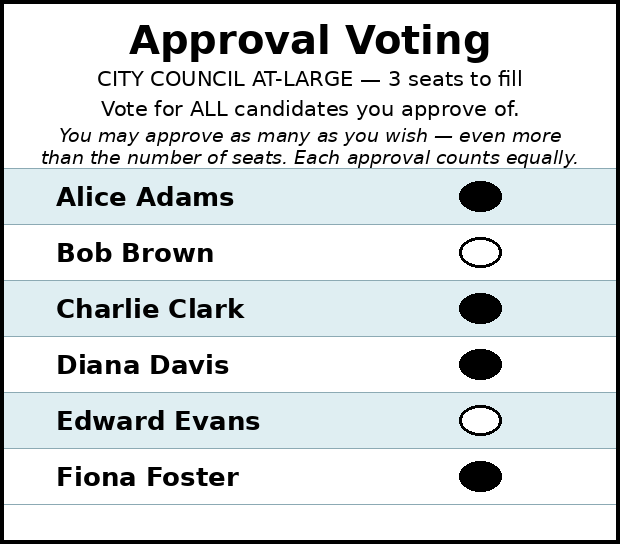
Five cases, in teaching order — the last two swap the counting rule instead of the ballot, and are the runnable half of Satisfaction Approval Voting:
approval_bloc_3seats_c6_b5.yaml— the plain mechanics: 3-seat council, six candidates, five voters; sum the columns, top three win (Adams, Brown, Clark). Matches the ballot mockup.approval_bloc_2seats_c4_b6.yaml— the majority sweep + priority tie-break (below).-
approval_bloc_4seats_c7_b12_lackner_skowron.yaml— the running example from Lackner & Skowron's Multi-Winner Voting with Approval Preferences (open access): AV ties {A,B,C,D} with {A,B,C,F}; PAV elects {A,B,C,F} outright — the committee that leaves fewer voters wholly unrepresented. Its "shadow STAR" companion runs the same profile through the STAR family (Bloc STAR / Allocated Score / SSS all seat D; only RRV recovers F, matching PAV): Lackner & Skowron — approval and its shadow STAR. Live on BetterVoting (BV27):jt6r76results ↗ — BV's Approval engine seats A,B,C,F (its random draw broke the D/F tie for F, and it correctly flagstieBreakType: random): BV27 two-view case. -
SAV vs AV — disjoint committees (
.yaml) — Brams & Kilgour's own example (Proposition 2): ten voters, four candidates, two seats. AV elects{Ada, Ben}, SAV elects{Cleo, Dev}— no candidate in common, from identical ballots. The four slate voters' marks were worth a whole vote each to AV and half a vote each to SAV. PAV splits the difference (one seat from each side, four-way tied), which is the proportional answer for a 40% bloc holding two seats. Live on BetterVoting (BV2271):4hfwqdresults ↗ — Approval, STAR and Ranked Robin races on the same ten voters, and all three elect Ada and Ben. - SAV covers everyone AV leaves out (
.yaml) — the same paper's Proposition 5: seventeen voters, three candidates, two seats. AV seats the two most-approved and strands the three Cole-only voters; SAV seats the smallest pair that represents all seventeen. The most-approved candidate of all wins no seat — every one of their supporters already has a second choice in the committee. Here PAV agrees with SAV but sequential PAV does not. Live on BetterVoting (BV2272):dr6fmgresults ↗ — again Approval, STAR and Ranked Robin, and again all three land on Ash and Bree.
The flagship case, approval_bloc_2seats_c4_b6.yaml, teaches the one thing that matters about bloc counting: it is majoritarian. Six voters, four candidates, two seats — a 4-voter majority (all approve Amy, two also Ben) takes both seats; the 2-voter minority behind Cora and Doug gets nothing. Bonus lesson: Ben and Cora tie 2–2 for the last seat, and the engine's tie note shows candidate priority order breaking it for Ben:
The six ballots, as marked and as counted — note that the same Yes/No paper fills two seats as easily as one; only the count changes:
The ballots as marked — a filled Yes is a 1 in that candidate's column, a filled No a 0:
| # | Ballot as marked | Amy | Ben | Cora | Doug |
|---|---|---|---|---|---|
| 1 | 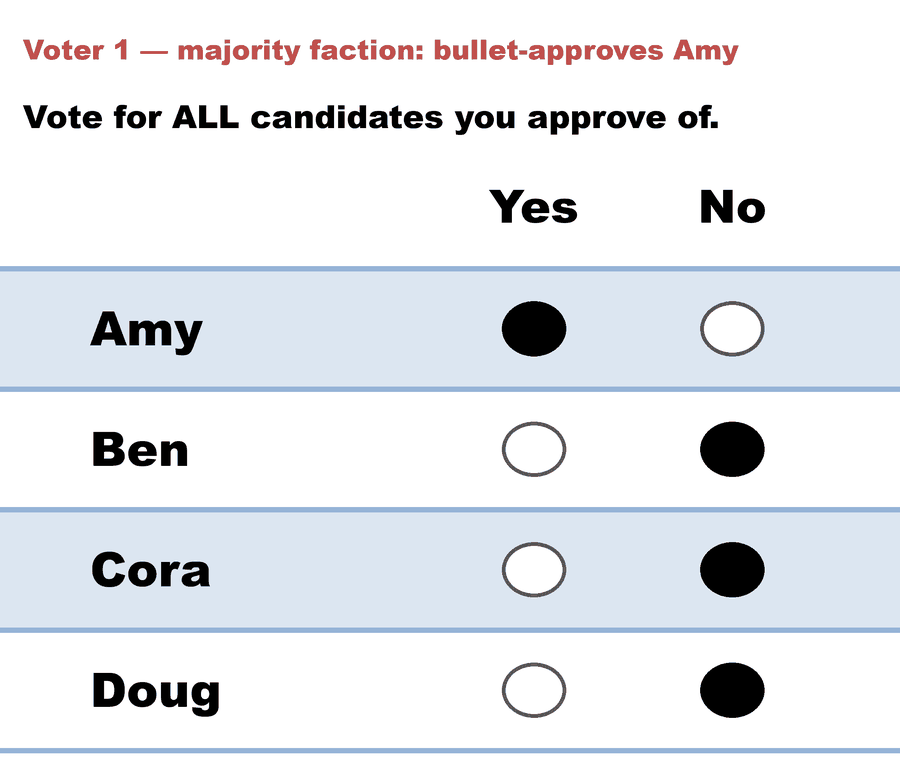 |
1 | 0 | 0 | 0 |
| 2 | 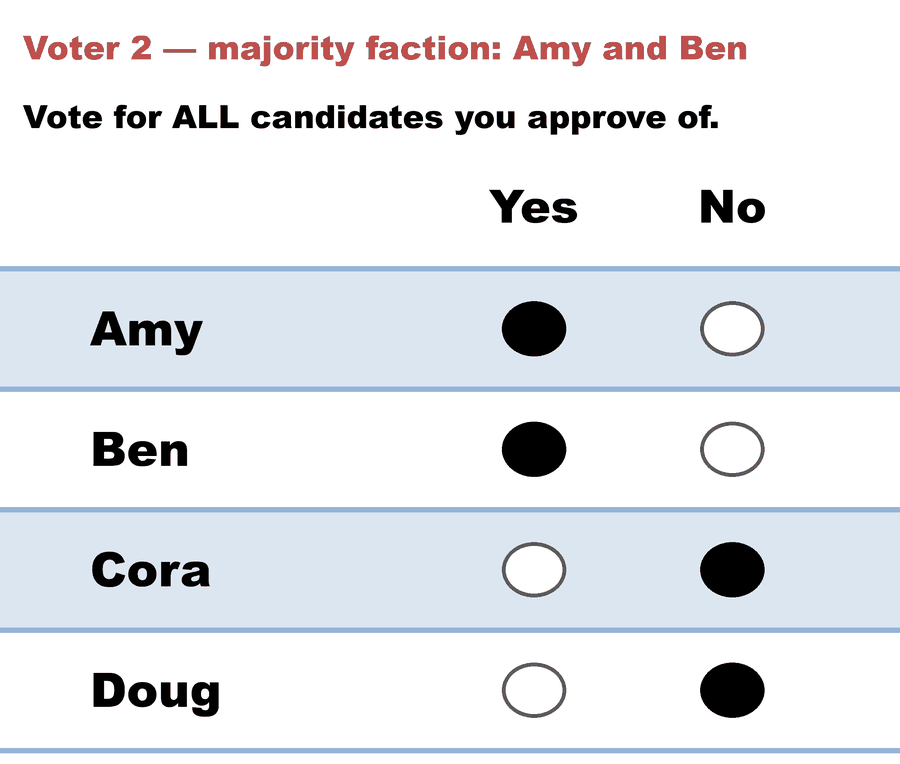 |
1 | 1 | 0 | 0 |
| 3 | 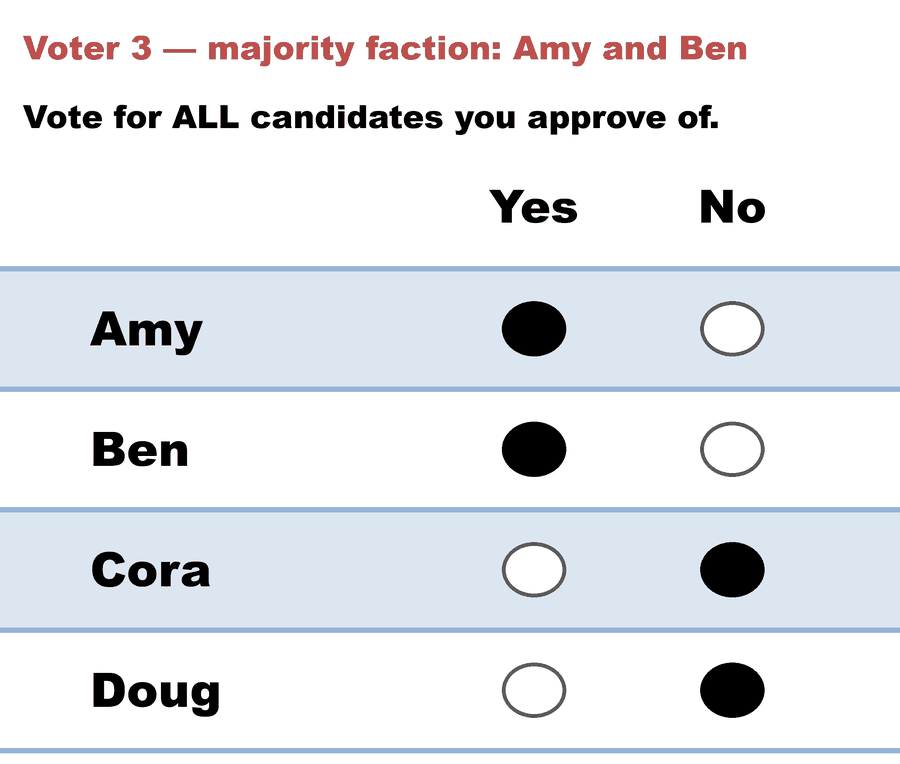 |
1 | 1 | 0 | 0 |
| 4 | 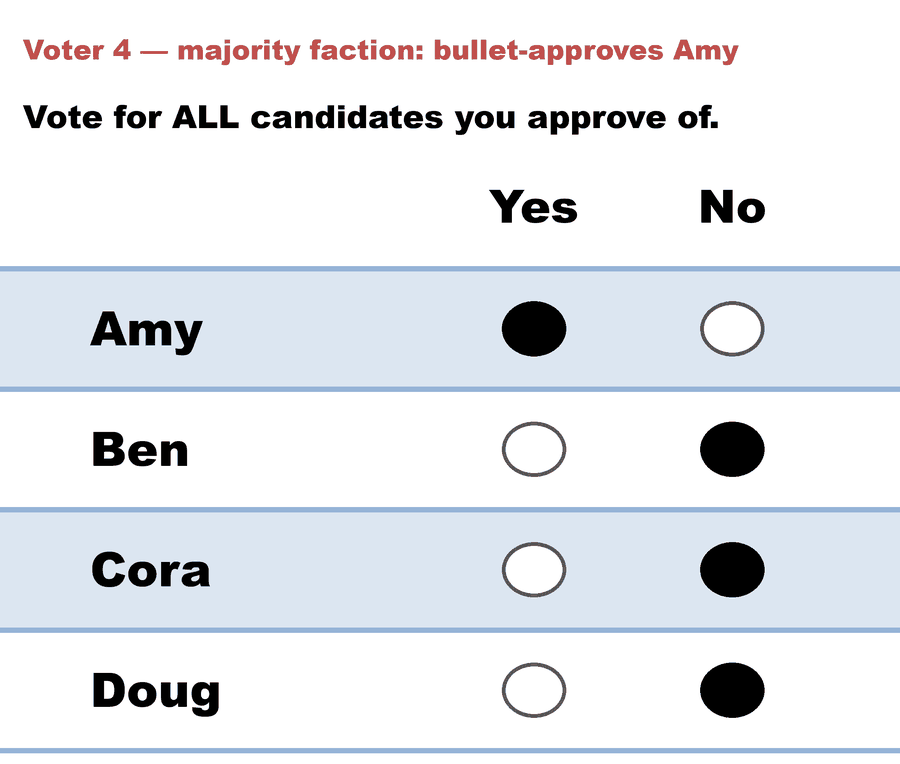 |
1 | 0 | 0 | 0 |
| 5 | 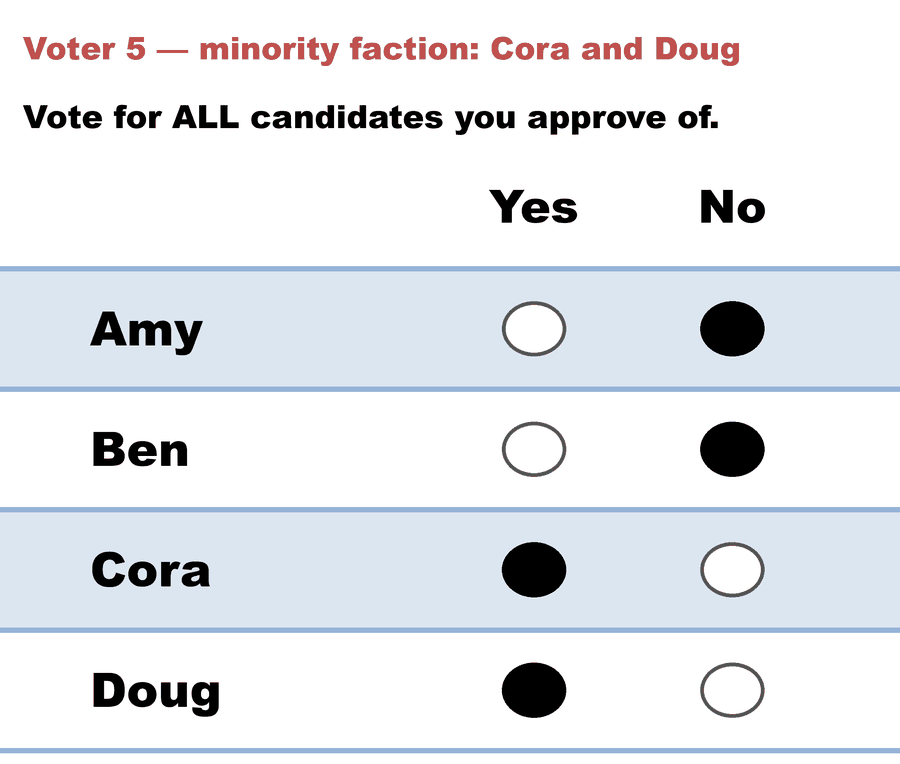 |
0 | 0 | 1 | 1 |
| 6 | 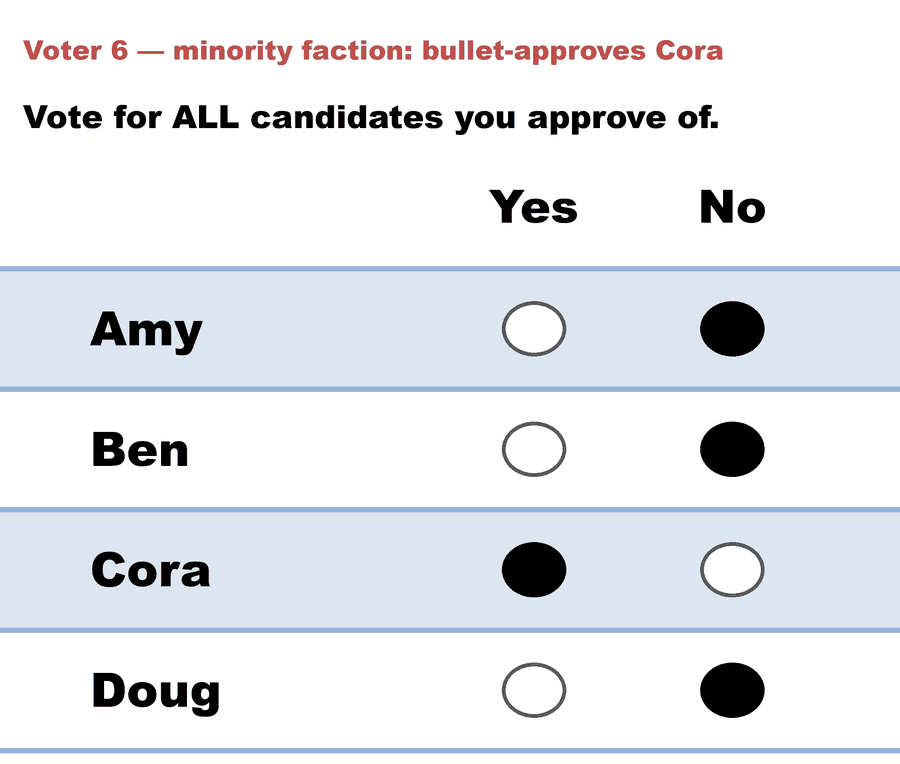 |
0 | 0 | 1 | 0 |
--- Approval Voting (2 winners) ---
 Tabulating 6 ballots (any non-zero score = approval).

Ballots:
   columns = Amy, Ben, Cora, Doug      (1 = approve; 0 = not approved)
     2 × 1,0,0,0
     2 × 1,1,0,0
     1 × 0,0,1,1
     1 × 0,0,1,0

   Amy  -- 4 (67%) -- Elected
   Ben  -- 2 (33%) -- Elected
   Cora -- 2 (33%)
   Doug -- 1 (17%)
  Note: Ben, Cora each have 2 approvals and tie for the last 1 seat.
        Candidate priority order (Ben > Cora) broke the tie: Ben elected, Cora not elected.

[Approval Distribution] (how many candidates each ballot approved)
   9 approvals across 6 ballots — average 1.5 of 4 (range 1–2).
     approved 1: 3 ballots
     approved 2: 3 ballots

[Co-Approval Matrix]
 Of the voters who approved the ROW candidate, the % who ALSO approved the COLUMN candidate.
         |  Amy   |  Ben   |  Cora  |  Doug  |
   -------------------------------------------
   Amy   |   --   |  50%   |   0%   |   0%   |
   Ben   |  100%  |   --   |   0%   |   0%   |
   Cora  |   0%   |   0%   |   --   |  50%   |
   Doug  |   0%   |   0%   |  100%  |   --   |

Winners — Approval Voting (2 winners)
  Amy, Ben
Run it yourself:
python STARVote_LH_tabulation_engine/starvote_larry_hastings.py 04_Approval/02_Examples/multiwinner/cases/approval_bloc_2seats_c4_b6.yaml
The proportional Approval rules (SPAV, PAV, seq-Phragmén) run on the same file via the abcvoting engine — all of them break the sweep and give the minority its seat (Amy + Cora):
pip install abcvoting   # once
python 06_Other/abcvoting_tabulation_engine/abc_tabulation.py 04_Approval/02_Examples/multiwinner/cases/approval_bloc_2seats_c4_b6.yaml
Same trade-off, score-ballot edition: Bloc STAR sweeps too (Bloc STAR); the proportional STAR methods fix it (proportional STAR). Concepts: Approval — Multi-Winner.