BV2271 — SAV and Approval elect committees with nothing in common¶
Level: 301 · deep dive
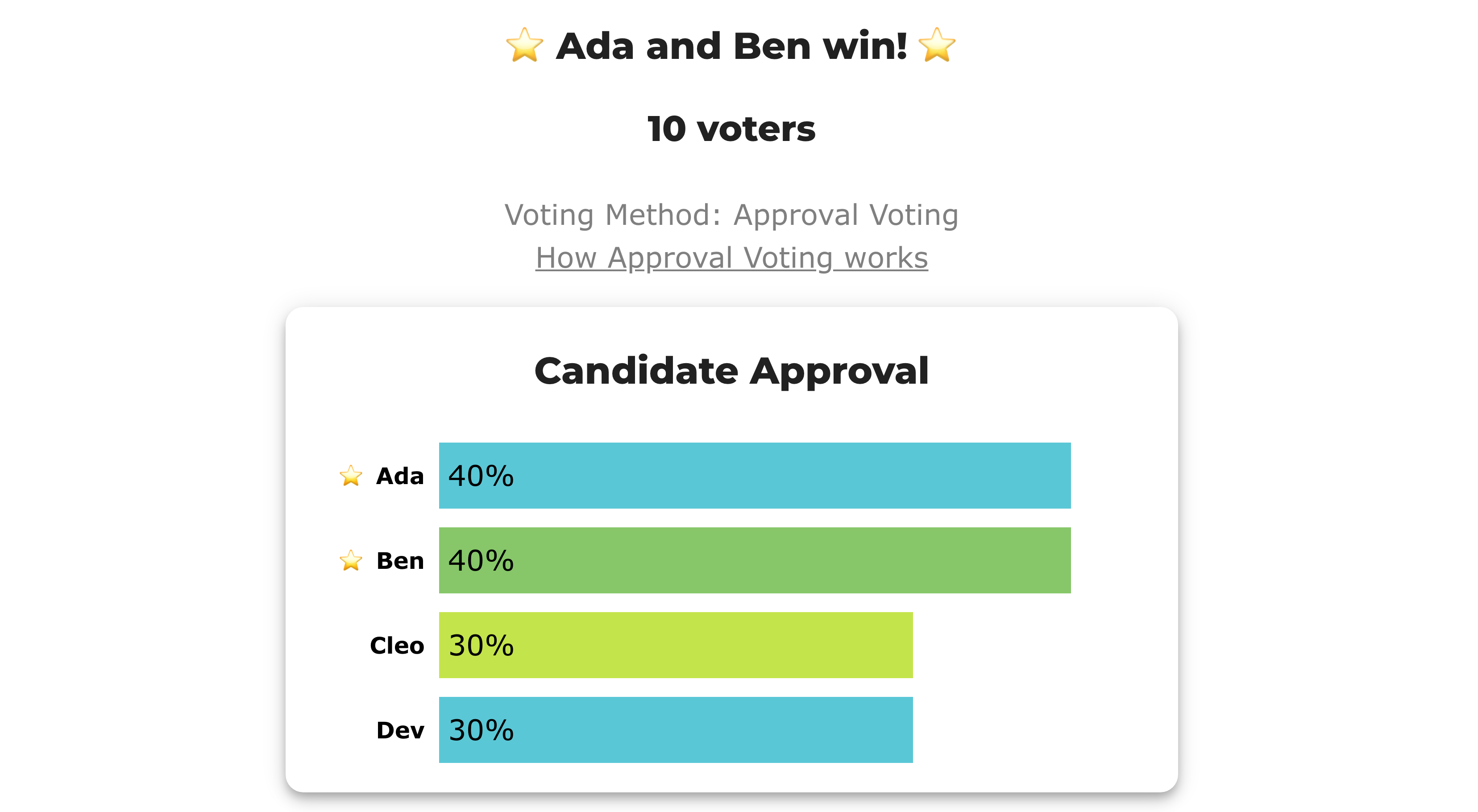
Brams & Kilgour's own worked example (Satisfaction Approval Voting, MPRA 22709, §2 — the proof of their Proposition 2), run live. Ten voters, four candidates, two seats. Bloc Approval seats Ada and Ben; SAV seats Cleo and Dev — not one candidate in common, from identical ballots. The live election carries the three methods BetterVoting can tabulate, and the question it settles is whether they agree with each other.
▶ Live on BetterVoting: vote · results ↗ (election 4hfwqd).
Reference files: LH case approval_sav_disjoint_c4_b10_brams_kilgour.yaml · full generated report · frozen export …_bv_export.json. Concept page: Satisfaction Approval Voting. Created via create_bv_test_election.py.
The election¶
Ten voters, two seats. Four approve a two-person slate; six bullet-vote:
| voters | approve |
|---|---|
| 4 | Ada, Ben |
| 3 | Cleo |
| 3 | Dev |
The one thing that changes between the two counts is what a mark is worth:
| Ada | Ben | Cleo | Dev | elects | |
|---|---|---|---|---|---|
| Approval (AV) — one vote per mark | 4 | 4 | 3 | 3 | Ada, Ben |
| SAV — one vote per ballot, split | 4×½ = 2 | 4×½ = 2 | 3×1 = 3 | 3×1 = 3 | Cleo, Dev |
The four slate voters marked two names each. Under AV that is two whole votes; under SAV it is one vote in halves — and a half was not enough to beat a bullet vote.
View 1 — BetterVoting, three methods¶
BetterVoting has no SAV tabulator, so the live election runs the three methods that do read this electorate, all bloc at two seats. The STAR and ranked ballots add a within-slate preference the approval ballot cannot express (3 of the 4 slate voters prefer Ada); the approval sets are exactly the paper's.
| Race | Method | Elected | BV's tieBreakType |
|---|---|---|---|
| 1 | Approval (bloc, 2 seats) | Ada, Ben | none |
| 2 | STAR (bloc, 2 seats) | Ada, Ben | random — see below |
| 3 | Ranked Robin (bloc, 2 seats) | Ada, Ben | none |
All three agree. That is the finding worth having: the disagreement is not "bloc Approval versus everything else," it is SAV versus everything else. Whatever SAV is doing here, no method in ordinary use does it.
The random flag on race 2 is honest and harmless. In the second STAR round Cleo and Dev tie at 15 points for the second finalist slot, so BetterVoting draws for it — but Ben beats either finalist in the runoff, 4–3. The winner set is independent of the draw, which is why this case is publishable rather than lot-dependent.
View 2 — the LH engine¶
--- Approval Voting (2 winners) ---
 Tabulating 10 ballots (any non-zero score = approval).

Ballots:
   columns = Ada, Ben, Cleo, Dev      (1 = approve; 0 = not approved)
     4 × 1,1,0,0
     3 × 0,0,1,0
     3 × 0,0,0,1

   Ada  -- 4 (40%) -- Elected
   Ben  -- 4 (40%) -- Elected
   Cleo -- 3 (30%)
   Dev  -- 3 (30%)

[Approval Distribution] (how many candidates each ballot approved)
   14 approvals across 10 ballots — average 1.4 of 4 (range 1–2).
     approved 1: 6 ballots
     approved 2: 4 ballots

[Co-Approval Matrix]
 Of the voters who approved the ROW candidate, the % who ALSO approved the COLUMN candidate.
         |  Ada   |  Ben   |  Cleo  |  Dev   |
   -------------------------------------------
   Ada   |   --   |  100%  |   0%   |   0%   |
   Ben   |  100%  |   --   |   0%   |   0%   |
   Cleo  |   0%   |   0%   |   --   |   0%   |
   Dev   |   0%   |   0%   |   0%   |   --   |

Winners — Approval Voting (2 winners)
  Ada, Ben
View 3 — SAV, off-platform¶
SAV is one of Lackner's abcvoting rules, so the same file counts under it directly:
python 06_Other/abcvoting_tabulation_engine/abc_tabulation.py \
  04_Approval/02_Examples/multiwinner/cases/approval_sav_disjoint_c4_b10_brams_kilgour.yaml \
  --rules av,sav,pav,seqpav,cc,seqphragmen
   av           Approval Voting (AV)                 ->  Ada, Ben
   sav          Satisfaction Approval Voting (SAV)   ->  Cleo, Dev
   pav          Proportional Approval Voting (PAV)   ->  Ada, Cleo | Ada, Dev | Ben, Cleo | Ben, Dev   [4 tied]
   seqpav       Sequential PAV (seq-PAV)             ->  Ada, Cleo
   cc           Approval Chamberlin-Courant (CC)     ->  Ada, Cleo | Ada, Dev | Ben, Cleo | Ben, Dev   [4 tied]
   seqphragmen  Phragmén's Sequential Rule           ->  Ada, Cleo
The finding¶
Three answers from one set of ballots, and each is right about something different:
- Ada + Ben (Approval, STAR, Ranked Robin) — the two candidates the most voters can live with. Represents 4 of 10 voters.
- Cleo + Dev (SAV) — represents 6 of 10. This is the paper's argument: bloc Approval "can fail to reflect the diversity of interests in the electorate," and here it demonstrably does.
- One from each side (PAV, seq-Phragmén, CC) — the proportional answer. A 40% bloc holding 2 seats is entitled to about 0.8 of them, so one seat is the honest share. Neither AV's two nor SAV's zero is proportional; they miss in opposite directions.
The seat the slate voters were owed is one. AV gave them two, SAV gave them none, and only the proportional rules gave them one — which is the cleanest statement of what "semi-proportional" costs.
See also¶
- Satisfaction Approval Voting (301) — the method, the authors' own counter-examples, the clone inversion, and a claim-check of the widely-copied Wikipedia retelling of this example.
- BV2272 — the coverage case, the same paper's Proposition 5, where SAV seats the only pair that represents everybody.
- ABC rules & the utilitarian–egalitarian spectrum (301) · Approval — multi-winner.