Ballot & Terminology Basics
The four ideas people most often get wrong about voting methods — a short, four-step reading path. Read in order, or jump to whichever myth you're clearing up.
→ New to the library? The front door is 00_START_HERE. This page is the ballot-types & terminology primer — the cluster of confusion hiding behind the word "RCV." For the deeper "what is a ballot vs. a count" foundation, see What is a voting method? — a ballot and a count (its spoken companion is the conversation version).
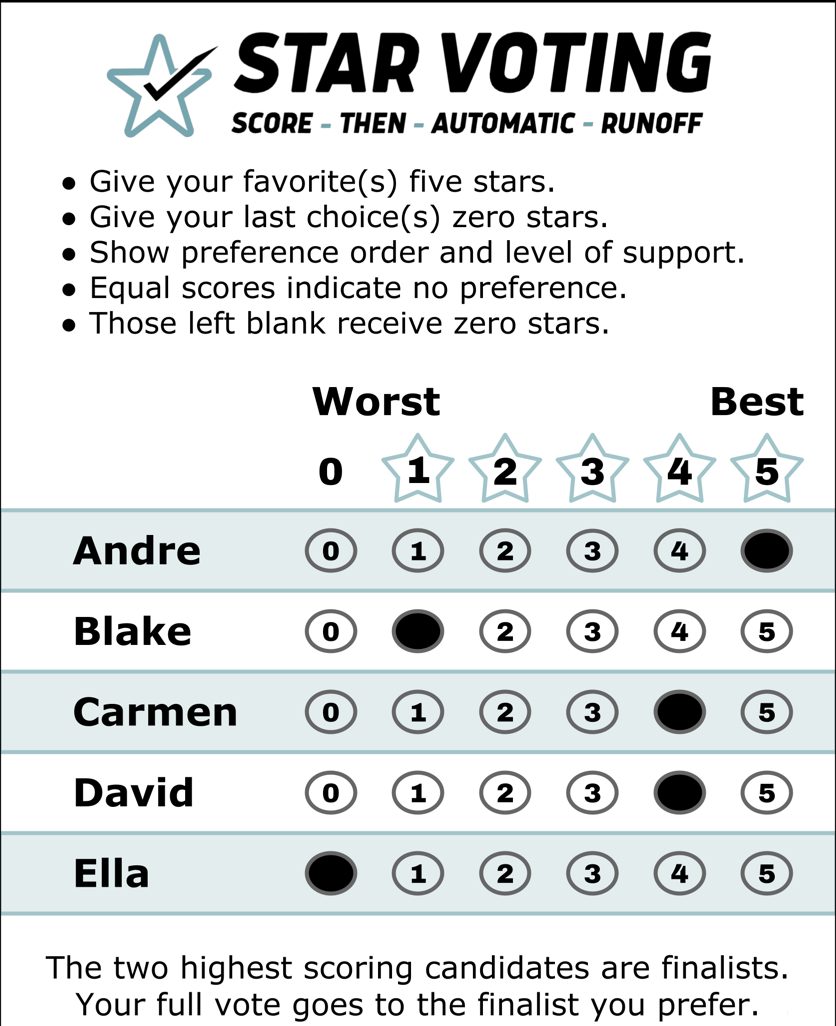
That's a score ballot — you rate each candidate 0–5 (order and strength), equal scores are allowed (both a 5 = Equal Support in the runoff), and a blank counts as 0. It is not a ranked ballot. Keeping those straight is exactly what myths 2 and 3 below are about. It's used by STAR (score, then an automatic runoff).
Most confusion about "RCV" comes from four mix-ups: a slippery name, mistaking scores for ranks, lumping in methods that aren't ranked at all, and assuming every ranked ballot works like the next. These four steps, read together, fix that.
The reading path
1. RCV vs. IRV vs. RCV-IRV — a note on terminology "Ranked Choice Voting" is an umbrella term, not one method. In the US it almost always means RCV-IRV (Hare). Start here so the words mean the same thing for everyone.
2. Scores vs. ranks — don't confuse ranks and ratings The core ballot distinction. A rank captures order only ("which do you prefer?"); a score/rating captures order and strength ("how much?"). Relative vs. absolute preference — and why they can crown different winners.
3. Scoring methods aren't RCV Approval and STAR are often lumped under "RCV," but they don't use ranked ballots at all — they're scoring (cardinal) methods, outside the ranked-voting family entirely.
4. Strict vs. weak ranks Even among ranked methods, the rules differ. Many allow equal ranks and compare candidates head-to-head (that's Ranked Robin / Condorcet) — RCV-IRV does neither. Clears up the most common false assumptions about RCV ballots.
One-screen summary
| Idea | The myth | The reality | Page |
|---|---|---|---|
| Terminology | "RCV = one method" | RCV is a family; US "RCV" = RCV-IRV (Hare) | the naming problem |
| Scores vs. ranks | "Rating ≈ ranking" | Rank = order only; score = order + strength | scores vs. ranks |
| What's even ranked | "STAR/Approval are RCV" | They're scoring methods, not ranked | scoring ≠ RCV |
| Strict vs. weak | "All ranked ballots act alike" | IRV forbids equal ranks & isn't pairwise; others allow/are | strict vs. weak ranks |
Where to go next
Want to see the ballots rather than read about them? Alternate ballot styles puts this same cast (Andre, Blake, Carmen, David, Ella) on a ranking, a yes/no, and a scoring ballot side by side, so you can watch what each style keeps and drops.
These four are the vocabulary. For what the choices actually do to outcomes, see the mechanism pages: center squeeze, monotonicity, summability, exhausted ballots, residual vote-splitting, and tabulation step by step. For the two methods compared head-to-head, see RCV-IRV vs. STAR.
And the problem all these methods are trying to fix: the spoiler effect and the plurality (choose-one) status quo it comes from. Front door & full index: 00_START_HERE · README.