Weak ranks — equal ranks allowed
A weak ranking lets you mark two candidates equal — "I like these two the same." (Formally: a weak order, or "order with ties.") Ranked Robin and the other Condorcet methods allow it; RCV-IRV (Hare) does not.**
→ The full contrast: strict vs. weak ranks · the other kind: strict ranks
What it means
On a weak-ranked ballot you may give two (or more) candidates the same rank. You're never forced to invent a preference you don't feel — if two candidates are equally good to you, you say so.
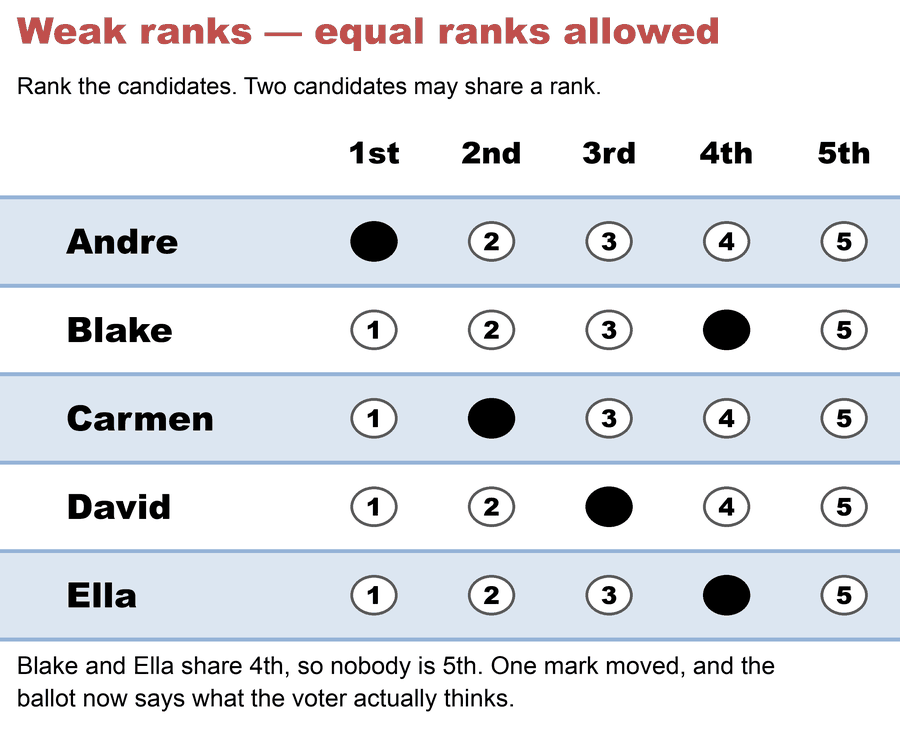
That's the same voter as on the strict ballot, with exactly one mark moved: Ella slides from 5th up to 4th, joining Blake. Two filled bubbles in one column is the whole difference — and the 5th column empties out, because once two candidates share 4th there is no 5th place to give.
In the PrefLib data taxonomy these are the TOC / TOI types (Ties allowed, Complete or Incomplete).
Which ranked methods allow it? Condorcet methods — Ranked Robin, Schulze, Ranked Pairs, Minimax — allow equal ranks and compare candidates head-to-head. Borda and Bucklin usually allow ties too. RCV-IRV (Hare) and STV do not — on those a tie is an overvote.
That last line is a fact about every jurisdiction that runs instant runoff, but it is a design choice, not a mathematical necessity. IRV can be extended to weak orders, in two natural ways, and a 2024 result proves they are not equally good — the one that keeps independence of clones is not the one organizations actually deploy. See RCV-IRV with equal ranks, with six runnable cases.
Why it matters
- Honest indifference. A voter can express "no preference" between two candidates instead of guessing an order.
- More expressive, less noise. Forcing a strict order records distinctions voters don't actually feel; equal ranks remove that pressure.
- It's what people wrongly assume RCV allows. Marking ties is a feature of other ranked methods, not the RCV-IRV that's on US ballots — a common surprise.
Weak ranks still only capture order, not strength — a second choice "could be as good as your favorite or almost as bad as your last choice," and even a weak ballot can't tell the difference. Scores can: scores vs. ranks.
Related
- Strict vs. weak ranks — the head-to-head, with the method table
- Strict ranks · Scores vs. ranks
- Ranked Robin — the Condorcet method that allows equal ranks and compares pairwise