The Ranked Ballot
One ballot style, many counts. A ranked ballot asks one question — "put the candidates in order" — and that single design choice fixes what any method downstream can ever know about you: your order, never your strength. This page is the anatomy of the ballot itself; its twin is the score ballot, and the side-by-side comparison is alternate ballot styles.
→ Companions: scores vs. ranks (the core distinction) · strict vs. weak ranks · the ranked-ballot method zoo (fifteen ways to count this one ballot) · terminology canon: TIPS_terminology
What it looks like
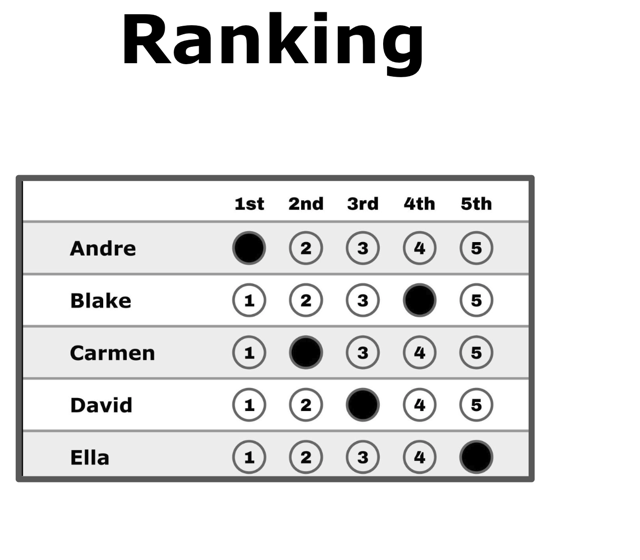
One row per candidate, one column per rank. This voter says: Andre first, then Carmen, then David, then Blake, and Ella last.
It's the same voter, the same opinion, as on the score ballot — line the expressions up and you can see what each style keeps:
| Candidate | Ranking (this page) | Yes/No | Score 0–5 |
|---|---|---|---|
| Andre | 1st | ● | 5 |
| Blake | 4th | ○ | 1 |
| Carmen | 2nd | ● | 4 |
| David | 3rd | ● | 4 |
| Ella | 5th | ○ | 0 |
Notice the middle of the field: the voter feels Carmen = David (both 4s), but this ballot has to call one of them 2nd and the other 3rd. The full side-by-side walk-through is alternate ballot styles.
The grid rules — and how they bite
A ranking is a grid constraint: on the common strict ballot, one mark per row and one per column. That coupling between rows is what makes the ranked ballot fussier to fill out than it looks:
- Duplicate ranks (an "overvote") — mark two candidates 2nd and, in most US RCV-IRV rules, that portion of your ballot (or all of it) is void. You weren't allowed to feel a tie.
- Skipped ranks — jump from 2nd to 4th and jurisdictions differ: some ignore the gap, some stop reading your ballot right there.
- Rank caps — many real ballots only offer 3–5 rank columns in a large field. Whatever you couldn't rank, the count treats as silence — a ballot-format path into exhausted ballots.
These aren't hypotheticals: reported spoilage runs roughly 4–9% for ranked ballots vs. 0–2% for rated ballots (see scores vs. ranks), and the errors fall hardest on voters with the least practice navigating grids.
What it captures — and what it throws away
A ranking records relative order only. It cannot say how much you prefer 1st over 2nd, and it spaces every rung equally even when the voter feels a cliff: this voter's real feeling might be "Andre, Carmen, David all great; Blake and Ella, no" — but 1st/2nd/3rd/4th/5th flattens that cliff into a smooth staircase. Any method that later needs strengths has to invent them (that's Borda, and why rank→score conversion fabricates information — the fidelity ladder).
Strict vs. weak is the one ballot-design fork inside the ranked family: a weak ranking allows equal ranks (A = B), a strict one forbids them. Ranked Robin happily reads weak rankings; typical US RCV-IRV ballots are strict, which is exactly the "forced to invent a preference" problem. Full story: strict vs. weak ranks.
One ranked ballot, many tabulations
This is the repo's core terminology point: RCV names the ballot, not the count. The identical grid above can be tabulated by:
| Count it with | Family | Notes |
|---|---|---|
| RCV-IRV (Hare) | elimination rounds | what "RCV" usually means in the US |
| Ranked Robin | Condorcet / round-robin | reads every pairwise matchup; allows equal ranks |
| STV | proportional | multi-winner transfers (STV vs proportional STAR) |
| Borda, Bucklin, and a dozen more | positional & hybrids | the method zoo runs 15+ on one screen |
Different tabulations of the same ballots routinely elect different winners — which is why "the ballots decided" is never the whole story. See what is a voting method? — a ballot and a count.
Related
- The score ballot — the twin page: independent 0–5 values instead of an order
- Alternate ballot styles — the same voter on ranking / Yes-No / scoring, side by side
- Scores vs. ranks — why order and strength are different data
- Exhausted ballots — where unranked finalists end up under IRV
- Which RCV-IRV? · Glossary:
ranked ballot