"Nuanced" — the full range, honestly
Level: 101 · for voters
A 5 where you love, a 1 where you don't, a genuine tie where you're torn, a blank where there's nothing to say. The ballot used the way it was designed.
← One of thirteen voting styles. Every style is legal and counted; this page is what this one means, when it fits, and what it trades away.
What this ballot says
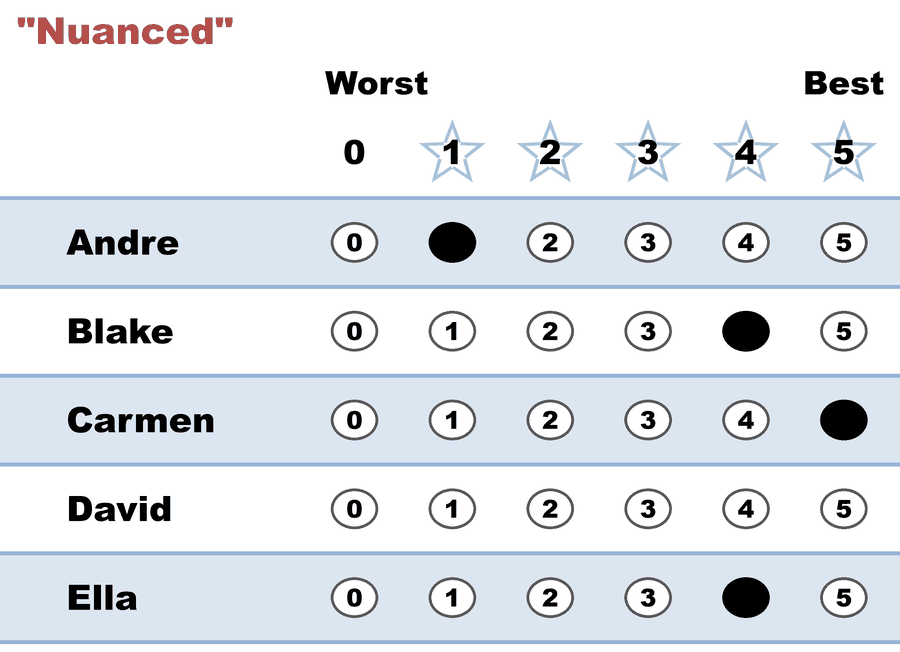
"Carmen first; Blake and Ella both strong — and I truly can't split them; Andre barely; David no." The equal 4s are the signature move: a real tie, recorded as one, because equal scores are allowed and no rule forces you to invent a preference you don't feel.
When it fits
- Always — this is the style the instructions on the ballot are steering you toward: favorite at 5, worst at 0 or blank, everyone else wherever they honestly land.
- Especially in big fields, where "compare each candidate against your two anchors" is fast, and a forced full ranking would be real work.
The trade-off, honestly
There barely is one — that's the point of this page sitting beside the others. This ballot maximizes what the count can hear from you: full weight at the top, real distinctions where you feel them, none where you don't. The one consequence worth knowing: any two candidates you scored equally are an Equal Support pair if they both reach the runoff — you told the count you're happy either way, and it takes you at your word. That's not a flaw; it's your tie, honored.
This exact style in a real election
In the runnable style-gallery election, the nuanced row is 3,4,0,3,1,5 — full range, with an honest 3–3 tie for two mid-field candidates. Bianca (4) and Frank (5) became the finalists, and the ballot's runoff vote went to Frank — this voter's true favorite — by the 5-over-4 gap. Every distinction it recorded got used; the one tie it declared was between two candidates who didn't make the final anyway.
Related
- Ranked — what this ballot looks like when you don't allow yourself ties
- Scores vs. Ranks — why ratings carry more honest information than forced rankings