"Approval-style" — only 0s and 5s, across the whole field
Level: 101 · for voters
Every candidate gets either full marks or nothing. A yes/no threshold, drawn wherever you choose to draw it.
← One of thirteen voting styles. Every style is legal and counted; this page is what this one means, when it fits, and what it trades away.
What this ballot says
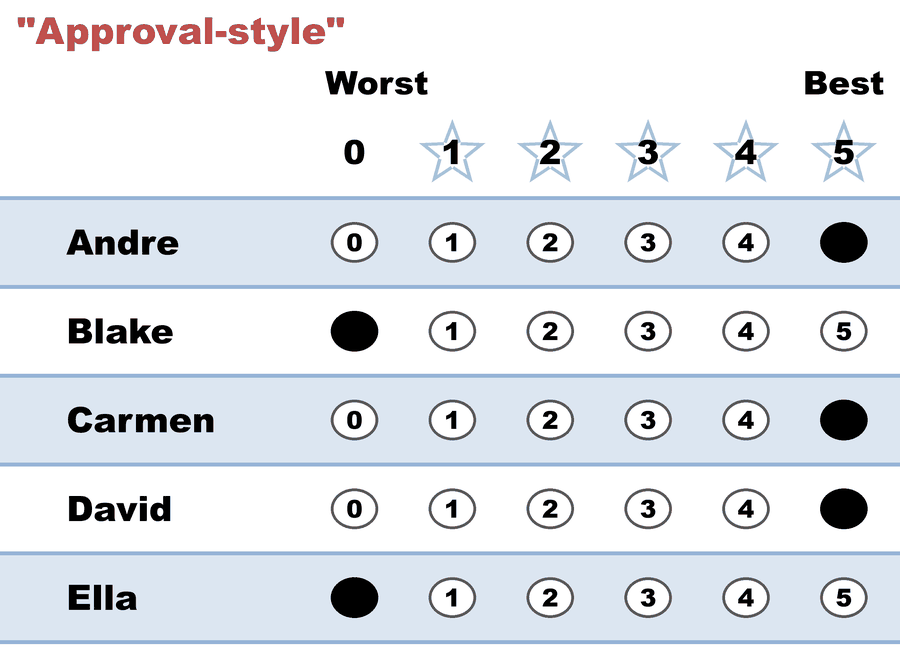
"Andre, Carmen and David are acceptable. Blake and Ella are not." No middle, no ordering — one line drawn across the field, with everyone above it at 5 and everyone below it at 0. It is a STAR ballot filled out as an Approval ballot, and the count accepts it without complaint.
Worth separating from the Partisan style, which produces similar-looking marks for a different reason. Partisan is about a team — my side, all of them, none of yours. Approval-style is about a threshold: this voter might well have put two rivals from opposing camps above the line and left a nominal ally below it. Same marks, different question answered.
When it fits
- Your honest opinion really is a cliff rather than a slope — some candidates are qualified and the rest are not, and the gaps within each group don't feel real to you.
- You want maximum weight behind everyone you like: a 5 pushes a candidate toward the final harder than a 4 does, and this ballot spends the maximum on every candidate it supports.
- You're deciding quickly, or in a large field, and you trust your yes/no judgement more than your ability to rank fine distinctions.
The trade-off, honestly
This ballot is loud in the first round and silent in the second. In the scoring round it spends every point available to it, so it has the most possible influence over who reaches the final. But STAR then asks a second question — which of these two finalists do you prefer? — and a ballot with only 0s and 5s often has no answer. If two of your 5s become the finalists, it lands as Equal Support: you helped choose the matchup and then declined to call it. Same story if two of your 0s make the final.
The fix costs nothing and requires no strategy: keep the threshold, but break the tie at the top. Give your genuine favorite the 5 and your next-best approved candidate a 4. Every candidate you approve of still gets near-maximum scoring-round weight, and now the runoff has something to work with. That single point is the difference between voting in the final and watching it.
This exact style in a real election
In the runnable five-more election, the approval-style row is 5,0,5,0,0 — Alice and Clara above the line, Bruno, Diego and Erin below it. Both of this ballot's 5s became the finalists, so it sat out the Clara-versus-Alice runoff as Equal Support: the two candidates it had done the most to promote were the two it then had nothing to say about.
A whole election of these ballots has its own case: STAR à la Approval, where every voter scores only 0 or 5 and the scoring round becomes a plain approval count.
Related
- STAR à la Approval — an entire election cast in this style
- Partisan — the same all-or-nothing marks, drawn around a team instead of a threshold
- Decent Backup — the one-point change that keeps the runoff vote
- Approval Voting — the method this ballot is borrowed from
- STAR's Automatic Runoff — where Equal Support ballots land