"Ranked" — using each score once, like a ranking
Level: 101 · for voters
5, 4, 3, 2, 1 — every score used exactly once, top choice to last. A ranking, volunteered onto a scored ballot.
← One of thirteen voting styles. Every style is legal and counted; this page is what this one means, when it fits, and what it trades away.
What this ballot says
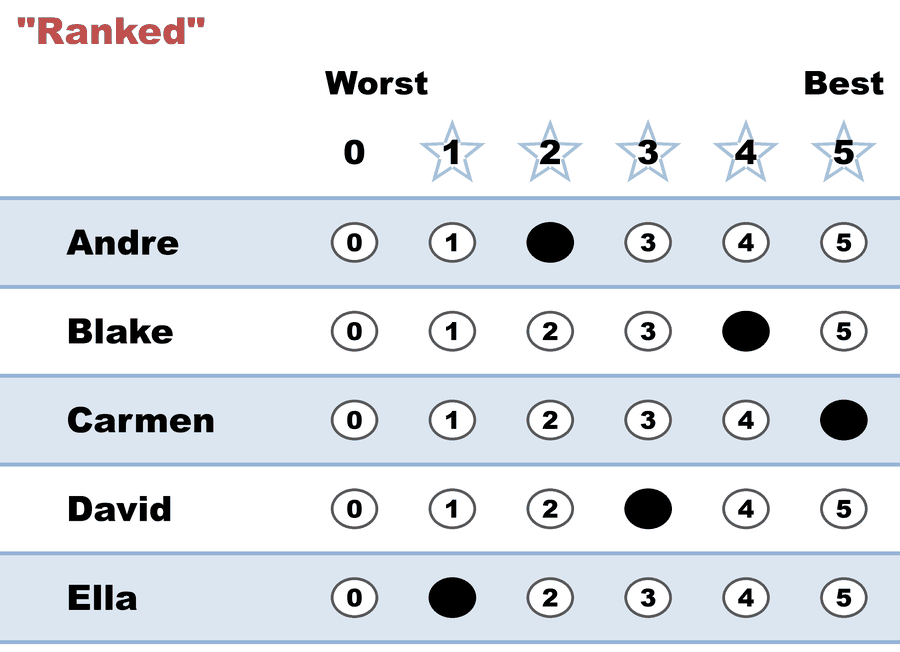
"Carmen > Blake > David > Andre > Ella." By spending each score exactly once, the voter has written a strict 1st-through-5th ranking in stars. STAR reads it happily — every gap is a real preference in the runoff, and the scoring round hears a clear spread.
When it fits
- You come from ranked-choice voting and this is the mental model you trust — it transfers directly, nothing about it is wrong.
- Your preferences genuinely are evenly spaced, one clear step between each candidate — then this ballot is not just legal but exact.
The trade-off, honestly
You've volunteered a constraint the ballot doesn't impose. A ranking must invent a difference between every pair — even two candidates you honestly can't split — and must space all differences equally, even when your real gap between 1st and 2nd is a hair and between 2nd and 3rd is a canyon. That's the core scores-vs-ranks distinction: a rating carries order and strength; a forced ranking carries order and manufactures the rest. The Nuanced style says everything this one says, plus the ties and true distances — with less effort, because you never break a tie you don't feel.
This exact style in a real election
In the runnable style-gallery election, the ranked-style row is 2,5,0,3,1,4 — a full six-way ranking (Bianca > Frank > Desi > Allen > Edith > Chris). Bianca and Frank became the finalists, and the ballot's runoff vote went to Bianca (5 over 4) — the ranking's top preference, honored exactly.
Related
- Nuanced — more information, less work: the ballot rankings wish they were
- Scores vs. Ranks — don't confuse ranks and ratings; the distinction this style blurs