"Partial Ballot" — score the ones you know, leave the rest
Level: 101 · for voters
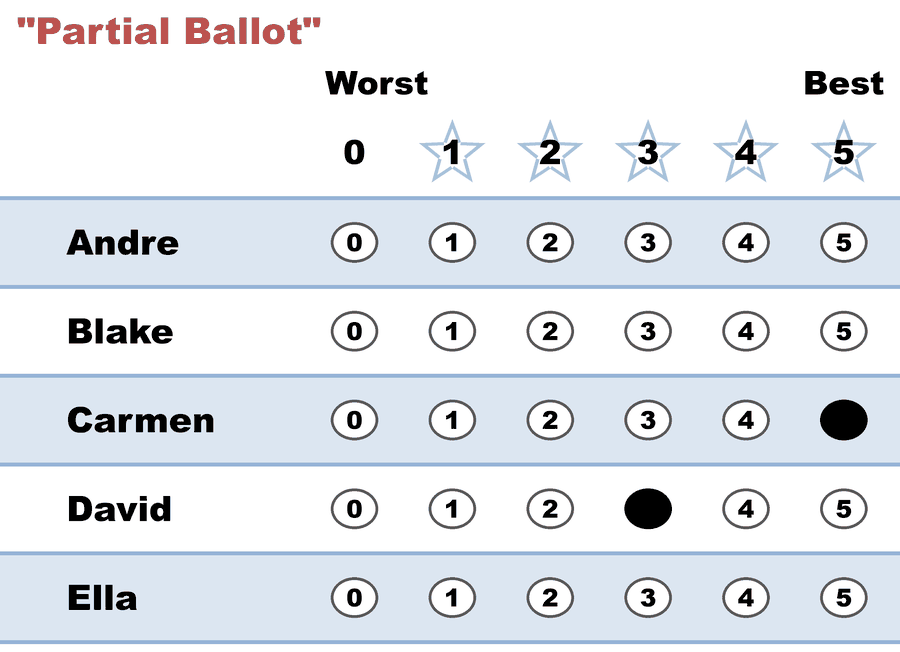
Two candidates you've actually heard of get real scores. The others stay blank, because you have no opinion to give them.
← One of thirteen voting styles. Every style is legal and counted; this page is what this one means, when it fits, and what it trades away.
What this ballot says
"Carmen I like, David is decent, and I genuinely don't know the other three." This isn't a statement about the field — it's a statement about the voter's information. It's probably the most common ballot in any real down-ballot race, and it's completely legal: no skipped row can spoil a STAR ballot.
It's worth distinguishing from Traditional, which looks similar in the marks. A traditional bullet vote is a decision — this one, nobody else. A partial ballot is a gap in knowledge. The count can't tell them apart, which is exactly what the next section is about.
When it fits
- Long ballots and down-ballot races — judicial retention, water boards, at-large council seats — where nobody has met most of the candidates.
- Large primary fields where you know the three names from the news and none of the other eleven.
- Any race where you'd rather record a small honest opinion than a large invented one.
The trade-off, honestly
Here is the part that surprises people: a blank is not an abstention from that candidate — it's a zero. The ballot's printed rules say so plainly ("those left blank receive zero stars"), and the count applies them literally. So a row you left empty because you'd never heard of the candidate lands on the tally in exactly the same place as a row you deliberately scored 0 to say "this one, never."
That's not a flaw to be fixed — a score has to be some number, and there's no neutral value available (see abstention vs. zero vs. NOTA for why "no opinion" can't simply be left out of an average). But it does mean the choice is yours to make deliberately: if you'd rather not push an unknown candidate to the bottom of the field, give them a middle score instead of a blank. Leave the row empty when "I don't want this one" is true; use a 2 or a 3 when the honest statement is "I don't know."
This library's YAML files keep the distinction visible even though the arithmetic doesn't — - for a blank, ~ for a race abstention, & for a candidate abstention. All three tabulate as 0 and all three are reported separately, so a reader can always see which zeros were opinions and which were silences.
This exact style in a real election
In the runnable five-more election, the partial row is -,-,5,3,- — Clara 5, Diego 3, and blanks for Alice, Bruno and Erin. Alice went on to become a finalist, losing the runoff to Clara. This ballot contributed a 0 to Alice's score total and then cast a full runoff vote against her — all from a voter whose actual opinion of Alice was that they had never heard of her. The ballot did no harm to its own goals (Clara won), but it's a clean illustration of a blank doing real work.
Related
- Traditional — the same sparse marks, made as a decision rather than a gap
- Compressed Middle — what "I don't know" looks like when you score it instead of skipping it
- Abstention vs. zero vs. NOTA — why there's no neutral score to give