Ballot expressiveness — one electorate, five papers
→ The topic page: What the ballot can and cannot say · the rates: Condorcet efficiency, measured · the sibling worked election: the crowded field · Level: 301 · deep dive
▶ Live on BetterVoting: vote · results ↗ (election 37yf8x, BV2280 — four of these five papers, one race each).
One line: twenty-five voters, nine candidates, and five different ballots — and the winner changes twice, once because the paper changed and once because the count did.
Every case in this folder is the same electorate. Voters and candidates sit at frozen positions on a single left–right spectrum, and every ballot is derived from those positions by a stated rule (build_cases.py) — nothing hand-written, nothing tuned. Finn beats all eight rivals head-to-head, so Finn is the Condorcet winner and the electorate's answer is fixed. The only thing that varies is what a voter is allowed to write down.
| Ballot | Count | Winner | On BV | |
|---|---|---|---|---|
| 0–5 scores | STAR | Finn | ✅ the Condorcet winner | ✔ |
| ranks all nine | Ranked Robin | Finn | ✅ the control | ✔ |
| ranks only five | Ranked Robin | Gus | ❌ the cap lost the answer | ✔ |
| ranks all nine | RCV-IRV | Ben | ❌ the count lost the answer | ✔ |
| ranks only five | RCV-IRV | Ben | ❌ unchanged — already lost | — |
Read the table down the middle column and the whole lesson falls out.
Three independent engines agree on every row. The LH engine tabulates all five; BetterVoting independently tabulates the four it carries and reports tieBreakType: none throughout; and both Ranked Robin rows are additionally cross-checked against pref_voting's Copeland, a library nobody here wrote. The frozen export is bv2280_37yf8x_bv_export.json.
On BetterVoting the rank cap is not a description, it is enforced — race 3 sets max_rankings: 5, so a voter filling it in actually runs out of places to put Finn. That is the whole point of minting it rather than only simulating it. (The fifth paper stays LH-only: it is the control that changes nothing, and did not earn a permanent public race.)
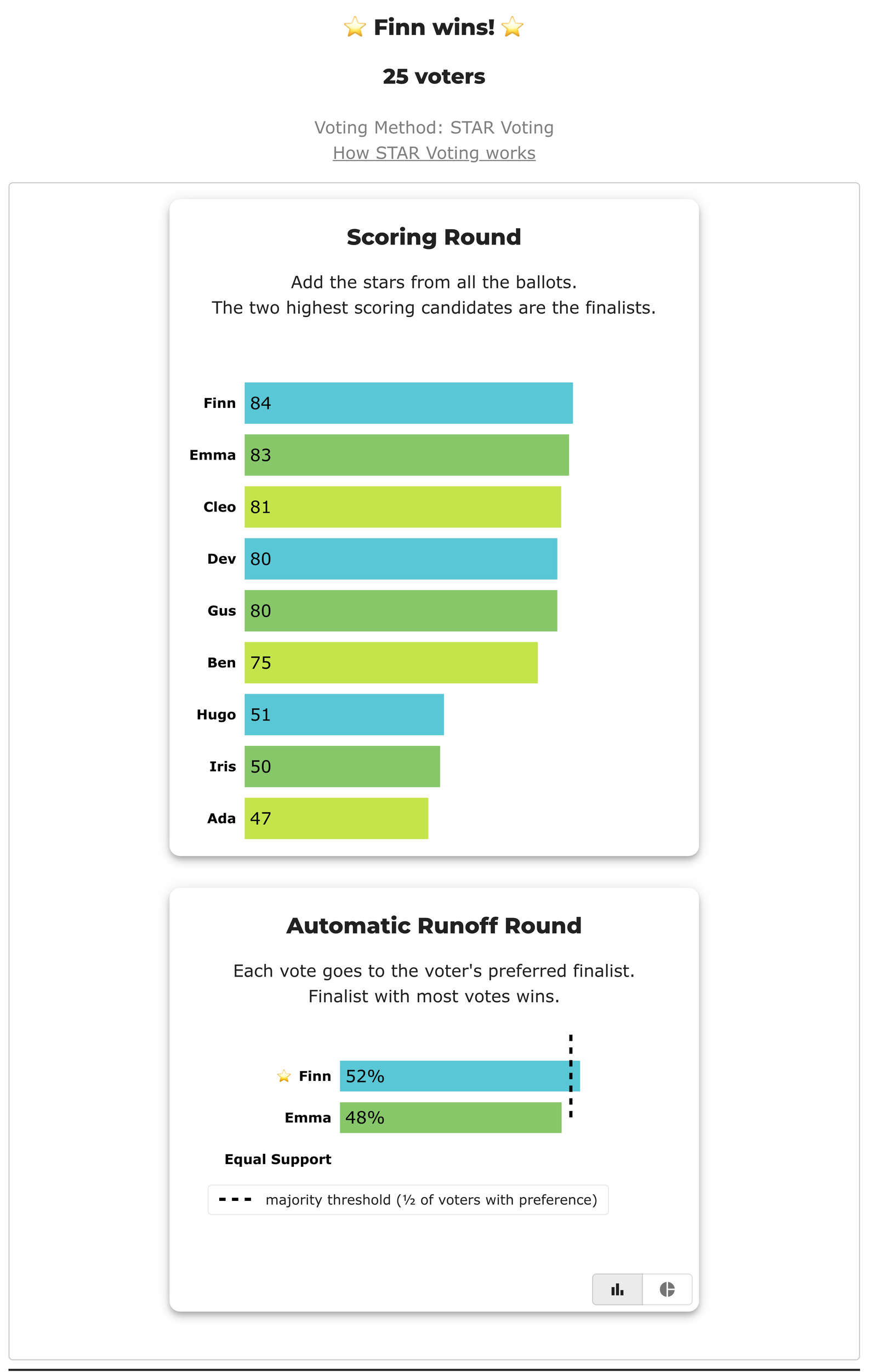
BetterVoting's STAR numbers are the LH engine's, line for line — scoring round 84/83/81/80/80, runoff Finn 13–12 with nobody at Equal Support.
The two things that are usually confused
Rows 2 and 3 differ only in the paper. Same voters, same Ranked Robin rule, same everything — except each voter may name five candidates instead of nine. That alone moves the winner from Finn to Gus. On the capped paper Finn's record falls from 8–0 (margin +38) to 5–1–2t (margin +11), not because anyone changed their mind but because only 16 of the 25 voters can fit Finn into five names at all. For the other nine, Finn is simply not on the paper, and a candidate who is not on the paper wins no head-to-head.
Rows 2 and 4 differ only in the count. Same voters, same full nine-name rankings, same ink. Ranked Robin returns Finn; RCV-IRV returns Ben. The paper cannot be what decided that one — center squeeze is, sharpened by a crowded field: Finn stands in the middle of nine candidates, so the first-choice votes elimination reads are split among the neighbours and Finn is eliminated before the head-to-heads Finn wins are ever consulted.
So "the ballot was not expressive enough" and "the count threw the answer away" are different failures, they hit different methods, and this folder separates them.
The part that surprises people
The ranked ballot is the one usually called more expressive, and at full resolution it is. But no large-field jurisdiction issues a full-resolution ranked ballot: New York City and Maine cap ranked ballots at five names; San Francisco used three for years. Against a realistic cap, the arithmetic reverses.
| On nine candidates | distinct opinions it can record |
|---|---|
| a ranked ballot capped at five | 3,620 |
| a strict ranking of all nine | 362,880 |
| a 0–5 score ballot | 10,077,696 |
The coarse-looking score ballot says something about every candidate. The capped ranked ballot says nothing at all about four of them. That is why row 1 finds Finn and row 3 does not — and it is the half of the expressiveness story that the usual framing leaves out.
The honest limit on that claim is row 5, which is why it is in the folder. Capping the ballot changed Ranked Robin's winner and left IRV's alone — IRV had already lost Finn on the uncapped ballot for an unrelated reason. A rank cap bites a method that reads the whole ballot and glances off one that only ever reads the top of it. "The cap costs you the answer" is a claim about the count as much as the paper.
What the score ballot actually loses
Nine candidates will not fit on six rungs, so every voter here must give at least two candidates the same score — a pigeonhole, not a tendency. But the forced minimum is only 3 of 36 pairs (8.3%), and these voters actually tie about 16%. Most of the flattening is ordinary rounding, not the hard limit.
And in this election it costs nothing: the preference that decides the race — Finn over everyone — survives the rounding, and STAR returns the Condorcet winner from a ballot that cannot even rank the field. The runoff is Finn 13, Emma 12, with zero voters expressing no preference between them.
[Divergence from STAR]
  STAR                   = Finn
  Choose-One (Plurality) = Ada   (differs from STAR)
  Approval               = Emma   (differs from STAR)

--- STAR Voting Method (single winner) ---

[STAR Voting]
 Tabulating 25 ballots.
Count × Ada,Ben,Cleo,Dev,Emma,Finn,Gus,Hugo,Iris
    4 ×   0,  2,   2,  2,   3,   4,  5,   5,   5
    2 ×   4,  5,   4,  4,   4,   2,  2,   0,   0
    2 ×   0,  1,   2,  2,   2,   3,  4,   5,   5
    2 ×   0,  1,   2,  2,   2,   4,  4,   5,   5
    2 ×   0,  2,   3,  3,   3,   5,  4,   2,   2
    2 ×   5,  5,   4,  4,   4,   2,  2,   0,   0
    2 ×   5,  4,   3,  3,   3,   2,  1,   0,   0
    1 ×   5,  4,   4,  3,   3,   2,  1,   0,   0
    1 ×   0,  2,   3,  3,   4,   5,  4,   2,   1
    1 ×   2,  4,   5,  5,   5,   3,  2,   0,   0
    1 ×   0,  2,   3,  3,   3,   5,  5,   3,   3
    1 ×   3,  5,   5,  5,   4,   3,  2,   0,   0
    1 ×   1,  3,   5,  5,   5,   4,  3,   0,   0
    1 ×   0,  2,   3,  3,   3,   5,  5,   2,   2
    1 ×   5,  4,   4,  4,   3,   2,  2,   0,   0
    1 ×   3,  5,   5,  5,   5,   3,  2,   0,   0

[STAR Voting: Scoring Round]
 The two highest-scoring candidates advance to the next round.
   Finn          -- 84 -- First place
   Emma          -- 83 -- Second place
   Cleo          -- 81
   Dev           -- 80
   Gus           -- 80
   Ben           -- 75
   Hugo          -- 51
   Iris          -- 50
   Ada           -- 47
 Finn and Emma advance.

[STAR Voting: Automatic Runoff Round]
 The candidate preferred in the most head-to-head matchups wins.
   Finn          -- 13 -- First place
   Emma          -- 12
   Equal Support --  0
 Finn wins.
   Runoff math:
     25  ballots cast
   −  0  Equal Support (no preference between the two finalists)
     ──
     25  voters with a preference  (majority = 13)
           Finn 13 (52%)  ·  Emma 12 (48%)

[STAR Voting: Winner — STAR Voting Method (single winner)]
 Finn
For an election where the same compression does cost STAR the answer, see the crowded field at rung 7 — that folder is the other half of this one.
Caveats
- A truncated ballot's unstated pairs are a convention, not arithmetic. Here a candidate you left unranked is counted as beaten by everyone you did rank, and tied with everyone else you left off. Other published treatments split that pair half-and-half, and the choice can move a result. It belongs in any quotation of the capped rows.
- Nothing here is settled by a tie-break. That was a search constraint, not luck — an earlier candidate electorate for this folder had an 8–8 IRV elimination tie whose winner flipped between lot rules, and was discarded for it. Every winner above survives any tie-break rule.
- One election is one election. The rates behind it — how often each of these things happens, across four electorate models and field sizes 3 to 11 — are on the topic page, measured rather than argued from this case.
- Sincere ballots throughout. No strategy, no truncation by choice; the cap is imposed by rule, as a real jurisdiction imposes it.
See also: What the ballot can and cannot say · the crowded field · Why more candidates make every method miss · scores vs ranks · strict vs weak ranks · exhausted ballots · method comparisons