BV2263 — Over 50%: single-winner STAR, a candidate with every point on every ballot
Generated from bv2263_xw23m9_over_50_percent.yaml — do not edit by hand. Regenerate: python STARVote_LH_tabulation_engine/tools_adam/scripts/build_yaml_pages.py.
Method: STAR (single winner) · 1 seat · Expected winner: A
▶ Live on BetterVoting: vote · results ↗ (election xw23m9 · test BV2263).
Scenario
The ceiling case, and the control for reading every other STAR result: what a landslide looks like when it is as large as a landslide can get.
Three voters, three candidates. A is scored 5 by all three; one voter gives B a single point; nobody scores C at all. - Scoring round: A = 15 of a possible 15 (100% of the maximum, average 5.0), B = 1, C = 0. A and B advance. - Automatic runoff: all three ballots prefer A. A 3, B 0, Equal Support 0. A wins on every denominator there is — 100% of the maximum score, 100% of the ballots, 100% of the voters with a preference between the finalists.
Two things this case is here to show, both easier to see at the ceiling than in a close race: 1. STAR does not stop early. Even a unanimous max-score candidate is put through the automatic runoff; there is no "wins outright in round 1" shortcut the way a majority of first choices ends an RCV-IRV count in its first round. The scoring round chooses finalists, never the winner. 2. "Over 50%" is three different questions. Score share, ballot share and decided-voter share coincide here and only here; they come apart as soon as a ballot rates the two finalists equally.
The multi-seat twin is BV1815 (02_STAR_Bloc), whose three ballots hand A 12 of 15 and still buy exactly one seat: the second goes to C on 2 points, after a runoff nobody wins. Read the pair together — 02_STAR_Bloc/01_Learn/over_50_percent.md.
Ballots
The ballots as marked — the filled bubble is the score given, and the score is the number in its column:
| # | Ballot as marked | A | B | C |
|---|---|---|---|---|
| 1 | 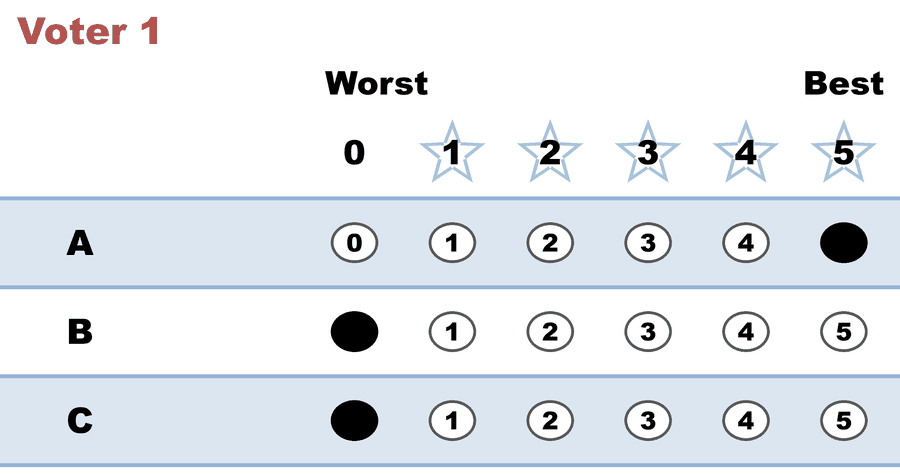 |
5 | 0 | 0 |
| 2 | 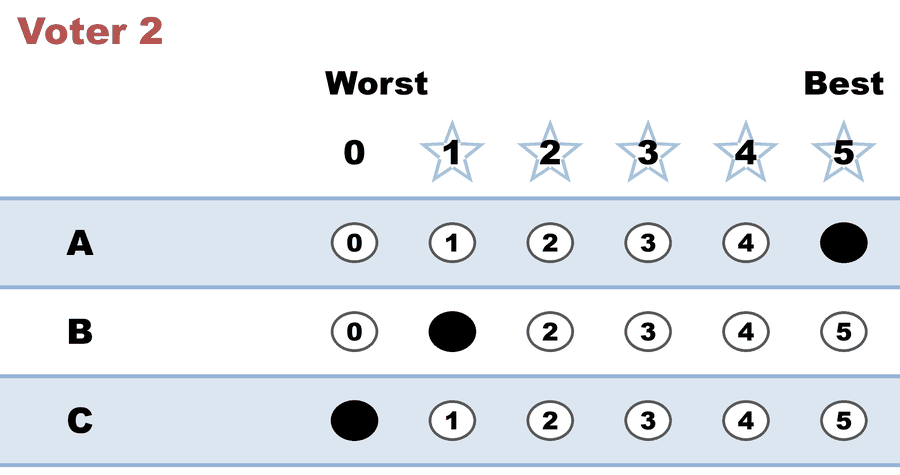 |
5 | 1 | 0 |
| 3 | 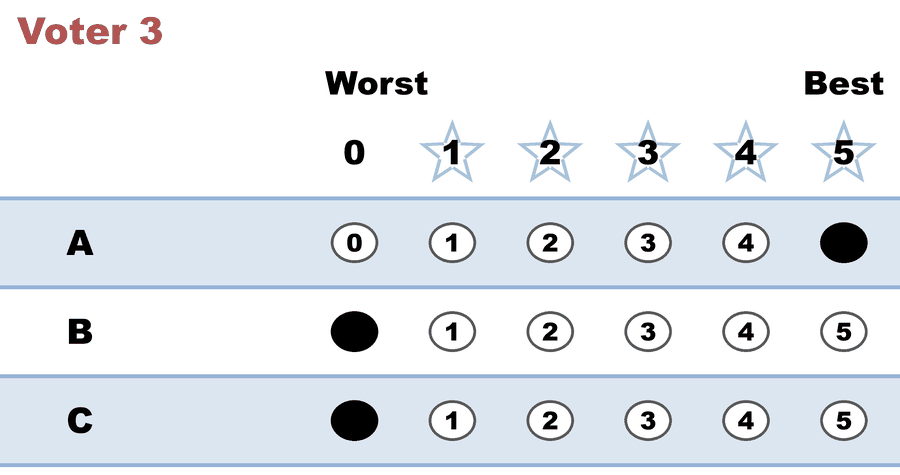 |
5 | 0 | 0 |
The same ballots as the file records them:
Row 1 = candidate names; each later row is one voter's 0–5 scores (a N × prefix = N identical ballots).
A,B,C
5,0,0
5,1,0
5,0,0
What the engine says
The count, step by step — the rounds and how the winner is reached:
--- STAR Voting Method (single winner) ---

[STAR Voting]
 Tabulating 3 ballots.
Count × A,B,C
    2 × 5,0,0
    1 × 5,1,0

[STAR Voting: Scoring Round]
 The two highest-scoring candidates advance to the next round.
   A             -- 15 -- First place
   B             --  1 -- Second place
   C             --  0
 A and B advance.

[STAR Voting: Automatic Runoff Round]
 The candidate preferred in the most head-to-head matchups wins.
   A             -- 3 -- First place
   B             -- 0
   Equal Support -- 0
 A wins.
   Runoff math:
     3  ballots cast
   − 0  Equal Support (no preference between the two finalists)
     ─
     3  voters with a preference  (majority = 2)
           A 3 (100%)  ·  B 0 (0%)

[STAR Voting: Winner — STAR Voting Method (single winner)]
 A
Full audit — preference matrix, Condorcet, and score distribution
--- Runoff (Preference) Matrix ---
Head-to-head / pairwise comparison
Legend: For - Equal Support - Against
        * indicates Top 2 Finalist
               |    * A     |   * B     |     C     |
-----------------------------------------------------
         * A > |    ---     |3 - 0 - 0  |3 - 0 - 0  |
         * B > | 0 - 0 - 3  |   ---     |1 - 2 - 0  |
           C > | 0 - 0 - 3  |0 - 2 - 1  |   ---     |

[Condorcet Winner]
  Condorcet Winner: A — matches the STAR winner

[Condorcet Loser]
  Condorcet Loser: C — loses every head-to-head matchup

[Score Distribution] (how many ballots gave each star rating)
                Score
Candidate  5  4  3  2  1  0  | Total   Avg
A          3  0  0  0  0  0  |    15   5.0
B          0  0  0  0  1  2  |     1   0.3
C          0  0  0  0  0  3  |     0   0.0
Everything in one file: the _tabulated mirror (regenerated on every run; every analysis forced on).
Run it yourself:
python STARVote_LH_tabulation_engine/starvote_larry_hastings.py 01_STAR/02_Examples/cases/bv2263_xw23m9_over_50_percent.yaml
See also
More cases in this set: 02a_c3_b1_three-candidates · 02b_c3_b2_three-candidates · 03a_c3_b3_style-bullet-vote · 03b_c3_b3_1_style-protest-vote · 03b_c3_b3_2_expand_style-protest-vote · 03c_c6_b8_style-gallery · 03d_c5_b5_style-gallery-five-more · 04b_c4_b3_display-options-all · 05a_c5_b3_unanimous-ballots · 06a_c9_b3_large-field-equal-support · 06b_c9_runoff-overturns-leader · 09_c4_b100_tennessee-capital · abstentions · bv2182_tg4779_faq_runoff_reversal · bv2184_fyy886_lunch_vote · bv2187_qrw6wb_ann-bob-cal · bv2256_c8h3tb_traditional_style · csv_ambiguity_ex1_c4_b8 · display_options_demo · equal_support_runoff_demo · quorum_demo_c3_b6 · quorum_fail_demo_c3_b6 · same_mean_different_spread_c2_b5 · star_ala_approval · three_winners_cw_score_runoff · vote_splitting · vote_splitting2 · vote_splitting3 · vote_splitting_scenario1_spoiler · vote_splitting_scenario2_bloc_leads · vote_splitting_scenario3_outsider_wins