Majority Judgment¶
Every voter grades each candidate in a shared language of words — To Reject, Poor, Acceptable, Good, Very Good, Excellent — and the candidate with the highest median grade wins. Not the total, not the average: line each candidate's grades up in order and take the middle one. Michel Balinski and Rida Laraki proposed it in 2011 as a replacement for the whole ranked model, not just for one counting rule.
→ Run it: the 101 case mj_101_c3_b5.yaml · Counted by grade_methods_report.py (pref_voting cross-checked). · The argument: Grading as a rival primitive. · The case against: Majority Judgment's paradoxes. · Family: Approval · Range / Score · STAR.
Non-EVC method. MJ is a rival to STAR from inside the cardinal camp — it argues against summing scores, which is what STAR's Scoring Round does. This library teaches about it rather than promoting it, so it lives in other methods. The honest comparison is the point, and quoting Balinski and Laraki as allies for "score ballots are better" while their book argues against the aggregation rule would not be honest.
How it works¶
The ballot is a grade grid — one column per grade, and the columns are words, not numbers. That is not decoration. Balinski and Laraki's central claim is that a shared vocabulary — the same Excellent you and I both learned from school reports, wine judging and figure skating — carries meaning that a bare 7-out-of-10 does not, and that this common language is what makes one voter's grade comparable to another's.
Here are the five ballots of the 101 case exactly as those voters marked them, each with the grades the file records underneath:
The ballots as marked — the filled bubble is the grade given, and the grade is the word in its column. The grades the file records are repeated under each ballot:
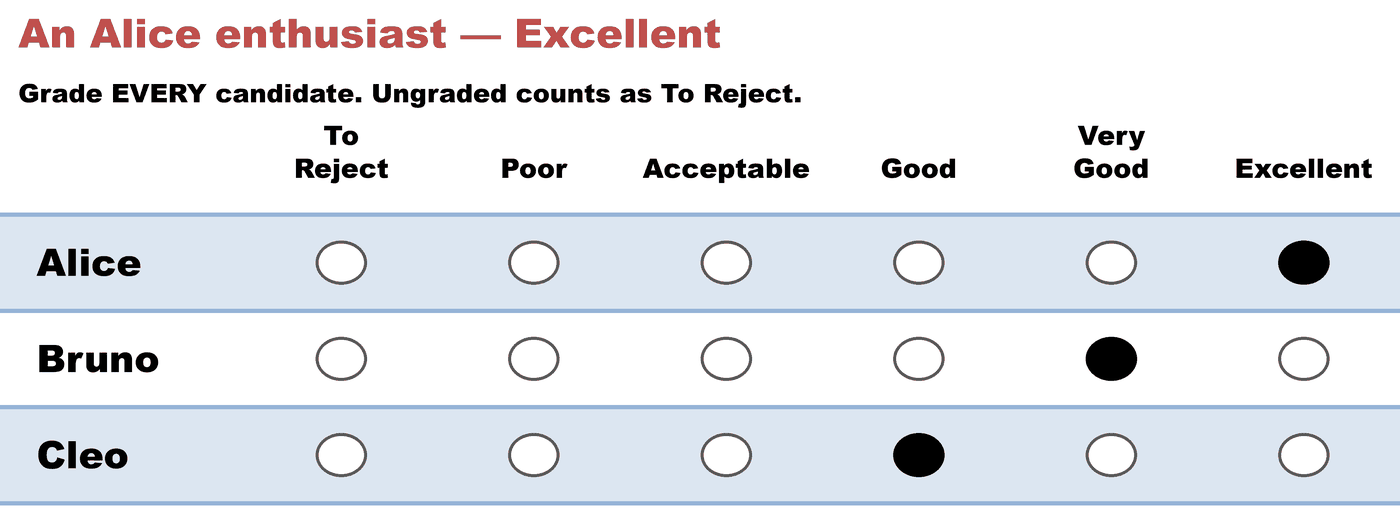
Alice Excellent · Bruno Very Good · Cleo Good
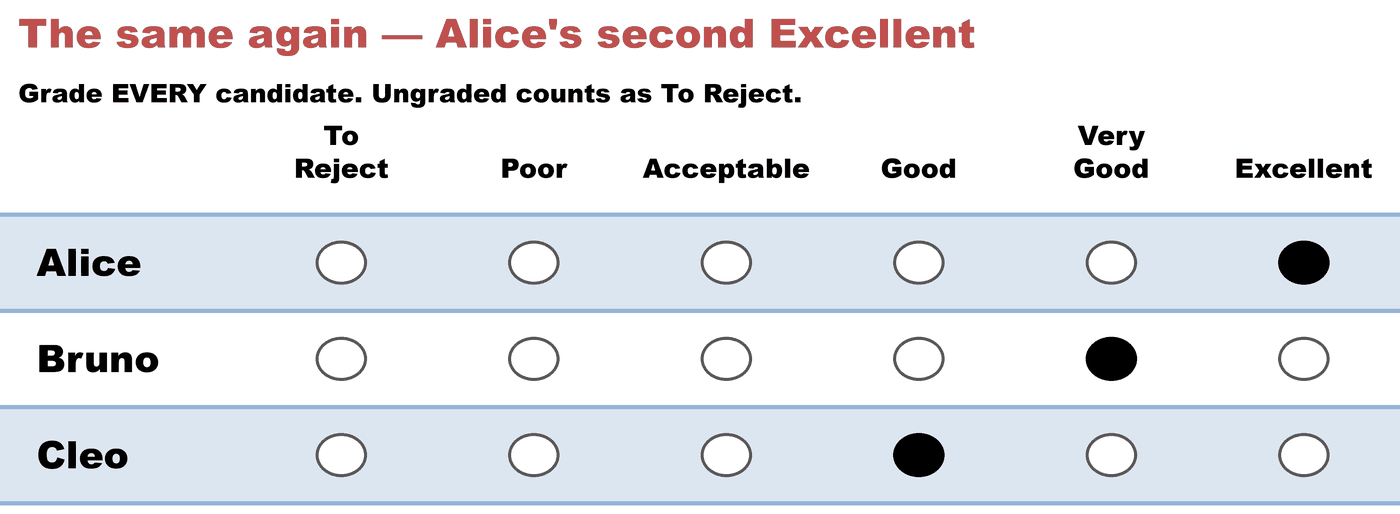
Alice Excellent · Bruno Very Good · Cleo Good
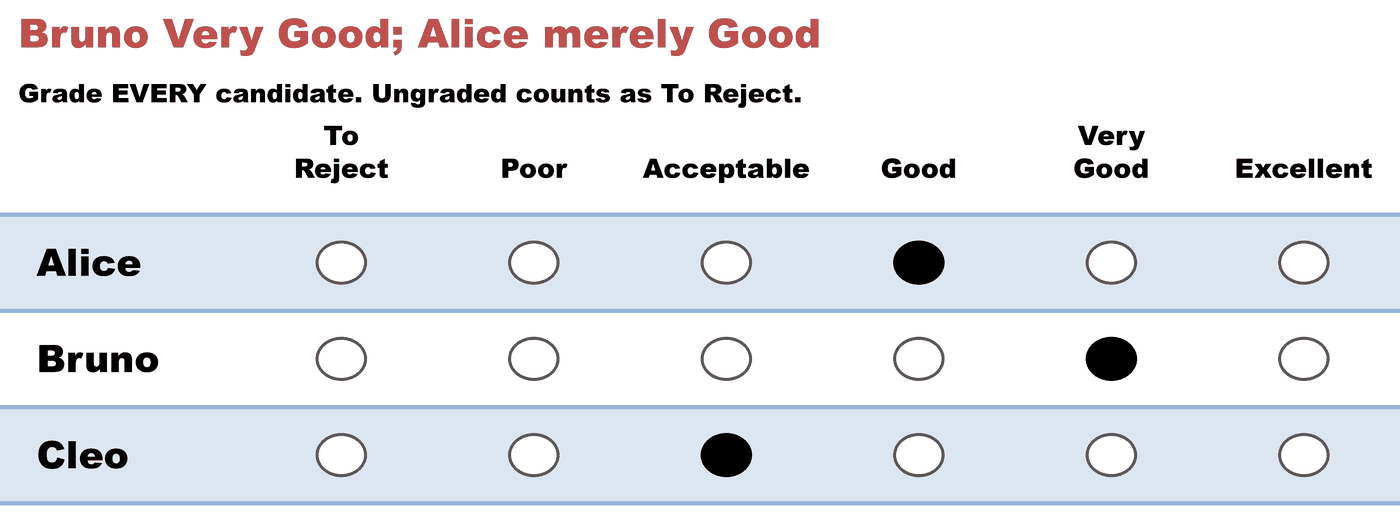
Alice Good · Bruno Very Good · Cleo Acceptable
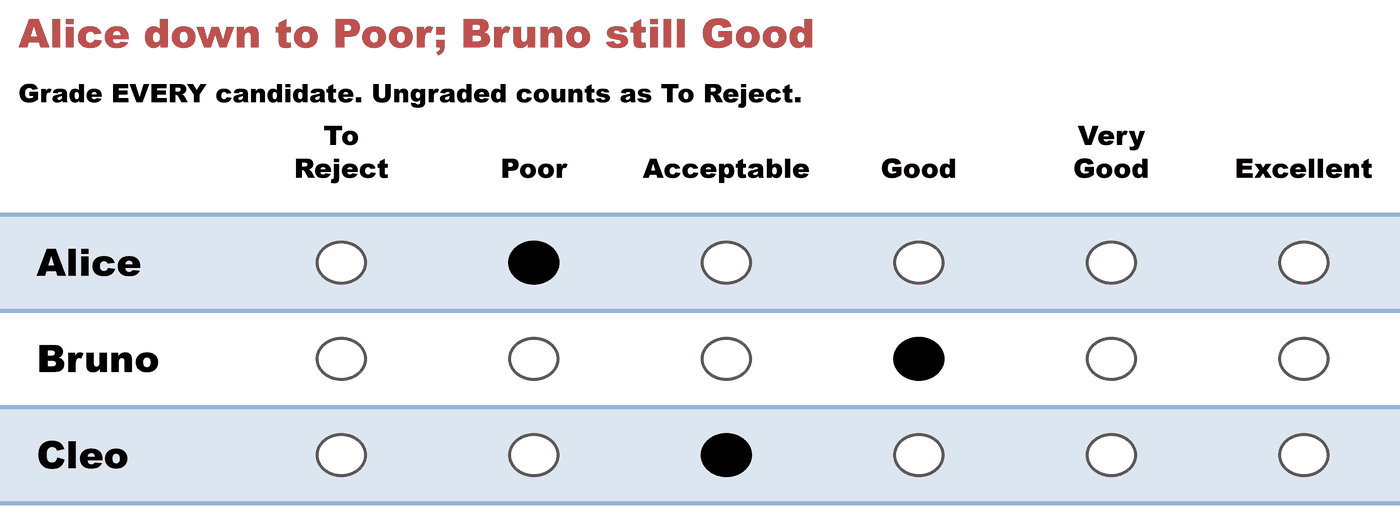
Alice Poor · Bruno Good · Cleo Acceptable
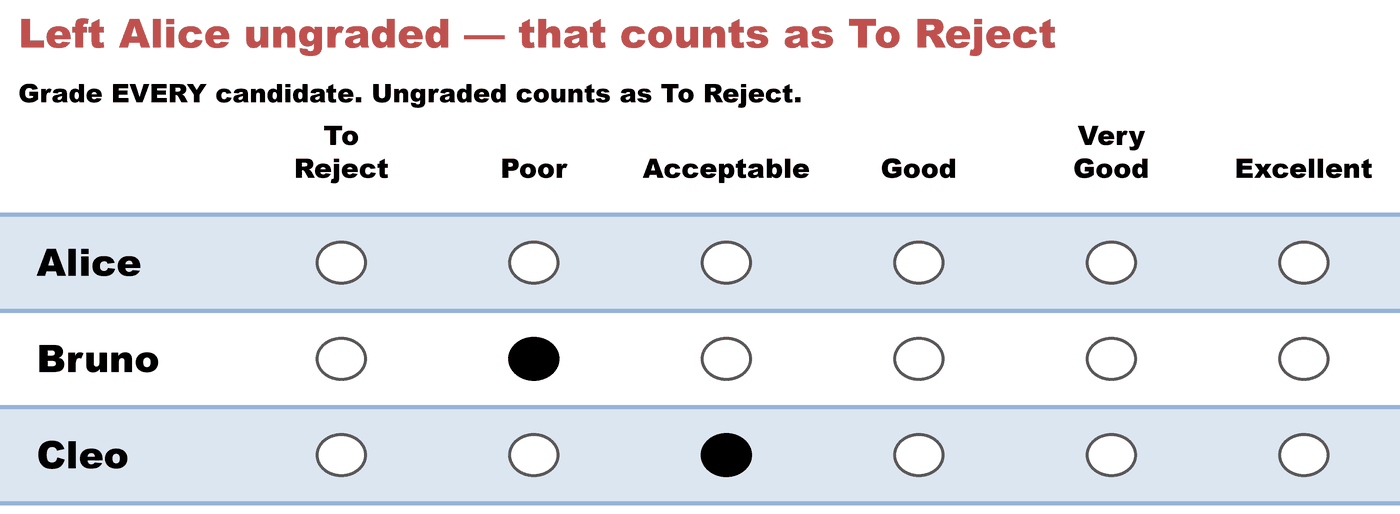
Alice — · Bruno Poor · Cleo Acceptable
Note Voter 5's ballot: they left Alice's row untouched. Under this procedure an ungraded candidate takes the bottom of the scale, so that blank counts as To Reject. The rule looks like bookkeeping and is not — it is the entire mechanism of MJ's truncation paradox, where a voter does better by saying less.
The count — the middle grade, not the average¶
Take each candidate's five grades, put them in order, and read off the one in the middle:
| Candidate | Grades in order | Median | (mean, for contrast) |
|---|---|---|---|
| Alice | To Reject · Poor · Good · Excellent · Excellent | Good | 2.8 |
| Bruno | Poor · Good · Very Good · Very Good · Very Good | Very Good | 3.2 |
| Cleo | Acceptable · Acceptable · Acceptable · Good · Good | Acceptable | 2.4 |
Bruno wins on a median of Very Good.
The candidate to watch is Alice. She collects the two loudest grades on the whole ballot — two Excellents, more enthusiasm than anyone else gets — and still finishes second, because her median is only Good. That is the median doing precisely the job it was chosen for: nobody can lift a candidate by grading them harder, only by being one more voter who puts them at or above that middle grade. Where Range lets one enthusiast's 10 outweigh three quiet majorities, the median cannot be dragged that way.
When medians tie — the Balinski–Laraki iteration¶
Two candidates sharing a median is common on a six-word scale, and MJ's answer is its most distinctive machinery: remove one instance of the shared median from each tied candidate and take the medians again, repeating until they separate. The candidate who runs out of support at that grade first loses.
It works, and it is opaque. A voter can follow "highest median wins"; almost nobody can follow four iterations of grade-stripping, and the iteration is exactly what makes MJ's reinforcement failure — three regions that each elect y, merging into an electorate that elects x — so hard to see coming. The 101 case above is deliberately built to avoid a tie, so the lesson is the median and not the machinery.
How it differs from Score — the same ballots, two winners¶
The comparison that matters most is with Range / Score, because MJ and Score hand the voter the same piece of paper. Both ask for a grade on every candidate. They part company at exactly one step, and it is worth doing that step slowly.
The one step that differs¶
Each candidate ends up with a column of five grades — one per voter. Both methods have to boil that column down to a single figure. That is the only place they disagree:
- Score adds the column up (equivalently, takes the mean — the ordinary average).
- MJ sorts the column and takes the middle one (the median).
Every grade has a position on the six-word scale — To Reject 0, Poor 1, Acceptable 2, Good 3, Very Good 4, Excellent 5 — so both are arithmetic you can check by eye:
| Candidate | The five grades, lowest first | Mean — add them, divide by 5 | Median — the middle one |
|---|---|---|---|
| Asha | To Reject · Good · Good · Very Good · Very Good | 0+3+3+4+4 = 14 → 2.8 | Good |
| Bodhi | Acceptable · Acceptable · Acceptable · Excellent · Excellent | 2+2+2+5+5 = 16 → 3.2 | Acceptable |
| Camila | Poor · Poor · Poor · Acceptable · Good | 1+1+1+2+3 = 8 → 1.6 | Poor |
Bodhi has the higher mean (3.2). Asha has the higher median (Good). Same five ballots, and the two rules point at different people.
The reason is in the two right-hand columns. The mean touches every grade, so Bodhi's two Excellents — 5 apiece — haul his total past Asha's four warm ones. The median adds nothing at all: it walks to the middle of the sorted list and stops. It can see that two voters put Bodhi above Acceptable; it cannot see that they went all the way to Excellent. One rule measures how much, the other measures how many got at least this far.
→ The idea in general, beyond this election: mean, sum, and median — a method-defining choice.
Here are the ballots those three rows came from:
The ballots as marked — the filled bubble is the grade given, and the grade is the word in its column. The grades the file records are repeated under each ballot:
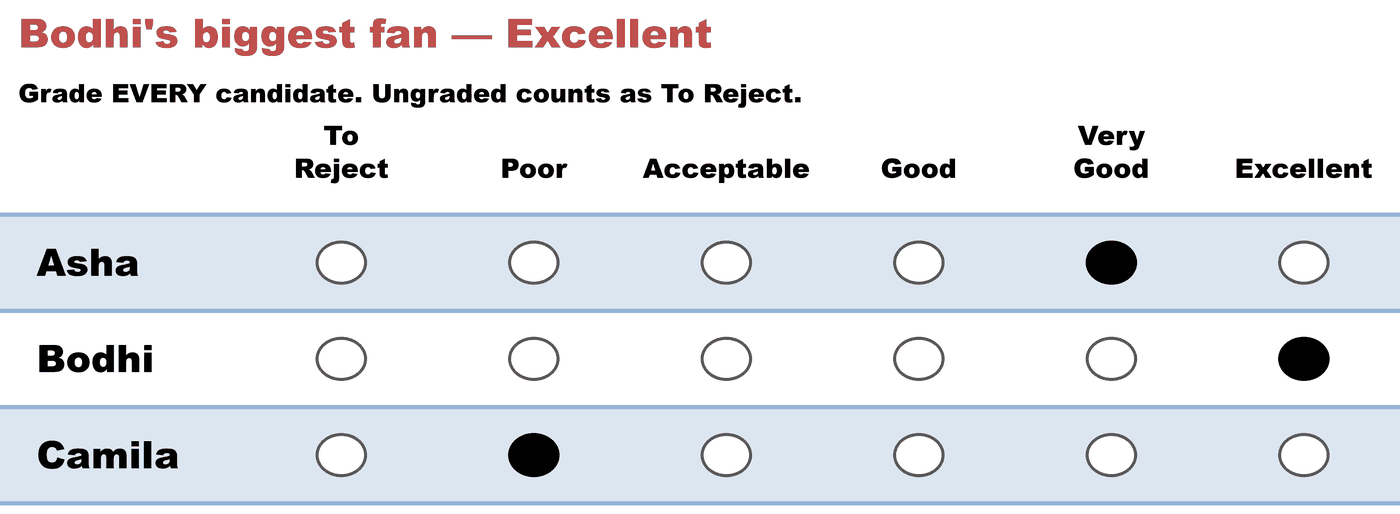
Asha Very Good · Bodhi Excellent · Camila Poor
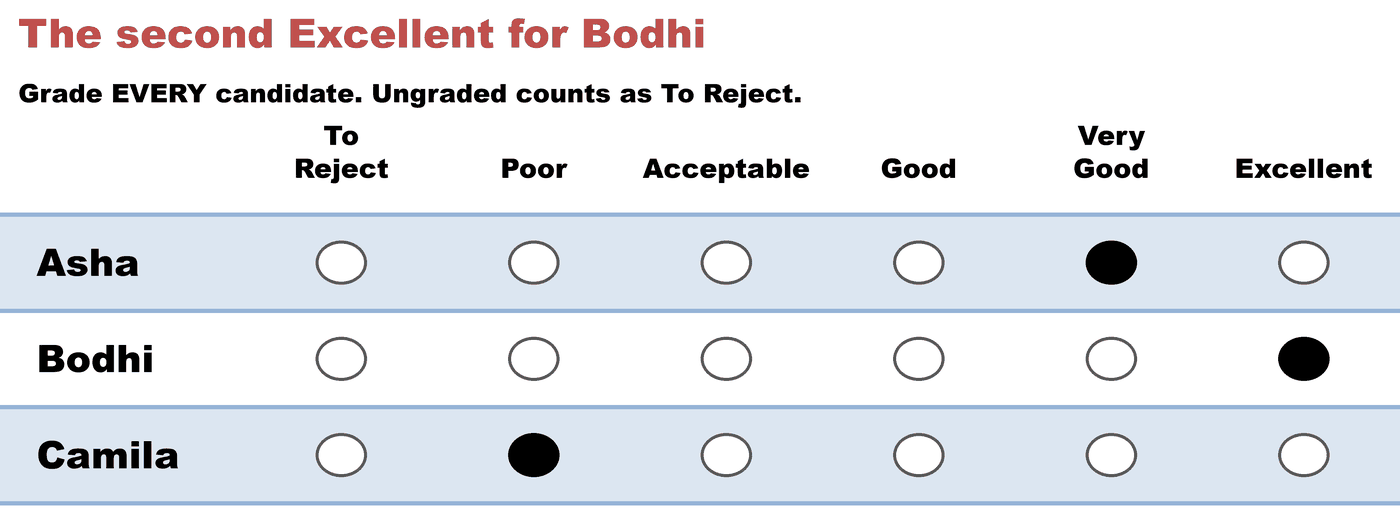
Asha Very Good · Bodhi Excellent · Camila Poor
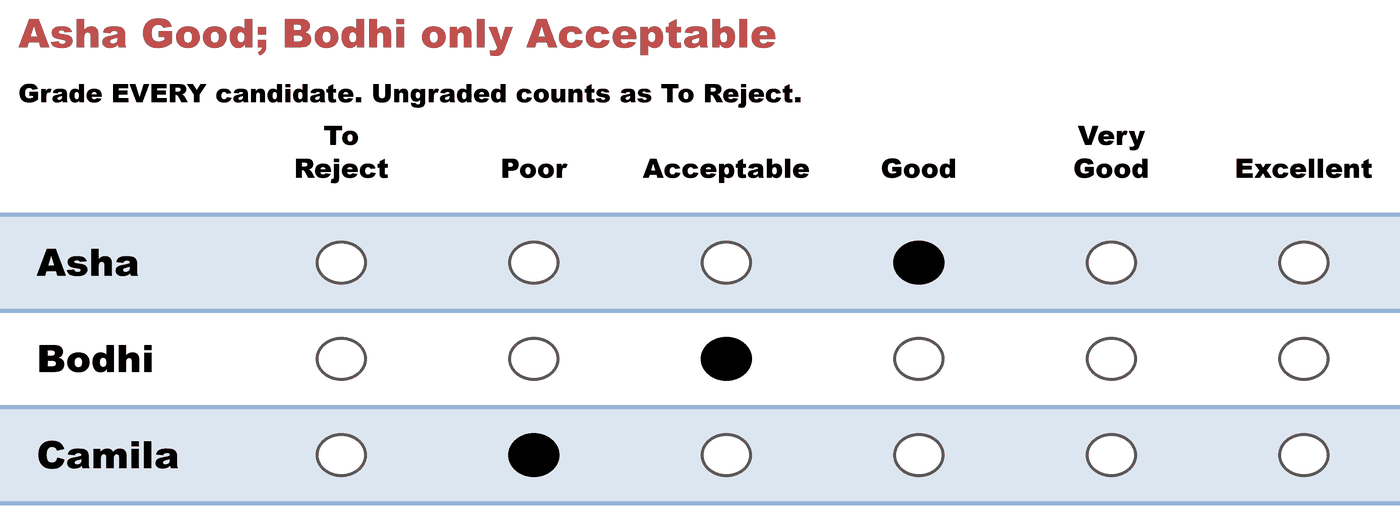
Asha Good · Bodhi Acceptable · Camila Poor
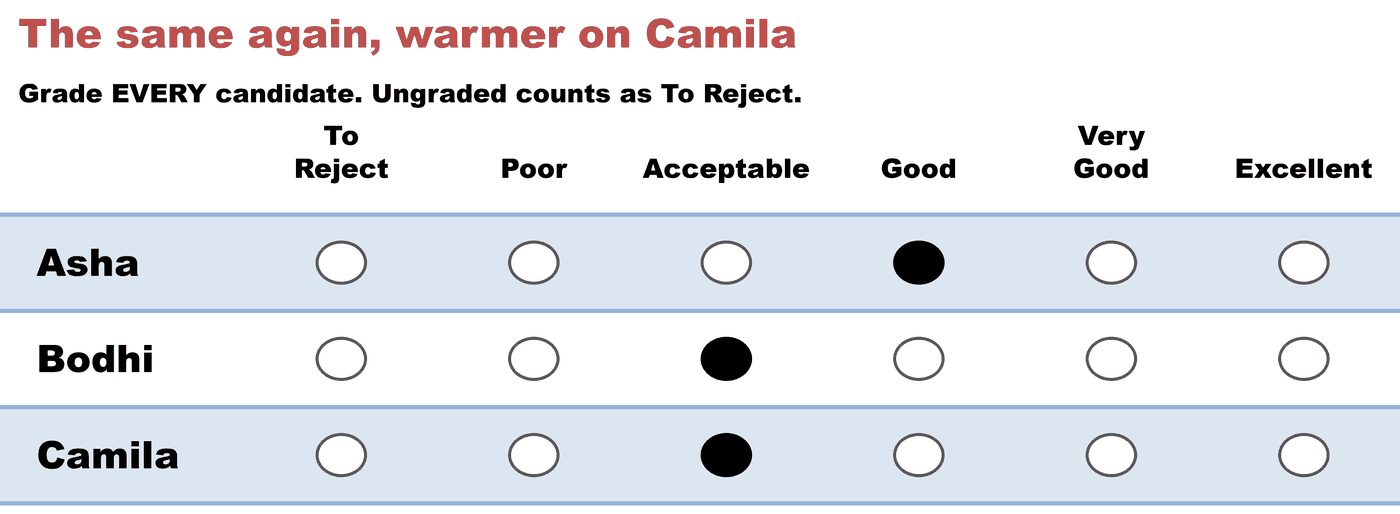
Asha Good · Bodhi Acceptable · Camila Acceptable
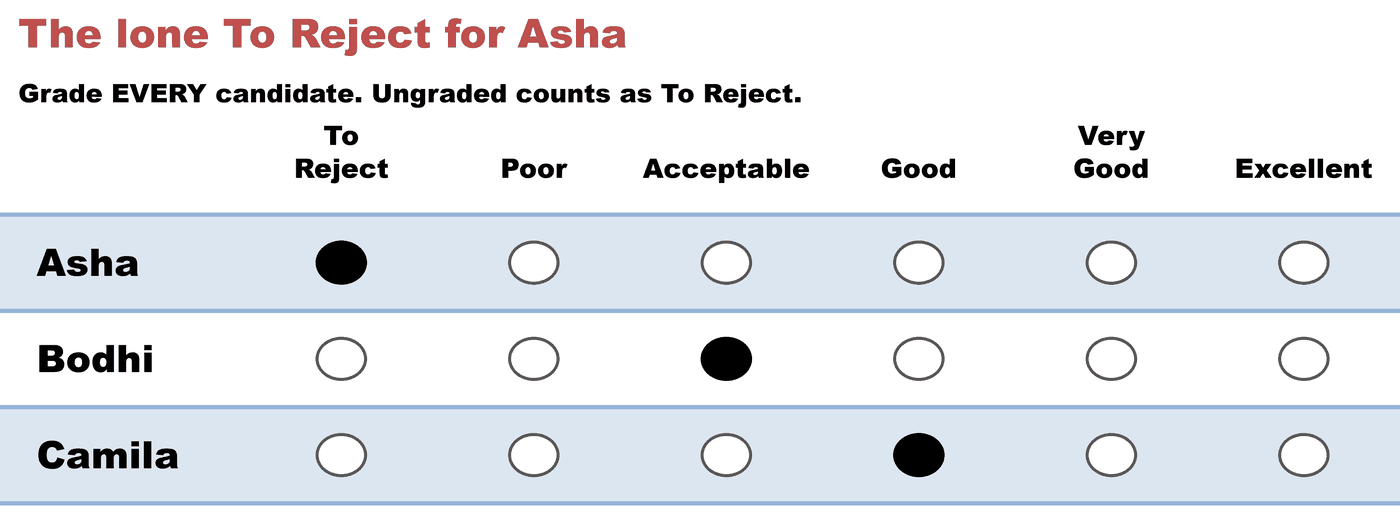
Asha To Reject · Bodhi Acceptable · Camila Good
Score elects Bodhi. Majority Judgment elects Asha. Nobody changed their mind between the two counts, and no ballot was marked differently — the only thing that changed is what the count does with the column.
uv run STARVote_LH_tabulation_engine/tools_adam/pref_voting_tabulation_engine/grade_methods_report.py 06_Other/Majority_Judgment/cases/mj_vs_score_c3_b5.yaml
Grades:
                     V1          V2          V3          V4          V5     mean      median
   Asha       Very Good   Very Good        Good        Good   To Reject   (2.80)        Good
   Bodhi      Excellent   Excellent  Acceptable  Acceptable  Acceptable   (3.20)  Acceptable
   Camila          Poor        Poor        Poor  Acceptable        Good   (1.60)        Poor

Winner — Range Voting (highest mean): Bodhi
   (grades scored by position on the scale, To Reject=0)

Winner — Majority Judgment (highest median): Asha
   medians: Asha Good, Bodhi Acceptable, Camila Poor

Head-to-head — every pair, by how many voters graded one ABOVE the other:
   Bodhi beats Asha   3–2
   Asha beats Camila   4–1
   Bodhi beats Camila   3–1
   Bodhi is the Condorcet winner — beats every rival head-to-head.
   ⚠️  Majority Judgment elects Asha — NOT the Condorcet winner. Bodhi beats Asha head-to-head.

 pref_voting Range (mean): Bodhi   vs this report (Bodhi): AGREE ✓
 pref_voting Majority Judgment: Asha   vs this report (Asha): AGREE ✓
The catch: MJ's winner loses the head-to-head¶
Read the last block of that report before deciding the median looks wise here. Ask the five voters to choose between Asha and Bodhi directly and Bodhi wins 3–2 — V1, V2 and V5 all grade him above her. Bodhi also beats Camila, so he is the Condorcet winner: the candidate who would win every head-to-head. Score elects him. Majority Judgment does not.
That is not a quirk of this construction — it is MJ's majority-criterion failure, which Balinski and Laraki accept openly, arguing that a majority's ordering should not overrule the electorate's evaluations. Whether you find that defensible is the argument; that it happens is not in dispute. It happens here, in the smallest election built to show the two rules apart. (For the record, STAR elects Bodhi too — the scoring round puts him and Asha in the runoff, and the runoff is that same 3–2.)
So the honest reading of this page is not "the median finds the broadly acceptable candidate." It is: the median is unmoved by intensity, and that cuts both ways — it ignores a saboteur's To Reject, and it equally ignores three voters who actually prefer someone else.
What the median buys: the lone To Reject is pivotal — under Score only¶
V5 is the one voter who rejects Asha outright. Had V5 given her the Good that V3 and V4 did, her mean would be 3.4 and Score would elect Asha too — the divergence exists only because of that single grade. Her median does not move an inch: Good with the To Reject, Good without it.
That one cell is the argument, in both directions at once. Balinski and Laraki designed the median precisely so that a voter cannot sink a candidate by grading them at the floor — the strategy their book is most worried about, and MJ genuinely blocks it. Score advocates answer that V5's To Reject is not noise to be filtered out but a voter telling you something real, and a method that shrugs at it has thrown away the evidence it asked for. This election does not settle that; it shows you the exact cell where the two philosophies disagree, and it is one cell.
The rule of thumb: the mean moves smoothly — change one grade and the total shifts a little. The median moves in jumps — change one grade and either nothing happens at all, or the winner changes, depending only on whether you crossed the middle. That is the same sensitivity, seen from the good side here and from the bad side in the truncation paradox, where one blank drops a candidate four grades.
Where it sits in the graded family¶
- Approval is the same idea at two grades — approve or don't.
- Range / Score grades on the same kind of paper and counts it by the mean. MJ and Range are the same ballot, different average.
- STAR sums the scores and then holds an automatic runoff between the top two — a majority check bolted onto a sum.
- MJ takes the median and adds no runoff, because on its own account a majority's ordering should not be allowed to overrule the electorate's evaluations.
So all four read a grade of some resolution; they differ in what they do with the column afterwards. See the fidelity ladder.
Pros and cons¶
| Pros | Cons |
|---|---|
| ✅ Robust to exaggeration. One voter's Excellent cannot drag the median the way it drags a mean — the strongest argument for the method, and it is a real one. | ⚠️ Fails the majority criterion — by design. A candidate an absolute majority grades above another can lose. Balinski and Laraki defend this; most voters would call it a bug. |
| ✅ A common language of words rather than bare numbers, which is what the method offers as an answer to "your 7 isn't my 7". | ⚠️ The premise is now contested experimentally. Delemazure, Brunetti, Baujard & Bouveret (2026) found grade distributions shift with the scale offered — evidence against grades carrying absolute meaning. |
| ✅ Strategy-proof in grading — Balinski & Laraki prove median-type rules are the ones a voter cannot push in their preferred direction by misreporting a grade. | ⚠️ Fails the Condorcet criterion, also by design, and carries the longest paradox list in Felsenthal's appendix: worked here. |
| ✅ Independence of irrelevant alternatives holds trivially — a candidate's median depends only on that candidate's own grades, so Arrow's theorem doesn't bind. | ⚠️ The tie-break is opaque. Medians tie often, and "iterate until they separate" is not something a voter can check by eye. |
| ✅ Field-tested on real voters — the Orsay 2007 experiment ran MJ alongside the French presidential first round, with ~1.08% invalid ballots. | ⚠️ A median discards magnitude entirely. Two Excellents and two To Rejects read the same as four Acceptables if the middle grade matches. |
The one-line summary: MJ fixes the mean's intensity problem by refusing to average at all — and inherits a different disease, in which one well-placed middle grade can overrule an absolute majority. Whether that trade is worth it is the whole debate, and the paradoxes page is where it gets argued.
Ballot examples¶
06_Other/Majority_Judgment/cases/mj_101_c3_b5.yaml— the intro above (three candidates, five voters, the six-word scale, one ungraded cell).06_Other/Majority_Judgment/cases/mj_vs_score_c3_b5.yaml— the mean-versus-median split above: the same five ballots elect Bodhi under Score and Asha under MJ.- Felsenthal's four §A9 examples — the case against — live in Felsenthal's paradox review, worked and are worked on Majority Judgment's paradoxes.
Links¶
- Majority Judgment: Measuring, Ranking, and Electing — Balinski & Laraki (MIT Press, 2011), the method's own case. (The authors advocating their own method — the strongest rival case within the cardinal camp, and one that cuts against score-summing.)
- Balinski & Laraki, Election by Majority Judgment: Experimental Evidence — the Orsay 2007 write-up. (Hosted on rangevoting.org, which advocates score voting and is critical of MJ; the paper is the authors' own, the host is not neutral.)
- Majority judgment — Wikipedia — the neutral summary, with the criteria table.
- Glossary: Glossary — voting methods & criteria · reading list: Rated & score methods.
Tabulation (the details)¶
MJ exists in neither the LH engine nor BetterVoting — its ballot holds words and its tie-break is unique to it — so files here carry a grades: block instead of ballots: and are counted by grade_methods_report.py, which computes the median and the Balinski–Laraki iteration from scratch and cross-checks both against pref_voting on every run:
uv run STARVote_LH_tabulation_engine/tools_adam/pref_voting_tabulation_engine/grade_methods_report.py 06_Other/Majority_Judgment/cases/mj_101_c3_b5.yaml
=== Range Voting (mean) and Majority Judgment (median) ===
 5 voters, 3 candidates, grades To Reject–Excellent.

Grades:
                    V1          V2          V3          V4          V5     mean      median
   Alice     Excellent   Excellent        Good        Poor   To Reject   (2.80)        Good
   Bruno     Very Good   Very Good   Very Good        Good        Poor   (3.20)   Very Good
   Cleo           Good        Good  Acceptable  Acceptable  Acceptable   (2.40)  Acceptable

 1 ungraded cell(s) took the scale floor (To Reject): Alice/V5.
 That convention — ungraded equals lowest — is what makes truncation profitable under both rules.

Winner — Range Voting (highest mean): Bruno
   (grades scored by position on the scale, To Reject=0)

Winner — Majority Judgment (highest median): Bruno
   medians: Alice Good, Bruno Very Good, Cleo Acceptable

 pref_voting Range (mean): Bruno   vs this report (Bruno): AGREE ✓
 pref_voting Majority Judgment: Bruno   vs this report (Bruno): AGREE ✓
One caveat worth stating before you quote an MJ number. The tie-break has two published readings, and they are not interchangeable. This repo's tool implements the iterative one — strip a shared median, recompute, repeat. pref_voting implements the majority gauge: compare the share of voters above the median against the share below. On a profile where two candidates share a median and both have more detractors than supporters at it, the gauge as implemented compares only the losing shares and can return a tie where the iteration separates the candidates cleanly. Both descend from Balinski and Laraki; say which one a number came from. The 101 case above sidesteps the question by having no tie at all, which is why its two cross-checks agree.
The same tool counts Range / Score on the same files — that is why every report prints both winners. Reading the mean and the median side by side is the fastest way to see what choosing one over the other actually costs.