⭐ Rated & score methods — this repo's home turf
The cardinal family: ballots where you grade candidates (approve / score 0–5 / grade Reject–Excellent) rather than only rank them. STAR lives here — a score ballot plus an automatic runoff — so these are the books that argue the case STAR builds on. Read them to understand why scoring instead of ranking, and where the scholars who pioneered it think it still falls short.
← Back to Books on Voting Methods
Also on this shelf in spirit: Poundstone's Gaming the Vote (the popular case for range/score voting) — it lives on the Popular introductions shelf.
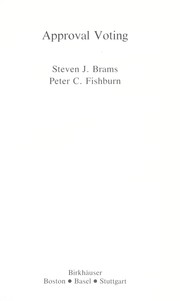 |
### Approval Voting — Steven J. Brams & Peter C. Fishburn (1983; 2nd ed. 2007)
The founding text of modern approval voting: mark every candidate you approve of, most marks wins. Brams and Fishburn coined the name and made the theoretical case, and this is where it's laid out first and most fully. The 2007 edition adds two decades of adoption experience.
**The lean:** These are approval voting's **inventors-advocates** — the book argues *for* the method. It's the cleanest statement of "the simplest cardinal ballot," which is exactly the baseline STAR extends (a 0–5 score is a richer approval mark, and the runoff answers approval's "where do I draw the line?" problem).
**In this repo:** [Approval voting](../../04_Approval/01_Learn/approval_voting.md) · [Approval's honest limits](../../04_Approval/01_Learn/approval_honest_limits.md) · [scores vs. ranks](../scores_and_ranks/scores_vs_ranks.md)
|
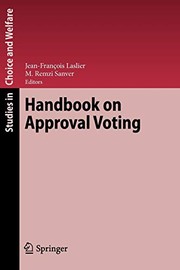 |
### Handbook on Approval Voting — Jean-François Laslier & M. Remzi Sanver, eds. (2010)
The scholarly reference: an edited volume collecting the theory, experiments, and real-world trials of approval voting in one place. Denser than Brams & Fishburn and multi-author, so it also surfaces the *critiques* — useful when you want the debate, not just the pitch.
**The lean:** An edited academic handbook, so more balanced than a single-advocate book — but its subject is approval, and contributors are largely sympathetic. Best mined for specific chapters (Laslier's own experimental work is a highlight).
**In this repo:** [Approval voting](../../04_Approval/01_Learn/approval_voting.md) · [multi-winner approval](../../04_Approval/01_Learn/Multiwinner_Approval/README.md) · the repo cross-checks approval counts against the [`abcvoting` engine](../tabulation_engines/README.md)
|
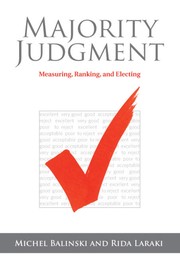 |
### Majority Judgment — Michel Balinski & Rida Laraki (2010; MIT Press)
*Measuring, Ranking, and Electing.* A full-length case for a rated method built on **median grades** rather than sums: voters grade every candidate on a verbal scale (Excellent … Reject) and the highest *median* grade wins. Rigorous and self-contained — it develops the theory from scratch and confronts Arrow's theorem head-on.
**The lean:** Balinski and Laraki are **advocating their own method**, majority judgment, and part of the book argues it beats score-summing (STAR's family) on strategy-resistance. Read it as the strongest rival case *within* the cardinal camp — the median-vs-sum debate is a real one, and worth understanding before you defend the runoff-on-sums design STAR uses.
**In this repo:** [Majority judgment](../voting_paradoxes/majority_judgment.md) · [what makes a voting method good](../topics/what_makes_a_voting_method_good.md) · [scores vs. ranks](../scores_and_ranks/scores_vs_ranks.md)
|
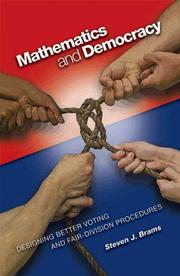 |
### Mathematics and Democracy — Steven J. Brams (2008; Princeton)
*Designing Better Voting and Fair-Division Procedures.* Broader than a single method — Brams treats voting **and** fair division (cake-cutting, apportionment) as one design problem: how do you build procedures with good properties? A bridge from "which method wins?" to "how are procedures engineered?"
**The lean:** Brams designs and champions specific procedures (approval voting, and here "satisfaction approval" and others), so it's advocacy-tinged — but the framing is constructive engineering, and the fair-division half is largely orthogonal to the voting debates.
**In this repo:** [electing more than one](../topics/electing_more_than_one.md) · [proportional representation](../../03_STAR_PR/01_Learn/README.md) · [Who's who](../topics/whos_who_voting_reform.md)
|
Where to go next