📘 Popular introductions — start here, no math required
The books to read first, and the ones to lend. Narrative, example-driven, written for a general audience — you can finish any of these on a couple of flights and come away understanding why the way we vote matters.
← Back to Books on Voting Methods
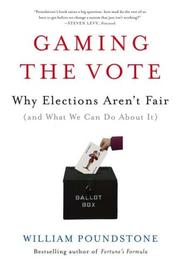 |
### Gaming the Vote — William Poundstone (2008)
*Why Elections Aren't Fair (and What We Can Do About It).* The most readable popular book in the field: spoilers, strategy, and a tour of real elections that went sideways, building to a case for **range (score) voting**. If you read one book off this whole shelf, read this one — it's the closest popular title to this repo's own outlook.
**The lean:** Openly pro-**range/score voting** — it argues score is the best single-winner method. That happens to align with the *cardinal* family [STAR](../../01_STAR/01_Learn/STAR_start_here.md) belongs to, so enjoy it but notice the advocacy. STAR's automatic runoff is a later refinement Poundstone's range voting doesn't include.
**In this repo:** [Range voting](../../06_Other/Range/concepts/range_voting.md) · [scores vs. ranks](../scores_and_ranks/scores_vs_ranks.md) · [the spoiler effect](../topics/spoiler_effect.md)
|
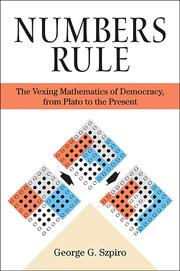 |
### Numbers Rule — George G. Szpiro (2010)
*The Vexing Mathematics of Democracy, from Plato to the Present.* A history told through its characters — Pliny, Ramon Llull, Borda, Condorcet, Laplace, Dodgson (Lewis Carroll), Arrow — each chapter a person and the paradox they wrestled with. The gentlest on-ramp to *why* the mathematics is hard.
**The lean:** Broadly neutral and historical — no single method is being sold. Its job is context, not a verdict.
**In this repo:** [Who's who in voting reform](../topics/whos_who_voting_reform.md) · [voting paradoxes](../voting_paradoxes/README.md) · [Borda](../../06_Other/other_ranked_methods/borda.md)
|
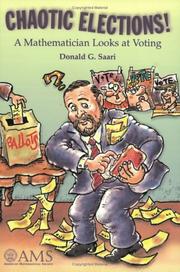 |
### Chaotic Elections! A Mathematician Looks at Voting — Donald G. Saari (2001)
Short, vivid, and slightly more mathematical than the two above — Saari uses geometry to show how the *same ballots* can hand victory to different candidates depending only on the counting rule. The book that makes "the method is the message" click.
**The lean:** Saari is the field's most famous **defender of the Borda count**, and this book argues its case. Read it for the geometric intuition about *why methods disagree*; weigh the Borda advocacy against Borda's own well-known weaknesses (it's easy to strategize and isn't Condorcet-consistent — see the [ranked-method zoo](../topics/ranked_ballot_methods_zoo.md)).
**In this repo:** [Borda](../../06_Other/other_ranked_methods/borda.md) · [what makes a good winner](../topics/what_makes_a_good_winner.md) · [voting paradoxes](../voting_paradoxes/README.md)
|
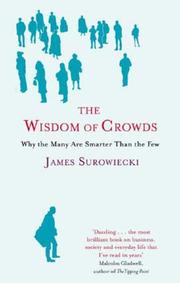 |
### The Wisdom of Crowds — James Surowiecki (2004)
*Why the Many Are Smarter Than the Few.* The popular case for **aggregation**: pool enough independent, diverse judgments and the average beats almost every individual in it — the ox-weight guessing contest at the county fair, prediction markets, the submarine found by a committee of guesses. It's the intuition underneath *ask everyone and add it up*, which is what a score ballot does with more resolution than a single X.
**The lean:** Pro-aggregation — and note what it aggregates. Surowiecki's examples are **estimates**, where a right answer exists and errors cancel; an election mostly aggregates **preferences**, where there is no fact to converge on. So the crowd's "wisdom" doesn't transfer automatically: read this for why collecting *more information per voter* is worth doing, not as proof that a score total is *correct*. His own three conditions — independence, diversity, decentralization — are also the ones campaigns and party cues erode, which is a fair warning to reformers.
**In this repo:** [What makes a good winner](../topics/what_makes_a_good_winner.md) · [scores vs. ranks](../scores_and_ranks/scores_vs_ranks.md) · [simulate utilities, not ballots](../topics/simulate_utilities_not_ballots.md) · [the social welfare function](../topics/social_welfare_function.md)
|
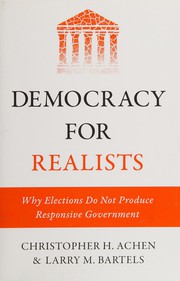 |
### Democracy for Realists — Christopher H. Achen & Larry M. Bartels (2016)
*Why Elections Do Not Produce Responsive Government.* A systematic demolition of what the authors call the **folk theory** of democracy — the picture in which voters hold considered policy views and elections translate those views into government. Decades of survey evidence say group loyalty and partisan identity do most of the work, and that retrospective "throw them out" voting is far blunter than it looks.
**The lean:** Skeptical of voter competence, and it cuts **against** easy reformism — including ours. If identity rather than policy drives the vote, a better ballot buys less than reform advocates hope. Two honest replies: their target is the folk *theory*, not the claim that counting rules matter (a method that eliminates the consensus candidate does that no matter why anyone ranked them), and their own prescription is stronger parties and groups rather than better ballots. On the shelf precisely because it's the strongest "your reform won't fix this" argument here — read it before you promise too much.
**In this repo:** [Does better voting end polarization?](../topics/does_better_voting_end_polarization.md) · [two-party dominance](../topics/two_party_dominance.md) · [STAR for skeptics](../../01_STAR/01_Learn/getting_started/star_for_skeptics.md) · [the problem in four causes](../topics/the_problem_in_four_causes.md)
|
Where to go next