Majority Judgment's paradoxes — the median misbehaves too (§A9 worked)¶
New to Majority Judgment? Start with the method itself → Majority Judgment. That page shows the grade ballot (with pictures of how voters mark it), the count worked on a five-voter election, the Balinski–Laraki tie-break, and the pros and cons. This page assumes all that and goes straight to where the median misbehaves.
The Majority Judgment (MJ) procedure (Balinski & Laraki): voters grade every candidate on a common ordinal scale; the highest median grade wins, with an iterative tie-breaking algorithm when medians match. Felsenthal lists MJ as vulnerable to the Condorcet Winner, Condorcet Loser, Absolute Winner, Absolute Loser, Truncation, Reinforcement, No-Show, and Twin paradoxes — the longest list of any procedure in the appendix except successive elimination. Like Range Voting, most of them need only two candidates. MJ has no tabulator on BetterVoting or in the LH engine, so this repo counts it with grade_methods_report.py, which computes the median and the Balinski–Laraki tie-break from scratch and cross-checks both against pref_voting on every run. In each table below, later letters are higher grades.
uv run STARVote_LH_tabulation_engine/tools_adam/pref_voting_tabulation_engine/grade_methods_report.py method_comparisons/felsenthal_paradoxes/cases/mj_ex25_absolute_winner_loses.yaml
Examples 25, 27 and 28 are runnable case files. They keep Felsenthal's letter grades, so they are grade-ballot files, not LH election files — letters fit neither the engine's numeric 0–5 ballot nor BetterVoting — which is why they carry a grades: block instead of ballots: and have no _tabulated mirror. Example 26 is the exception and stays prose: its grade tables are in Felsenthal & Machover's paper and were never reproduced on this page, so there is nothing here to turn into a file. Building it would mean inventing three 101-voter regions and calling them the source's, which is not a thing this repo does.
→ The case for the method, and the argument underneath it: Grading as a rival primitive — Balinski & Laraki's claim that the preference order is the wrong primitive, the common-language-of-grades move that buys interpersonal comparability, the Orsay 2007 field experiment, and the 2026 study that tests the premise and rejects it. Read the case for before the paradoxes below.
Sources: Dan S. Felsenthal, "Review of Paradoxes Afflicting Various Voting Procedures Where One Out of m Candidates (m ≥ 2) Must Be Elected", University of Haifa / LSE, revised 26 May 2010; Appendix §A9 — drawing on Felsenthal & Machover (2008), "The Majority Judgement voting procedure: a critical evaluation" (the paper that discusses MJ's paradoxes at length). Balinski & Laraki's Majority Judgment (2011) is the case for the method — see the books list.
Example 25 — the absolute winner loses (Felsenthal & Machover 2008: 330)¶
| Grades (A–H) | V1 | V2 | V3 | Median |
|---|---|---|---|---|
| x | B | C | H | C |
| y | A | F | G | F |
Case: mj_ex25_absolute_winner_loses.yaml
Three ballots, and the whole paradox is visible on the middle one:
The ballots as marked — the filled bubble is the grade given, and the grade is the word in its column. The grades the file records are repeated under each ballot:
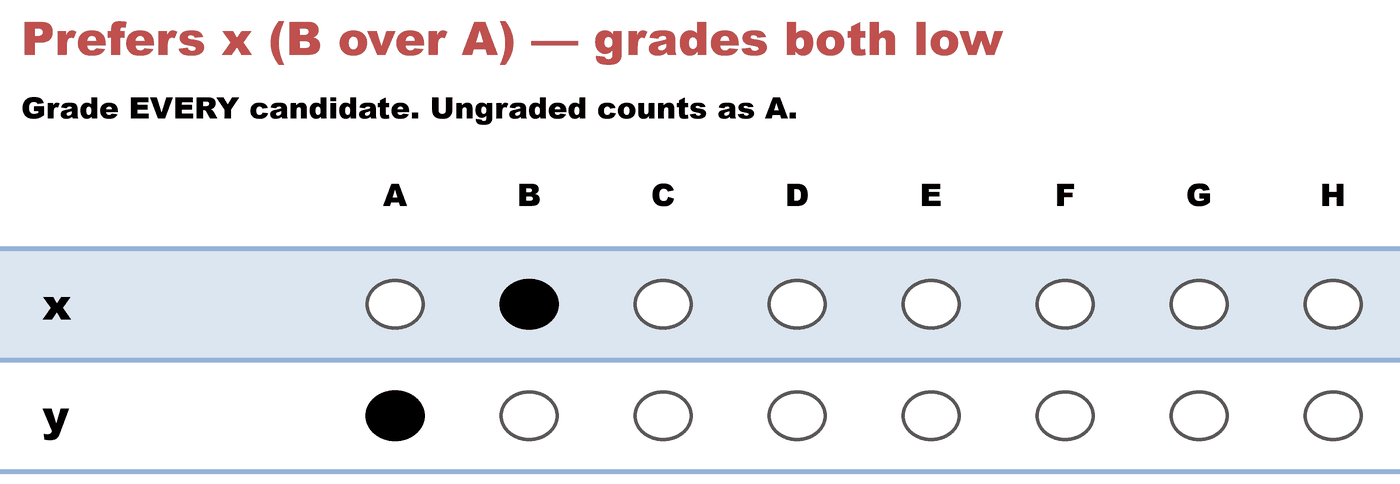
x B · y A
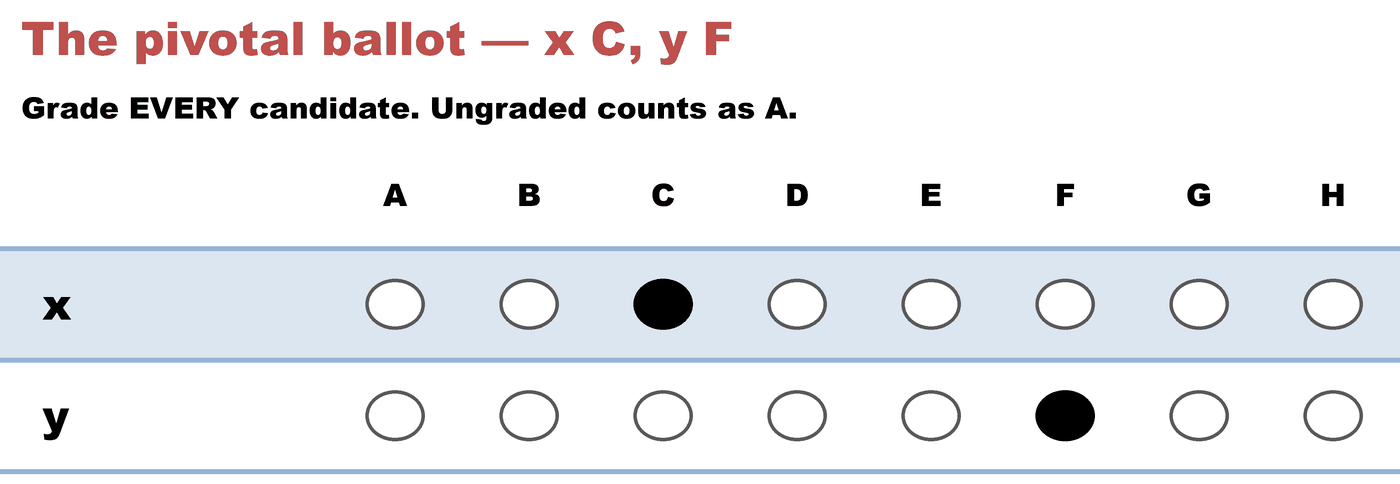
x C · y F
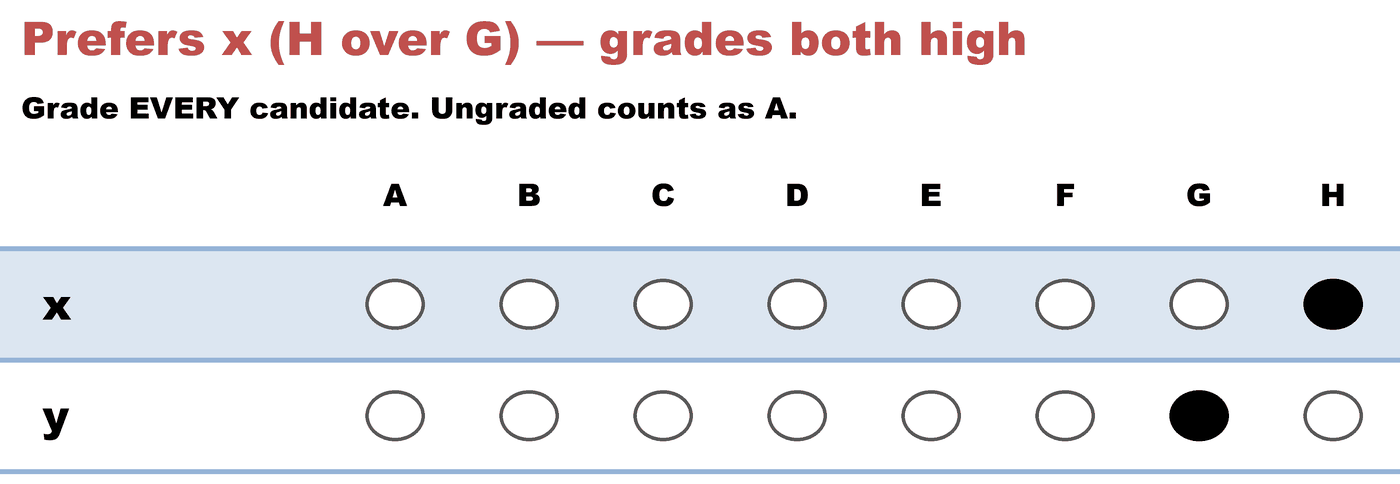
x H · y G
MJ elects y (median F > C). But an absolute majority — V1 and V3 — graded x above y: x is the Condorcet and absolute winner, y the Condorcet and absolute loser. Same disease as Range Voting's Example 23, median flavor: one middling grade (V2's F for y) placed just right outweighs two majorities.
This is the example that matters most for the method's own argument. The median was proposed because a mean can be dragged by one extreme grade — and that is true. It is also beside the point: a median can still be set by a single well-placed grade, and here it is. Read the case for the method first at Grading as a rival primitive, then this.
Worth being precise about what this example does and does not indict, because it is easy to over-read. It is not a mean-versus-median divergence — the mean elects y here too (x 3.33, y 3.67), so Range fails it identically. What it indicts is grading arithmetic of either kind against a majority. For the difference between the two rules, where the same ballots really do elect different candidates, see MJ vs Score.
Example 26 — Reinforcement failure (Felsenthal & Machover 2008: 327)¶
Three regions of 101 voters grade x and y on A–D. In every region the two candidates have equal median grades, so Balinski & Laraki's tie-breaking algorithm decides (2, 7, and 2 iterations): y wins all three regions. Merge the regions (13 iterations): x wins. Three electorates that each chose y produce a union that chooses x — the Reinforcement paradox, median flavor.
No case file, deliberately. The grade tables live in Felsenthal & Machover's paper and were never reproduced on this page, so there is nothing here to make runnable — and inventing three 101-voter regions to fit the stated iteration counts would be fabricating a source's data. When the tables are to hand this becomes a file like the others. The iterative tie-break is what makes the failure possible and what makes it opaque; grade_methods_report.py prints each iteration for the examples it can count, which is the nearest available view of the mechanism.
Example 27 — No-Show and Twin (Felsenthal & Machover 2008: 329)¶
| Grades (A–F) | V1 | V2 | V3 | V4 | V5 | V6 | V7 | Median |
|---|---|---|---|---|---|---|---|---|
| x | A | A | A | D | E | E | F | D |
| y | B | B | B | C | F | F | F | C |
Case: mj_ex27_noshow_twin.yaml
MJ elects x (median D > C). V1 and V2 prefer y (they graded x the lowest grade). If they abstain, the five remaining grades are A,D,E,E,F (median E) vs y's B,C,F,F,F (median F) — y wins. Staying home gives them their preference: the No-Show paradox. Read in reverse it's the Twin paradox: V3 votes alone, y wins; V3's two twins join, and x wins.
uv run STARVote_LH_tabulation_engine/tools_adam/pref_voting_tabulation_engine/grade_methods_report.py --abstain V1,V2 method_comparisons/felsenthal_paradoxes/cases/mj_ex27_noshow_twin.yaml
--abstain removes voters outright, which is a different lever from the --ungrade used two examples down: abstaining changes the denominator, and that is precisely what moves a median.
Example 28 — the Truncation paradox¶
| Grades (A–J) | V1 | V2 | V3 | V4 | V5 | V6 | V7 | Median |
|---|---|---|---|---|---|---|---|---|
| x | A | A | A | J | E | D | G | D |
| y | B | B | B | C | H | E | H | C |
Case: mj_ex28_truncation.yaml
MJ elects x. V6 (x: D, y: E — prefers y) grades only y: x's V6-grade becomes the lowest (A), x's median collapses from D to A, and y wins. Grading less got V6 more: the Truncation paradox, driven by the same ungraded-equals-lowest convention as RV's Example 24.
uv run STARVote_LH_tabulation_engine/tools_adam/pref_voting_tabulation_engine/grade_methods_report.py --ungrade x/V6 method_comparisons/felsenthal_paradoxes/cases/mj_ex28_truncation.yaml
The size of that collapse is the thing to watch. A mean moves smoothly when one grade changes; a median jumps — one blank drops x four positions down the scale, because it changes which grade sits in the middle rather than nudging an average. That sensitivity is the flip side of the robustness the median is chosen for.
What this folder takes from §A9¶
The median was proposed to tame the mean's intensity problem, and these examples show the cure inherits the disease: medians still let a well-placed single grade overrule an absolute majority (Ex.25), and the tie-break machinery adds a reinforcement failure that is genuinely hard to see coming (Ex.26). MJ's paradoxes need only two candidates — no cycle, no elimination order — which is Felsenthal & Machover's core critique: the pathologies live in the grading arithmetic itself.