Pareto efficiency — can a rule elect a committee everybody would trade away?
Level: 301 · deep dive
One line: a committee is dominated when some other committee of the same size gives every voter at least as many approved winners and somebody strictly more — and a surprising number of respected approval rules will elect one anyway.
The definition
The single-winner version of Pareto is familiar and weak: don't elect someone every voter ranks below somebody else. See social welfare function for how it behaves there — and note the warning on that page that the single-winner row is a type error on a multi-winner rule. This is the multi-winner replacement.
Comparing committees needs a rule for turning "which candidates do I approve" into "which committee do I prefer". Lackner & Skowron use the obvious one — count your approved winners:
Definition 3.1. A committee
W₁dominatesW₂if (1) every voter has at least as many approved candidates inW₁as inW₂, and (2) at least one voter has strictly more. A committee dominated by no other committee of the same size is Pareto optimal.
Two strengths follow, and Table 3.1 distinguishes them:
- Strong Pareto efficiency — the rule never outputs a dominated committee.
- Weak Pareto efficiency — if a dominated committee wins, every committee dominating it also wins. (The rule may return the dominated committee, but never only it.)
The set extension is a choice, and the book says so explicitly: these verdicts hold for "count your approved winners" and need not survive a different reading of what a voter wants from a committee.
The smallest failure: Chamberlin–Courant, two voters
The ballots as marked — a filled Yes is a 1 in that candidate's column, a filled No a 0:
| # | Ballot as marked | A | B | C | D |
|---|---|---|---|---|---|
| 1 | 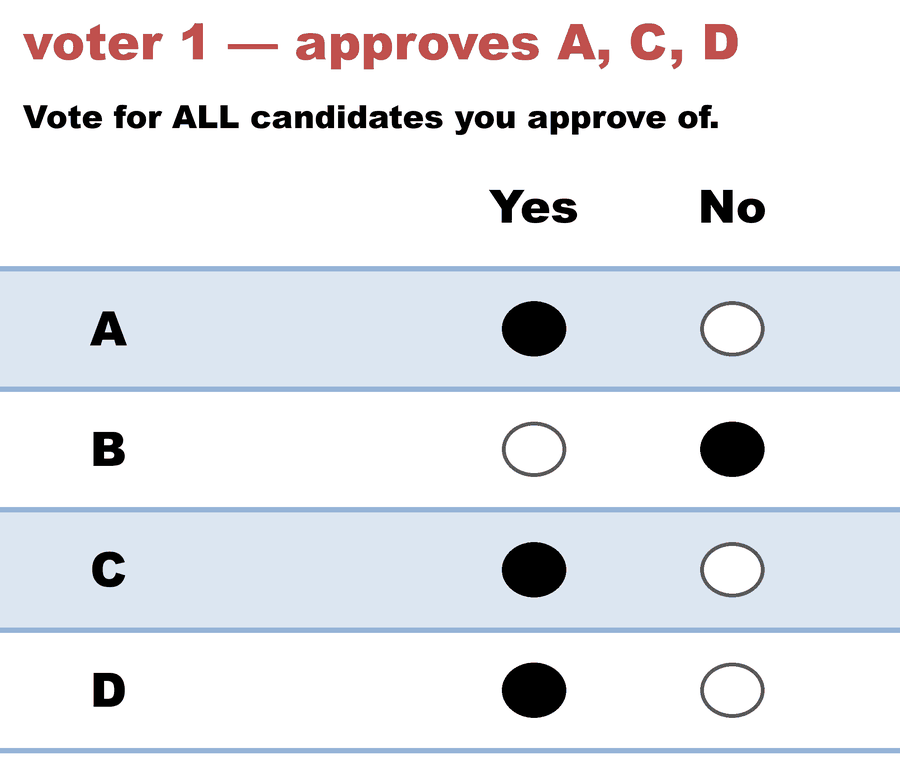 |
1 | 0 | 1 | 1 |
| 2 | 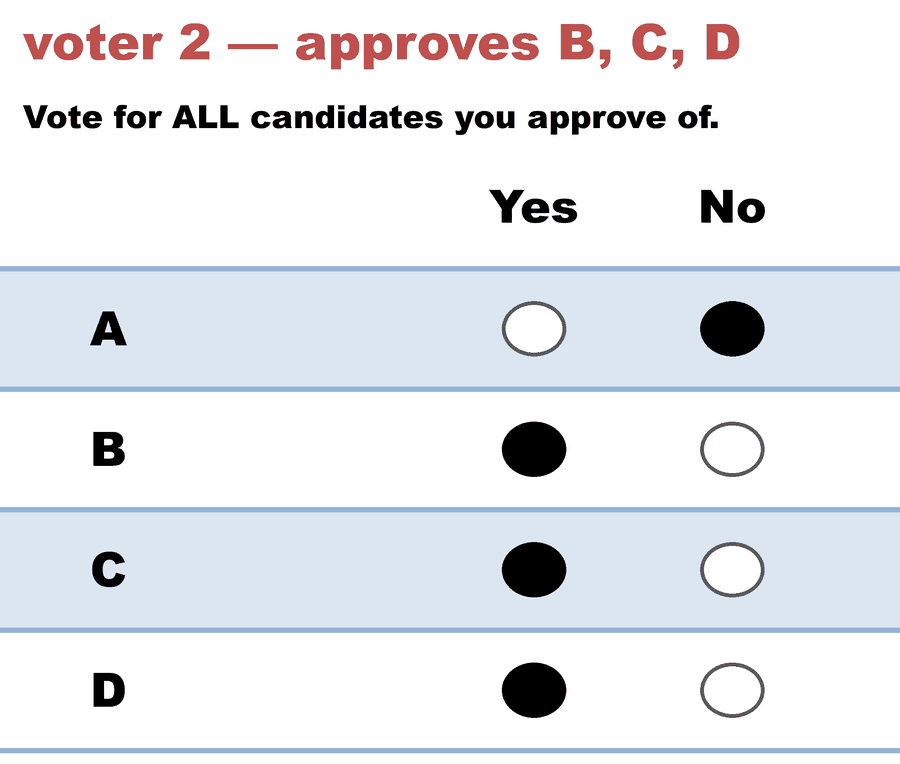 |
0 | 1 | 1 | 1 |
Two seats. Committee {C,D} gives both voters two approved winners; {A,B} gives both exactly one. So {C,D} dominates {A,B} outright.
Chamberlin–Courant asks only whether a voter has at least one approved winner. Both voters are covered by {A,B}; both are covered by {C,D}. CC scores them equally — in fact it scores all six two-seat committees equally, at 2 — and returns the lot, dominated committees included:
CC       {a,b} | {a,c} | {a,d} | {b,c} | {b,d} | {c,d}
AV       {c,d}
PAV      {c,d}
SAV      {c,d}
That is why CC is marked weak and not ✗: it does return {C,D} as well, so the dominating committee is never excluded — it is just not preferred. And it is why AV is marked strong: coverage saturates at one, but counting doesn't.
The repo's own Approval count on this file elects {C,D} and is a fair control:
--- Approval Voting (2 winners) ---
 Tabulating 2 ballots (any non-zero score = approval).

Ballots:
   columns = A, B, C, D      (1 = approve; 0 = not approved)
     1 × 1,0,1,1
     1 × 0,1,1,1

   C -- 2 (100%) -- Elected
   D -- 2 (100%) -- Elected
   A -- 1 (50%)
   B -- 1 (50%)

[Approval Distribution] (how many candidates each ballot approved)
   6 approvals across 2 ballots — average 3.0 of 4 (range 3–3).
     approved 3: 2 ballots

[Co-Approval Matrix]
 Of the voters who approved the ROW candidate, the % who ALSO approved the COLUMN candidate.
      |   C    |   D    |   A    |   B    |
   ----------------------------------------
   C  |   --   |  100%  |  50%   |  50%   |
   D  |  100%  |   --   |  50%   |  50%   |
   A  |  100%  |  100%  |   --   |   0%   |
   B  |  100%  |  100%  |   0%   |   --   |

Winners — Approval Voting (2 winners)
  C, D
The instructive failure: Monroe, and why it fails
CC's failure is a tie. Monroe's is a strict preference for the dominated committee, which is a different and more serious thing.
(No ballot art for monroe_pareto_dominated_c4_b24 — draw it with build_style_ballot_images.py --from-yaml 04_Approval/03_Criteria/cases/monroe_pareto_dominated_c4_b24.yaml.)
Row 1 = candidate names; each later row is one voter's approvals (1 = approve, 0/blank = not approved).
A,B,C,D
1,0,0,0   # 2 voters — approve A only
1,0,0,0
1,0,1,0   # 1 voter — approves A and C
1,0,0,1   # 1 voter — approves A and D
0,1,1,0   # 10 voters — approve B and C
0,1,1,0
0,1,1,0
0,1,1,0
0,1,1,0
0,1,1,0
0,1,1,0
0,1,1,0
0,1,1,0
0,1,1,0
0,1,0,1   # 10 voters — approve B and D
0,1,0,1
0,1,0,1
0,1,0,1
0,1,0,1
0,1,0,1
0,1,0,1
0,1,0,1
0,1,0,1
0,1,0,1
Two seats, 24 voters. Monroe assigns each winner an equal-sized constituency — here twelve voters each — and elects {C,D} with a Monroe-score of 22. But:
| Committee | voters with an approved winner |
|---|---|
{A,B} |
24 |
{C,D} |
22 |
Nobody is worse off under {A,B}, and the two voters who approve only A go from no representative at all to one. Every voter weakly prefers {A,B}; Monroe elects {C,D} regardless. Replayed:
Monroe            {c,d}          <- dominated
AV                {b,c} | {b,d}
PAV               {b,c} | {b,d}
CC                {a,b}
MAV               {a,b}
Method of Eq. Shares  {b,c} | {b,d}
Why it fails is the whole lesson. Equal-sized constituencies are a constraint, and a constrained optimum can be worse for everyone than an unconstrained one. Monroe is not carelessly built; it is doing exactly what it promises, and Pareto efficiency is what that promise costs. The book puts it plainly: Pareto efficiency "clashes with Monroe's goal to assign representatives to groups of similar size."
MAV's failure, which is a tie in disguise
Minimax Approval Voting minimises the worst voter's Hamming distance to the committee. On 1×{a,c}, 1×{b,c}, 1×{d,e} with one seat, every single-candidate committee leaves some voter at distance 3 — so MAV ties all of them, including {a}, which {c} dominates. Same shape as CC: an objective that saturates cannot see improvements past the saturation point.
Why you cannot just patch it
The obvious repair — "if the winner is dominated, output the committees that dominate it instead" — fails twice over:
- It breaks other things. Pareto efficiency and perfect representation (Chapter 4) are incompatible, so the patch trades one axiom for another.
- It isn't computable. Aziz & Monnot (2020) proved that deciding whether a given committee is Pareto optimal is coNP-complete (Theorem 3.1). You cannot even check the repair cheaply, let alone apply it.
Note the asymmetry that saves the day for the simple rules: finding a Pareto optimal committee is easy — AV and SAV do it in polynomial time. It is verifying an arbitrary one that is hard. See computational complexity.
What this means for the methods this repo teaches
- Bloc Approval — the LH engine's
Approval_Multi_Winner— is AV, so it inherits strong Pareto efficiency. On a committee-sized question this is the strongest thing that can be said for it, and it is worth saying because bloc Approval gets criticised (fairly) on proportionality grounds. - Approval's single-winner Pareto failure is a different animal. Felsenthal Example 6 shows Approval electing a Pareto-dominated candidate — but that is dominance measured against voters' underlying rankings, which an approval ballot doesn't record. Here dominance is measured in the approvals themselves. Both results are correct and they are not in tension; they are answers to different questions, and conflating them is an easy way to overclaim in either direction.
- STAR has no rule on this grid, because these are approval rules. The nearest bridge is the shadow-STAR page, which reads the same approval ballots as 0/5 STAR ballots.
Reproduce it
.venv/bin/python 06_Other/abcvoting_tabulation_engine/abc_axiom_check.py --verbose
The Pareto section replays Example 3.1 (Monroe) and both halves of Proposition A.1 (CC, MAV). --search 400 additionally hunts for a violation by AV, PAV and SAV — a hit would refute the table.
Related: the table · committee monotonicity — the next column · the ABC rules themselves · Pareto in the single-winner setting → social welfare function.