Inclusion-strategyproofness — the column where AV stands alone
Level: 301 · deep dive
One line: twelve of the thirteen rules in Table 3.1 can be gamed by a voter who simply narrows an honest ballot, and the one that can't is plain Approval Voting — which is the strongest honest thing this repo can say for bloc Approval, and worth saying precisely because the rest of the case for it is weak.
Why approval ballots get a second chance at this
Gibbard–Satterthwaite kills strategyproofness for every reasonable ranked single-winner rule. It does not apply here: an approval ballot is a much more restricted object than a linear order, so the impossibility doesn't reach, and strategyproofness is genuinely on the table. Table 3.1 is where the field cashes that in — and mostly finds it doesn't help.
Two definitions, and why the weaker one is the interesting one
Both come from Peters (2018), and both assume a resolute rule. A′ is an i-variant of A: only voter i changed her ballot.
Definition 3.6 — cardinality-strategyproofness.
|R(A,k) ∩ A(i)| ≥ |R(A′,k) ∩ A(i)|. Voterican never increase the number of her approved candidates on the committee by misreporting.Definition 3.7 — inclusion-strategyproofness.
R(A,k) ∩ A(i)is never a strict subset ofR(A′,k) ∩ A(i). Voterican never get a committee containing all the approved candidates she already had plus more.
Cardinality is the stronger axiom (it implies inclusion), and the reason to state the weaker one is that it makes fewer assumptions about the voter. Cardinality-strategyproofness assumes she only counts her winners and cannot tell them apart. Inclusion-strategyproofness allows her to have real preferences among the candidates she approves — so a manipulation only counts as successful when it is unambiguously better: she keeps everyone she had and gains someone.
A rule failing the weaker axiom is therefore the serious finding, and twelve rules fail it.
The smallest witness: SAV, two voters
The ballots as marked — a filled Yes is a 1 in that candidate's column, a filled No a 0:
| # | Ballot as marked | A | B | C | D | E |
|---|---|---|---|---|---|---|
| 1 | 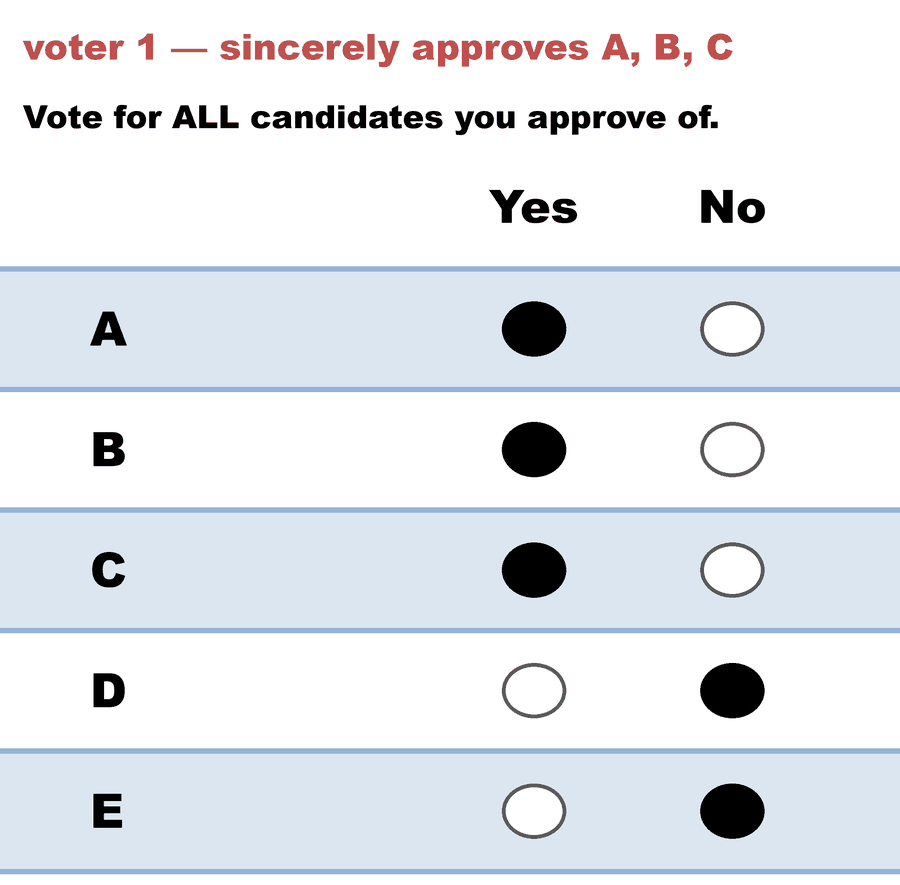 |
1 | 1 | 1 | 0 | 0 |
| 2 | 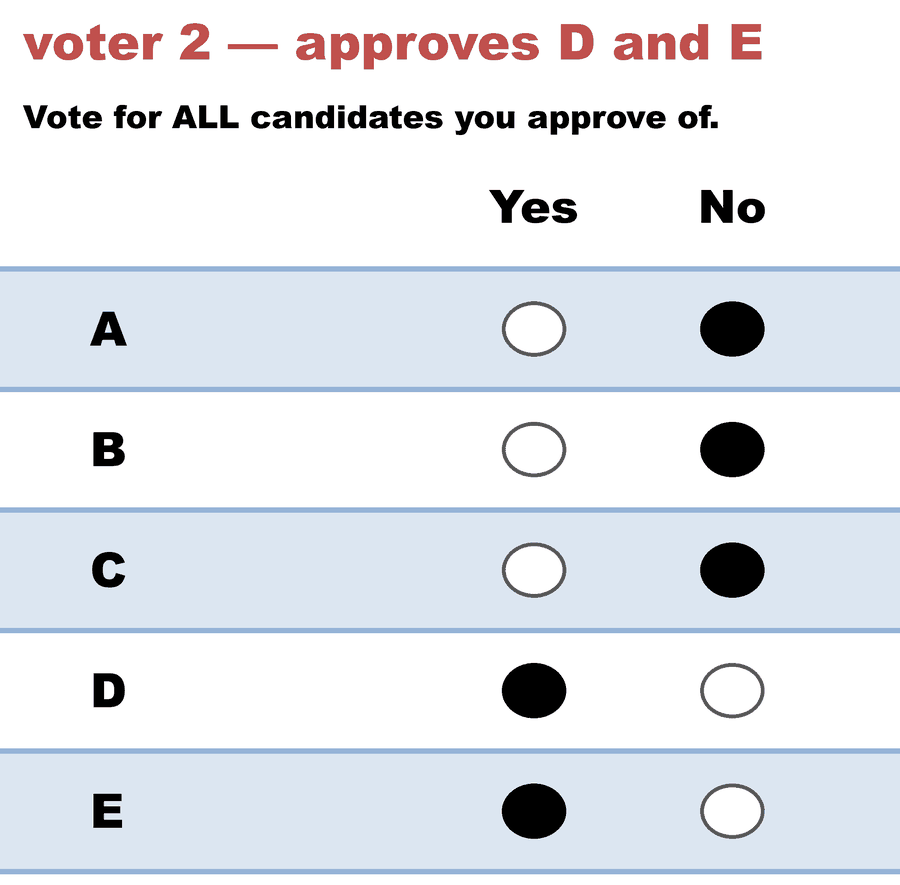 |
0 | 0 | 0 | 1 | 1 |
One seat. SAV gives each ballot one vote and splits it evenly among that ballot's marks. Voter 1's three marks are worth 1/3 each; voter 2's two marks are worth 1/2 each:
honest       SAV scores: d = e = 1/2 ; a = b = c = 1/3     -> {d}
voter 1 reports {a} alone
             SAV scores: a = 1 ; d = e = 1/2               -> {a}
Voter 1 goes from a committee containing none of her approved candidates to one containing A. She did it by deleting two honest approvals — no lie about anyone she dislikes, just a narrower truth.
The mechanism is SAV's own selling point. Dividing a vote by ballot length is what lets SAV distinguish these two ballots at all — plain AV ties all five candidates at one approval each and cannot separate them. The same division is what makes shortening a ballot pay. You cannot have the discrimination without the incentive.
The repo's Approval control on this file, showing the five-way tie:
--- Approval Voting (single winner) ---
 Tabulating 2 ballots (any non-zero score = approval).

Ballots:
   columns = A, B, C, D, E      (1 = approve; 0 = not approved)
     1 × 1,1,1,0,0
     1 × 0,0,0,1,1

   A -- 1 (50%) -- Elected
   B -- 1 (50%)
   C -- 1 (50%)
   D -- 1 (50%)
   E -- 1 (50%)
  Note: A, B, C, D, E each have 1 approval and tie for the last 1 seat.
        Candidate priority order (A > B > C > D > E) broke the tie: A elected, B, C, D, E not elected.

[Approval Distribution] (how many candidates each ballot approved)
   5 approvals across 2 ballots — average 2.5 of 5 (range 2–3).
     approved 2: 1 ballot
     approved 3: 1 ballot

[Co-Approval Matrix]
 Of the voters who approved the ROW candidate, the % who ALSO approved the COLUMN candidate.
      |   A    |   B    |   C    |   D    |   E    |
   -------------------------------------------------
   A  |   --   |  100%  |  100%  |   0%   |   0%   |
   B  |  100%  |   --   |  100%  |   0%   |   0%   |
   C  |  100%  |  100%  |   --   |   0%   |   0%   |
   D  |   0%   |   0%   |   0%   |   --   |  100%  |
   E  |   0%   |   0%   |   0%   |  100%  |   --   |

Winner — Approval Voting (single winner)
  A
Every other rule, same shape
The book gives a witness per rule (Proposition A.4), and all eleven replay. A representative sample:
| Rule | honest ballot → committee | misreport → committee | what she gains |
|---|---|---|---|
| CC | {a,b} → {a,c} |
{b} → {a,b} |
keeps a, gains b |
| PAV | {c,d,e} → {b,c,f} |
{e} → {b,c,e} |
keeps c, gains e |
| seq-PAV | {a,b} → {b,c,f} |
{a} → {a,b,f} |
keeps b, gains a |
| rev-seq-PAV | {a,b,c} → {b,d} |
{a} → {a,b} |
keeps b, gains a |
| Monroe | {b,d} → {a,b,e} |
{f} → {b,d,f} |
keeps b, gains d |
| seq-Phragmén | {a,b,c} → {b,f} |
{c} → {b,c} |
keeps b, gains c |
| Method of Eq. Shares | {b,c,d} → {b,d,e} |
{c} → {b,c,d} |
keeps b,d, gains c |
| MAV | {a,b,c} → {a,b,d} |
{c} → {a,b,c} |
keeps a,b, gains c |
Notice what almost every manipulation is. In eight of the eleven the misreport is a bullet vote or near-bullet vote — the voter drops most of her honest approvals and concentrates. This is the same incentive that shows up all over approval-style voting, and this repo has it in the STAR setting too: see bullet voting's backfire and tactical maximization. What the table adds is that under every proportional approval rule the incentive is structural, not incidental — the very reweighting that produces proportionality is what makes a shorter ballot more powerful.
AV's proof, and its limits
AV passes both axioms, and the argument is short enough to hold in your head. Decompose any ballot change into single steps. Disapproving a candidate you truly like can let at most one new candidate onto the committee — and only by removing the one you dropped, so you don't gain. Approving a candidate you dislike can let that candidate replace someone — which doesn't help you either. No single step helps, so no sequence does.
Then the caveats, which matter more than the result:
- Only under a fixed tiebreaking order on candidates. Ties are where manipulation lives, and AV's guarantee is stated on the resolute rule.
- Only for dichotomous preferences. If a voter actually prefers some approved candidates to others — the realistic case — AV is not strategyproof. Her strategic problem simply moves to where the approval threshold goes, which is the approval voter's real decision and is not modelled by these axioms at all.
- Strategyproofness is incompatible with proportionality. Chapter 4 shows even weak proportionality clashes with these axioms. AV's clean row is possible because AV promises nothing proportional.
So: AV is strategyproof in exactly the sense the model defines, and that sense is narrower than the word suggests. Stating the caveats is not undercutting the claim; it is what keeps the claim usable in an argument.
Two open cells — and what looked at first like a contradiction
CC and leximax-Phragmén carry ? in this column. But read Proposition A.4's opening sentence and it lists both among the rules that fail inclusion-strategyproofness, and Appendix A hands each one a counterexample. Table and appendix appear to disagree.
They don't, and the reconciliation is worth the detour, because it is a point about counterexamples generally. Build the two witnesses and look at what the manipulated profile returns:
| Rule | honest winner | manipulated winners | pays off? |
|---|---|---|---|
| CC | {a,c} (unique) |
{a,b} | {a,c} |
{a,b} yes · {a,c} no |
| leximax-Phragmén | {b,c,d} (unique) |
{a,b,c} | {a,b,d} | {a,c,d} |
first two yes · {a,c,d} no |
| PAV (for contrast) | {b,c,f} (unique) |
{b,c,e} (unique) |
unconditional |
For CC and leximax-Phragmén the misreport lands the election in a tie, and the manipulation pays only if the tiebreak resolves the right way. That is exactly what the proposition's phrase "without loss of generality we assume that a tie between committee {a,b} and {a,c} is resolved in favour of {a,b}" is doing — it is choosing the tiebreak that makes the counterexample work. So the honest statement is: these two rules are manipulable under some tiebreaking orders, and whether they are manipulable under every one is open. Every other failing rule in the table is manipulable outright, with a unique winner on both sides.
For PAV, seq-PAV, Monroe, MAV and the rest, no such caveat: the manipulated profile has a unique winner and the misreport pays whatever the tiebreak.
This is machine-checked rather than argued — abc_axiom_check.py computes the paying and non-paying tied committees for every strategy witness and fails if a rule's tiebreak-dependence stops matching its cell, so the ? and the explanation can't drift apart.
The transferable lesson: a counterexample that needs a particular tiebreak is a weaker object than one that doesn't, and the difference is invisible in a grid of ticks and crosses. It only shows up if you run it.
For this repo's methods
- Neither STAR nor RCV-IRV is on this grid, and the nearest single-winner relatives are the Favorite Betrayal Criterion and later-no-harm — kept distinct from each other and from this, per the terminology policy.
- The transferable lesson is the trade, not the ranking. Every rule here that resists manipulation is one that gives up proportionality, and every rule that delivers proportionality can be gamed by narrowing a ballot. That is the honest frame for comparing bloc and proportional methods — better than a checklist, and it cuts against the simple rules as often as for them.
Reproduce it
.venv/bin/python 06_Other/abcvoting_tabulation_engine/abc_axiom_check.py --verbose
Twelve inclusion-strategyproofness witnesses replay — one per failing rule.
Related: the table · consistency — the previous column · computational complexity — the last · Gibbard–Satterthwaite · SAV.