Non-monotonicity (RCV-IRV) — part 1: baseline, X wins
Generated from monotonicity_irv_before.yaml — do not edit by hand. Regenerate: python STARVote_LH_tabulation_engine/tools_adam/scripts/build_yaml_pages.py.
Method: RCV-IRV (Instant Runoff) · 1 seat · Expected winner: X
Scenario
Part 1 of the RCV-IRV monotonicity pair: 34 voters, X wins (Z is eliminated, Z's ballots transfer to X). This is the baseline for the paradox — in part 2 (monotonicity_irv_after.yaml) four voters RAISE X from second to first choice, change nothing else, and X LOSES. Keep both files side by side; the ballots differ only in those four voters.
Ballots
Each row is one voter's ranking, most-preferred first (N: prefix = N identical ballots).
12:X>Y
12:Y>Z
10:Z>X
What the engine says
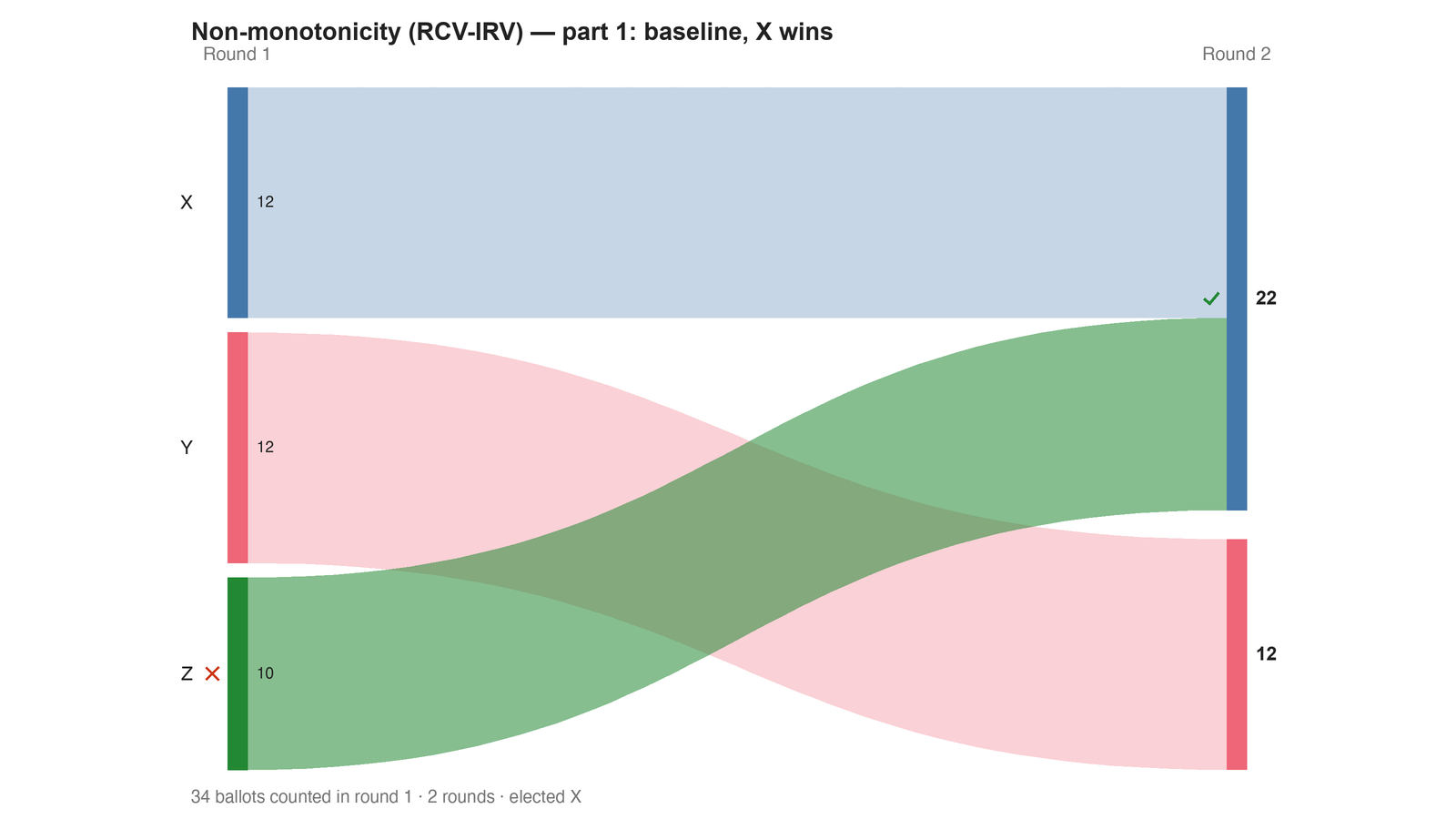
Where the votes went. Band thickness is votes; a band leaving an eliminated candidate lands on whoever that ballot ranked next, or on inactive if it ranked nobody who was left.
The count, step by step — the rounds and how the winner is reached:
--- RCV / Instant-Runoff Voting (single winner) ---
  Non-monotonicity (RCV-IRV) — part 1: baseline, X wins
 Tabulating 34 ballots (ranked ballots).

ROUND 1
Candidate      Votes  Status
-----------  -------  --------
Y                 12  Hopeful
X                 12  Hopeful
Z                 10  Rejected

FINAL RESULT
Candidate      Votes  Status
-----------  -------  --------
X                 22  Elected
Y                 12  Rejected
Z                  0  Rejected


Winner(s) — RCV / Instant-Runoff Voting (single winner)
  X

--- Transfers and inactive ballots (what the round tables leave out) ---
The tables above give each candidate's round total but not where a
transferred vote came FROM, nor how many ballots stopped counting.
Both are recomputed from the ballots, using the eliminations the
count above actually made.

ROUND 1 — 34 of 34 ballots still active; majority = 18
   Z eliminated with 10:
      → X                        10

FINAL ROUND — 34 of 34 ballots still active; majority = 18
   X                        22  (64.7% of the still-active)  ← elected
   Y                        12  (35.3% of the still-active)
   Never exhausted, never transferred:
      12 ballots held by Y carried a lower ranking that was never read
      (the count stopped here, so those preferences did nothing).

Inactive ballots at the final round: 0 of 34 (0.0%).
   X's 22 is a majority of the 34 still active AND of all 34 cast (64.7%).
Full audit — preference matrix, Condorcet, and score distribution
--- Smith Set (the generalized Condorcet winner) ---
The smallest group whose every member beats every candidate outside it —
the honest answer to "who is even in contention?".
   Smith set (3 of 3): X, Y, Z
   Outside (0):        —
   More than one member ⇒ NO Condorcet winner: the top of the tournament is a
   cycle, so the strongest "candidate" is a set, not a person. Which member of
   the set should win is exactly what Minimax / Ranked Pairs / Schulze disagree
   about — see 05_Ranked_Robin/01_Learn/cycle_resolution.md.
   RCV-IRV winner X is INSIDE the Smith set. ✓
      Not guaranteed — RCV-IRV is not Smith-efficient — but it holds here.
   More: 07_Concepts/topics/smith_set.md
Everything in one file: the _tabulated mirror (regenerated on every run; every analysis forced on).
Run it yourself:
python STARVote_LH_tabulation_engine/starvote_larry_hastings.py method_comparisons/monotonicity/cases/monotonicity_irv_before.yaml
See also
More cases in this set: alaska_upward_after · alaska_upward_before · mono_raise_delete_after · mono_raise_delete_before · monotonicity_irv_after · monotonicity_star_after · monotonicity_star_before · sf_d7_downward_after · sf_d7_downward_before