FSD — Paper-Ballot Demo Toolkit (bv_ballot_sheet.py)¶
Functional Specification (as-built). A dev/maintainer-facing spec for the printable-ballot tool and the paper-ballot demo workflow. The teacher-facing how-to is running_a_paper_ballot_demo.md; this doc records what it does, why the design choices were made, and — importantly — what it deliberately does not do.
Status: front-end (ballot generation) built, self-tested, and validated on real hardware (printed → QR scanned → voted → hand-marked ballot read → cast back to BV; see §7). Return-path (OCR — automated image→scores) is a documented roadmap, not built; until then the return path is a human transcribing marks into a YAML/CSV.
1. Goal¶
Let a teacher / workshop leader / demo runner turn a STAR election into printable paper ballots, so a room can vote on paper, hand-count, and compare the result to BetterVoting's official tally. The teaching payoff: two independent counts (paper + platform) that agree — the repo's "don't believe it, check it" story, made tangible.
2. Scope¶
In scope (built): generate print-ready ballots from a STAR election; link them to a BetterVoting election (id, results URL, QR); preview a ballot before the election is minted (§5.7); optional serial "receipts", write-in rows, and a custom QR target for offline demos.
Out of scope — deliberately (the guard):
- OCR / scan-to-YAML (the return path). Needs a vision engine; specified in §6 as the roadmap, not built. Rationale: an unverified OCR pipeline that silently misreads a score is worse than none.
- Threading serials through BetterVoting's vote API for digital "confirm counted." BV doesn't carry them and it isn't needed — the serial demo is complete on paper (§5.3). A truly digital verifiable count is end-to-end verifiability (E2E-V), a cryptography research area, flatly out of scope.
- Extra ballot options — parked "someday, if asked": other ballot types (Approval checkboxes, ranked-order grids), tear-off receipt stubs, localization (--lang), custom logos/branding, and multi-race-per-sheet ballots. Each is real polish or added capability but adds no lesson the single-race STAR paper ballot doesn't already teach; multi-race printing complicates both the sheet and the hand-count, and the "run 4 separate demos and compare" framing teaches the same thing with no code. (Revisit only if there's a concrete need — e.g. teaching the meta method-comparison on paper.)
- The compass for every call above: "does this add education, or just engineering?" Education → build; engineering-only → drop.
3. Workflow supported¶
One route to a REAL ballot (simplified 2026-07 — see §5.1), preceded since 2026-07-25 by a pre-mint preview (§5.7), because step 1 is irreversible:
0. Preview before you mint (optional)  → bv_ballot_sheet.py --spec [NAME] → PDF stamped PREVIEW
1. Create the election on BetterVoting → export its JSON
2. Print ballots from the export        → bv_ballot_sheet.py --bv-export … → PDF
3. Vote                                 → fill 0–5 bubbles on paper, and/or scan the QR
4. Count via BetterVoting               → hand-count and/or enter/cast the paper into BV
5. Compare to BetterVoting              → bettervoting.com/<id>/results
6. (roadmap) OCR paper → scores → cast into BV  (today: human transcribes)
create_bv_test_election.py (creates the election and saves its JSON to 06_Other/_demo_dropbox/ — so the id is real and the QR/results resolve; cf. FR-12), or the BV UI.
Why one route: earlier the tool also accepted --candidates (offline, no BV) and --yaml. Those were dropped to make the workflow singular and unambiguous — create → export → import → print. The cost, accepted deliberately: no offline printing (you must create a BV election first). The upside: the id is always real (no fabricated-id dead links), descriptions/title/candidates come from one authoritative source, and there is exactly one thing to document and teach.
Still hybrid. Because the ballot carries a real QR, the same election runs on paper and online at once — paper voters fill bubbles, QR voters scan and vote on BetterVoting (online votes need no transcription). So you can push most of a room to the QR and keep a few paper ballots to demonstrate the hand-count.
4. Functional requirements — the tool¶
FR-1 Input — one route to a real ballot, plus a preview route:
- --bv-export FILE — a BetterVoting export JSON. Extracts the title, election_id, candidate names, and the election + first-race descriptions. This is the only route that produces a real ballot (id, QR, results link). There is still no manual/candidate-list or YAML route (removed 2026-07, §5.1).
- --spec [NAME] (added 2026-07-25, §5.7) — a pre-mint preview: read the election straight from bv_election_specs.py before it exists on BetterVoting. There's no id, so no QR and no results link, and the notice is replaced with "PREVIEW - this election has NOT been created on BetterVoting yet. Do not hand out." Bare --spec takes the single entry of ELECTIONS; --spec NAME names one (needed whenever ELECTIONS points elsewhere, which it usually does). Passing both routes is an error.
- --keep-test-id — by default a leading repo Test ID ("BV2252 — ") is stripped from the printed title. BV<n> is an internal cross-reference (registry, git, the BV title/race titles); it means nothing to a voter holding paper, and the footer's election id is the one that actually resolves.
- --title / --question / --blurb — optional overrides (e.g. a cleaner ballot title than the verbose BV one). The blurb is now off unless asked for — see FR-3a. Everything else is output styling (FR-2 … FR-12).
FR-2 Output — a print-ready PDF (the only format). The ballot is composed as self-contained HTML (embedded CSS, inline-SVG QRs) and rendered to PDF via headless Chromium (playwright, playwright install chromium once). playwright is therefore required; if it's missing the tool errors with the install command (no HTML/ASCII fallback). --out takes a .pdf path (a non-.pdf extension is swapped for .pdf). (ASCII .txt and standalone .html outputs were removed 2026-07 at the user's request — PDF only.)
FR-2a Pagination: --per-page N is real (a print page-break-after every N ballots, never a trailing blank page). Default is 1 — one ballot per page, the right choice for ballots handed to voters individually (secret ballot). Set --per-page 2+ to pack multiple per sheet to save paper.
FR-3 Per-ballot content (styled after the official Equal Vote STAR ballot): a demonstration notice (FR-9); a STAR VOTING wordmark header (star-with-check facsimile + "SCORE · THEN · AUTOMATIC · RUNOFF"); the election title, optional description blurb (italic), and question; the four bulleted instructions ("Give your favorite candidate(s) five stars", etc.) plus a fine-print overvote line; the score grid — Worst/Best labels, star-outline column headers 1–5 (0 plain), digit-in-bubble cells, zebra-striped candidate rows; the finalist explanation ("The two highest scoring candidates are finalists…"); a footer with serial + BV id + results URL; and an optional promo line (FR-10).
FR-3a Descriptions (default flipped 2026-07-25). The first race's description still becomes the question line automatically (--question overrides). The election description no longer prints as the blurb by default — a BV description is written for the voting page: several hundred words, and it often narrates the expected outcome, which is both noise on a ballot and a spoiler. --blurb TEXT sets your own; --blurb-auto restores the old auto-from-export behavior. (Was: auto-blurb on, with --blurb "" as the escape — the escape had to be typed every single time, which is the sign of a wrong default.)
FR-10 Promo footer (optional, off by default): --promo adds a small footer line — Learn more: starvoting.org · equal.vote · bettervoting.com; --chapter "TEXT" appends a local chapter (e.g. STAR Voting NC (facebook.com/groups/starvotingnc)) and implies --promo. Off by default so the base ballot matches the clean official design; links are parameters, not the election description (see §5.5).
FR-11 Custom logo (optional): --logo FILE embeds a local image (SVG/PNG/JPG) as a self-contained data URI in the header, replacing the drawn STAR-wordmark facsimile — so a user can drop in the real Equal Vote logo or a chapter logo. Missing/unreadable file → a warning and graceful fallback to the facsimile. Bounded on purpose: one header logo, not a general image-insertion system (that would be engineering past the lesson).
FR-12 BV-id integrity — no dead links. The single input route already makes the id real by construction (it comes from an actual BV export). As a belt-and-suspenders against a stale or hand-edited export, --verify-bv pings GET /API/Election/{id} before printing: a definitive 4xx → drop the QR + results link and print a plain ballot (with a warning); confirmed → keep; unreachable (offline) → keep with a warning. Stdlib urllib, no new dependency; recommended before a real print run. (The dead-link risk originally surfaced via a synthetic demo99 export with a fabricated id; the one-route simplification removed the class of bug at the source, and --verify-bv catches the rest.)
FR-9 Demonstration notice (on by default): every ballot carries a standing notice — default "EDUCATION ONLY - a STAR Voting teaching demo, not a secret ballot." — because this tool only makes demo ballots. It also does real work: it makes the optional serial number read as a teaching device rather than surveillance (a numbered real ballot would break the secret ballot; the notice preempts the immediate — and correct — objection). --notice "..." overrides the text; --no-notice omits it (discouraged). Rendered as a bordered banner at the top of each ballot.
FR-4 QR code (required, not optional) — ONE big vote code (changed 2026-07-25). The header carries a single vote QR (→ bettervoting.com/<bv-id>) at 176px, captioned "Scan to vote online", in a fixed-width right rail. The results QR was dropped from the default ballot: the results URL already prints as text in the footer, and two competing codes halve the call to action. --results-qr puts it back as a small code (half size) beside the footer's results URL — where the text it encodes already is, not in the header. Because every ballot links to a live BV election it must be scannable: if segno (the QR library) is missing the tool errors with the install command — it does not silently print a QR-less ballot. --no-qr is the only way to deliberately omit it; and if --verify-bv finds the id doesn't resolve, the QR is dropped (→ plain ballot, since there's nothing real to scan).
- Implemented via the pure-Python segno library (declared in pyproject.toml, required). Missing segno → error (see above), not a QR-less ballot; --no-qr to force off deliberately.
- Size: --qr-size PX (default 176; the optional footer results QR prints at half).
- The preview's stand-in QR (preview route only). A --spec preview has no election id, so it would print no QR at all — which makes the layout hard to judge. It therefore prints a stand-in code at full size, captioned "TEST ONLY - sample QR", pointing by default at https://bettervoting.com/qp8w68/results — a real but CLOSED election (BV151), so a scan lands somewhere honest where no vote can be cast. That target is chosen against two worse options: an invented election id would print a scannable dead link (the failure FR-12 exists to prevent), and an open election would invite a stray vote into someone else's tally. --preview-qr URL retargets it, --no-qr drops it, and it is refused on --bv-export (a real ballot must carry its own election's code). Preview sheets also get a diagonal TEST ONLY watermark (--no-watermark to drop it) — unlike a header notice, it can't be cropped or overlooked.
- Implementation note: .ballot carries overflow: hidden for correctness, not looks — the rotated nowrap watermark is wider than the page, and Chromium's page.pdf() silently scales the whole document down to fit its widest content, which shrank every ballot and undid the page-fill (FR-2a). Clipping it to the ballot box keeps the sheet at 100%.
- The election id is printed ONCE (was three times): a bold Election <id> + the …/results link in the footer. The QRs carry captions only (no URL text), so the id isn't duplicated under them.
FR-5 Serial receipts (optional, --serials): number each ballot ("Ballot #N — keep this to verify it was counted"). See §5.3 for the verifiability design + secret-ballot caveat.
FR-6 Write-in rows (optional, --write-ins N): N blank "Write-in: ___" rows with a 0–5 grid. Front-end only — tallying write-ins (name matching across ballots) is an OCR-step concern (§6), not the printer's.
FR-7 Layout: --copies N, --per-page N (real page-breaks, default 1), --out FILE (a .pdf path). Print CSS avoids splitting a ballot across pages.
FR-8 Self-test (--selftest, offline): known-answer checks covering candidate presence, BV id + results URL, ballot count, bubble-grid arithmetic, HTML escaping, serials, write-in rows, pagination (per-page breaks, no trailing blank), the QR path (present/absent), the --bv-export schema (capitalized Election) + descriptions, the demonstration notice (+ --no-notice), the official-style chrome (wordmark, bullets, Worst/Best, stripes, star headers, explanation, digit bubbles), and the --logo embed. Operates on the composed HTML (no PDF render, no network — so playwright and --verify-bv are exercised manually, not in selftest). Exit non-zero on failure.
5. Key design decisions & rationale¶
5.1 One input route: print from a BetterVoting export (simplified 2026-07). The tool originally accepted three inputs — --bv-export, --yaml, and a manual --candidates list (which allowed offline, no-BV printing). At the user's request that was collapsed to --bv-export only: create the election on BV, export the JSON, print from it. The trade-off, chosen deliberately: offline printing is gone (you must create a BV election first). What it buys — a single unambiguous workflow, an id that's always real (no fabricated-id dead links, cf. FR-12), one authoritative source for title/candidates/descriptions, and far less to document. (An earlier version of this spec argued the offline/LH-only path was "the foundation"; the user reversed that in favor of simplicity — recorded here so the history is clear.)
5.2 Flag mistakes by reusing the repo's existing markers — don't invent a scheme. The marker vocabulary (see CLAUDE.md) already maps ambiguous input to 0-with-a-flag:
| On paper | Meaning | YAML |
|---|---|---|
| one bubble | valid 0–5 | that digit |
| ≥2 bubbles in a row (e.g. 2, 4 and 5) | overvote / ambiguous | ? (spoiled — counts 0, reported) |
| no bubble | no score | 0 (or - blank) |
| stray / illegible | unreadable | ? + run-log note |
So "voter marked 2, 4 and 5 for one candidate" → ? in that column; the engine already scores it 0 and surfaces it as spoiled. The ballot warns the voter up front.
5.3 Serials teach verifiability — with the secret-ballot tension as the lesson. Publishing the list of counted serials demonstrates counted-as-cast. But a serial linkable to a voter breaks ballot secrecy (coercion) — which is why real systems need E2E-V (crypto receipts that confirm your vote counted without revealing how you voted). The tool prints serials; the demo page frames the tension. Keep serials unlinked to identity in any real use; do not build BV/digital serial plumbing (§2). The default demonstration notice (FR-9) is the on-ballot half of this safeguard: it states in print that the sheet is a teaching demo, not a secret ballot — so a numbered ballot can't be mistaken for (or objected to as) a real one.
Why serials default OFF (a considered call, not an accident). The pull is real in both directions: - For ON: every demo would surface verifiability + the secret-ballot tension (the richest discussion the tool enables); numbered sheets aid hand-count reconciliation ("all 30 back, none duplicated"); and now that every ballot is stamped "EDUCATION ONLY," the main risk of ON is largely defused. - For OFF: the core STAR lesson (score → runoff) stays the focus; no privacy footgun if a demo is reused casually; and in a classroom, ballots handed out in seating order plus numbers are deanonymizable.
The decider is a default-design principle: a default is used by the person who isn't thinking about it. A serial only pays off paired with the discussion ("what breaks if we post a name→number list?"); a teacher who wants that types --serials, and that deliberate act is the signal they'll frame it. An ON default instead hands numbered ballots to the teacher who didn't plan the lesson — propagating the double-edged artifact without the framing that makes it safe. So: the safe, on-topic thing is the default; the richer-but-double-edged thing is a conscious opt-in. Serials OFF, notice ON, and the teacher docs actively invite --serials when verifiability is the lesson. Keep serials unlinked to identity in any real use; do not build BV/digital serial plumbing (§2).
5.4 QR is conditional, not decorative. The QRs are dropped only when the id doesn't resolve (--verify-bv) or --no-qr is set — never printed pointing at nothing.
5.6 Adopt the official ballot gray palette; skip the brand fonts. From Equal Vote's brand sheet:
- Grays applied (match + save ink, both cheap wins): bubbles #666666, stars #cccccc, alternating-row highlight #ececec (was a black bubble border, blue-gray stars, blue stripe). These are the exact ballot-element grays the brand specifies, and the lighter tones use less toner across a 30-ballot print run — which the source images explicitly flag ("too much black, too much ink"). The #999999 candidate-separator lines aren't added — we use the zebra stripe instead of lines (either is on-brand; stripe is cleaner).
- Background stays white, NOT the brand's off-white #fffdf5 — off-white is for digital graphics; on paper, filling the sheet wastes ink and white is the paper.
- Fonts: deliberately not changed. The brand fonts are proprietary (logo = Anteb; Equal Vote = Avenir Next Pro) or a webfont (Montserrat / Verdana) that would have to be embedded to keep the file self-contained — bloat and complexity for a difference the source itself calls invisible ("hard to tell Verdana isn't Montserrat"). The system sans stack already reads as a clean geometric sans. The one branded-type moment is the logo, which --logo (FR-11) handles. Verdict: not worth tinkering — a good logo carries the brand.
5.5 Match the official ballot; links are parameters, not description. The layout deliberately mirrors Equal Vote's recognizable STAR ballot (wordmark, bulleted instructions, Worst/Best, star headers, stripes, finalist footer) — familiarity buys credibility for a teaching artifact. Two calls fall out of that goal:
- The default logo is a facsimile, not the trademark. A self-contained file can't embed Equal Vote's actual logo asset, and every ballot is stamped EDUCATION ONLY, so we draw a star-with-check lookalike in inline SVG rather than pass off their mark. A user who has the right to the real logo (or a chapter logo) supplies it with --logo FILE (FR-11) — the decision to use a real mark is theirs, made explicitly.
- Promo links are --promo / --chapter parameters, kept OFF by default — not folded into the description. Reasons: (1) the description is election-specific content (what the vote is about); links are boilerplate promotion, identical across elections — mixing them would pollute the BV description field and repeat on every export; (2) the official ballot carries no URLs, so links-off is what keeps ours faithful; (3) a teacher promoting locally flips them on deliberately (--promo --chapter "…"), which is exactly when the promotion is wanted. On paper the links are read-and-type text (short domains), not clickable — so a compact one-liner beats a wall of full URLs.
5.7 A pre-mint preview route — restoring (a narrow version of) what §5.1 removed (2026-07-25). §5.1 collapsed three input routes to one and, with them, offline printing. That was right for printing, but it took out the only way to look at a ballot before the irreversible act: a BV election is permanent, undeletable, and its title/description/candidates can never be edited. --spec [NAME] reads the very spec you're about to send (from bv_election_specs.py), so the preview is of the real thing rather than a free-form ballot typed twice — the failure mode --candidates had. It prints no QR and no results link (there is no id yet) and stamps PREVIEW … Do not hand out where the notice goes, so a preview can't be mistaken for a live ballot. The paired check on the other tool is create_bv_test_election.py --dry-run, which prints the effective title, every race title, the candidates, the ballot count, and resolves the description's backlink URL (a 404 there is permanent — that's how BV2249 got one). Cost: one more route to document. Bought: the class of mistake that can't be fixed afterwards.
5.8 One big call-to-action QR, and a two-column header (2026-07-25). The header used to be QR | logo | QR at 88px, with a spacer to keep the logo centered when a code was missing. Two problems: two codes of equal weight make the voter choose between them at the moment you want a single obvious action, and 88px is small to scan across a table. So: the vote code only, at 176px, captioned "Scan to vote online". The results code isn't lost — --results-qr prints it small next to the results URL in the footer, which is where its meaning already lives. The layout follows: the intro stack (logo, title, blurb, question, instructions) flows in a left column with the big QR as a right rail, vertically amortized against a stack that was already ~200px tall — so the code costs almost no height and the score grid starts where it always did. Rejected: the QR centered above the title (adds its full height, buries the title), a dedicated QR row (same height cost with dead whitespace beside a 74px logo), and floating it beside the grid (steals grid width, and voters may read it as belonging to a candidate row). Right rail, not left, because the candidate names own the left edge and the reading spine stays title → instructions → grid. Companion change: the ballot is a flex column with a min-height computed from the page (10.2in printable ÷ ballots-per-page), and the grid sits in a flex:1 wrapper — so a one-per-page ballot stretches into the bottom third that used to be blank, giving taller, easier-to-mark rows instead of a ballot floating at the top of the sheet. --no-fill-page restores the old compact block. Instruction/candidate/explain type went up (13.5→17px, 15→17px, 12.5→14.5px) to use that same room.
6. Return-path (OCR) — roadmap spec, NOT built¶
Restated in the repo's terms (the goal, not the letter of the original suggestion):
1. Read each ballot image; locate candidate rows and the 0–5 bubble grid.
2. Per row, count filled bubbles → 1 = that score · 0 = 0 · ≥2 = spoiled.
3. Below a confidence threshold, or unreadable → flag + log for human review.
4. Emit a scores table (one scored/marked row per ballot) plus a run log naming every flagged ballot.
5. Cast the scores into the BV election (POST /API/Election/{id}/vote) — BV tallies them alongside the online voters. Loop closed. (This replaces the old "→ YAML → LH engine" endpoint; BV is the tabulation authority.)
Open design questions for whoever builds it: OCR engine choice (local tesseract preferred over a cloud API — offline, no key); bubble detection vs. handwriting; write-in name matching ("Bob"="bob"="Bobby"); deskew/threshold robustness. Build discipline: a synthetic-ballot round-trip self-test (render ballots with known scores → OCR → assert match) before it's trusted on real scans. Until built, transcribe by hand using the §5.2 table.
Prior art — Ocellus (found 2026-07). Ocellus (Evan Boyar / "NR8E"; source) is an independent web app that both designs and scans STAR paper ballots — it has shipped the return path this section only specifies. Study it before building. It independently arrived at this spec's central discipline and adds two ideas worth taking:
- Low-confidence marks are flagged, never guessed. A row read as empty is surfaced to the operator ("Read as blank; confirm" / "Confirm 1 mark to accept") and must be confirmed or corrected before the ballot is accepted — the same requirement §7's messy-ballot test produced (detect intent, flag low confidence). Independent convergence is good evidence the requirement is right.
- Repeated-read consensus — the scanner confirms the same read three times ("confirming the read (2 of 3)") before accepting, which kills single-bad-frame errors for almost no cost. Cheap, and not in our spec.
- An order-independent "election integrity code" — a digest over the complete ballot-plus-spoil set that is identical for every official holding the same set, whatever order they scanned in, so several phone scanners can merge and detect missing data. Know its limit before borrowing it: it proves the set of records agrees, not that the records match the paper. A systematic misread reproduces identically on rescan and yields the same code. It is a completeness/merge check, not a fidelity check — only a hand count against the paper catches a consistent misreading, which is exactly why §1's two-independent-counts framing stays the teaching payoff.
Licensing caution: the repository carries no LICENSE file, which under default copyright means all rights reserved — it cannot be forked, vendored, or copied from, regardless of being publicly readable. If we intend to build our own return path, ask the author for an explicit licence (BetterVoting is AGPL-3.0) before studying the implementation closely.
7. Verification status¶
- Verified (automated):
--selftestpasses (structure, bubbles, serials, write-ins, pagination (per-page breaks, no trailing blank), QR present/absent, and the--bv-exportschema — a frozen UI export nests everything under a capitalizedElectionkey + descriptions). Reads real frozen exports (mptvrm,2wfth7: title +election_id+ candidates + descriptions + results URL + QR all extracted). (The capitalized-Electioncase is why the earlier best-effort guess missed title/id until a real export was tested — now covered.) - Verified (manual):
--bv-export … --out ballots.pdfproduces a multi-page PDF, one ballot per page (confirmed via/Count), rendered by headless Chromium — from the real exports (mptvrm,2wfth7). - Verified (real hardware, owner: user — 2026-07): the full loop ran end to end on the
mptvrmPDF — (a) the QR scanned on a phone and opened the live election; (b) the ballot printed cleanly (banner, bubble grid, QR, serial line all legible, one per page); (c) the voter cast an online ballot via the QR and it landed in the BV tally (re-exported as a fresh_bv_export.json). The earlier "pending, needs a human" items are now cleared. - Insight from that run (see §3, workflow #2): the QR makes this a hybrid demo — some vote on paper, some scan-and-vote online. Online votes need no transcription (BV tabulates them instantly), so the more of the room that uses the QR, the less scanning/typing for the teacher; paper is then optional, kept only to demonstrate the hand-count.
- Return path proven end-to-end (owner: user — 2026-07). A hand-marked ballot photo (
mptvrm#1, deliberately messy: a slash, an ✗, a check, one faint) was read correctly (ala 2, bob 4, tome 5) and cast back into the live BV election viaPOST /API/Election/{id}/vote(HTTP 200; BVnTallyVotes1→2, BV STAR winner tome). So the supported return leg — paper → BV — and the scan→BV leg are demonstrated. The lesson the messy marks confirmed: a valid human mark is a slash/✗/check, not a filled bubble, so any future OCR must detect mark intent (not fill-darkness) and flag low-confidence marks for review. Note: the API cast is what the test tooling uses; a classroom normally enters paper ballots via the BV vote page/QR — a bulk paper→BV uploader is explicitly not built (engineering past the lesson).
8. Invocation¶
# The one route: recommended classroom print run — print from a BV export, with the
# official logo, chapter footer, ballot serials, a verified id, direct PDF.
python3 tools_adam/bv_ballot_sheet.py \
    --bv-export "06_Other/_demo_dropbox/<election>-<id>.json" \
    --title "A cleaner ballot title" \
    --copies 30 --serials --promo --chapter "STAR Voting NC (…)" \
    --logo tools_adam/assets/BW_long_form.jpg --verify-bv --out ballots.pdf

python3 tools_adam/bv_ballot_sheet.py --selftest        # known-answer checks
Dependencies: playwright (renders the PDF via headless Chromium — playwright install chromium once) and segno (the QR codes) are both required — every ballot is a PDF that links to a live BV election, so both the PDF render and the scannable QR are essential. Missing either → a clear error with the install command. (segno can be skipped only with --no-qr.) --verify-bv uses stdlib urllib. Both declared in pyproject.toml.
9. Test scenarios (QA matrix)¶
A rendered example ballot (BV-linked, long-form logo — note: this image predates the 2026-07-25 single-big-QR layout, §5.8):
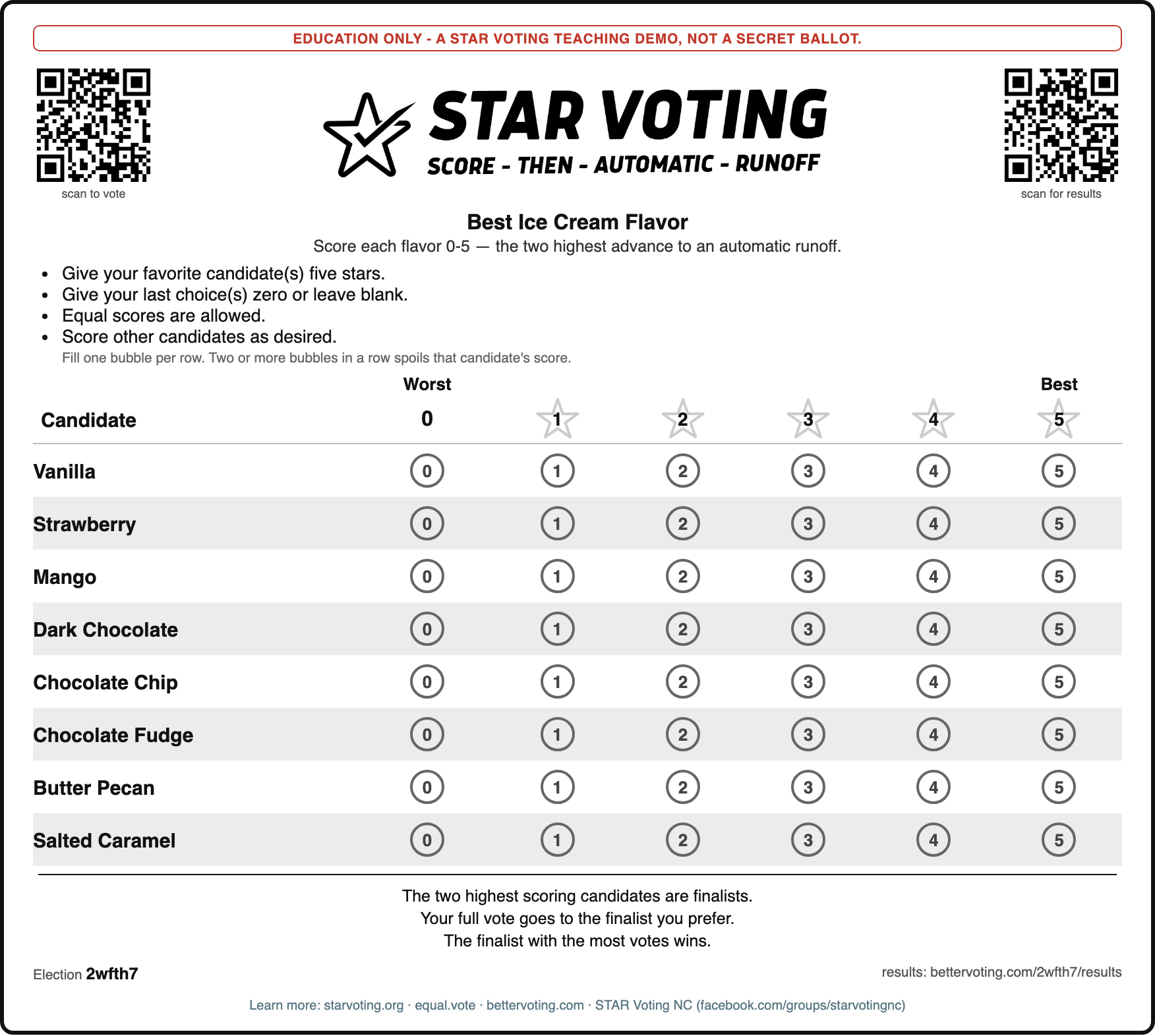
--selftest covers the offline render logic (FR-8); the scenarios below are the end-to-end cases to spot-check by eye. Each named election is a live BV demo created via create_bv_test_election.py.
| # | Scenario | Key flags | Expected |
|---|---|---|---|
| 1 | PDF, one big vote QR | --bv-export … --out b.pdf |
print-ready PDF; 176px vote QR in the right rail, "Scan to vote online"; no results QR; election id once in footer |
| 2 | Non-.pdf --out |
--bv-export … --out b.txt |
extension swapped → writes b.pdf (PDF is the only format) |
| 3 | Missing input → clear error | (no --bv-export, no --spec) |
exits naming BOTH routes |
| 4 | Descriptions from a real export | --bv-export <real _bv_export.json> |
race description → question; no blurb unless --blurb/--blurb-auto |
| 5 | Custom logo | --logo assets/BW_long_form.jpg (or NC_STAR_Logo1.jpg) |
image replaces the drawn wordmark; missing file → warning + facsimile |
| 6 | Serials (ballot numbers) | --serials |
"Ballot #N — keep this…" line; off by default |
| 7 | Write-in rows | --write-ins 2 |
two blank "Write-in: ___" rows |
| 8 | Promo + chapter footer | --promo --chapter "STAR Voting NC (…)" |
footer "Learn more:" line |
| 9 | Verify a real id | export of a live election + --verify-bv |
"confirmed"; QR + results kept |
| 10 | Verify a stale id | export whose id no longer resolves + --verify-bv |
"no election… printing plain"; QR + results dropped |
| 11 | QR size | --qr-size 220 |
larger vote QR |
| 11a | Results QR back on | --results-qr |
small code beside the footer results URL; header code unchanged |
| 11b | Pre-mint preview | --spec GOODBERRYS_SPEC --copies 1 |
PREVIEW notice, no QR, no results link, no id |
| 11c | Test ID stripped | export titled BV2252 — X |
ballot title prints X; --keep-test-id keeps the prefix |
| 11d | Page fill | --copies 1 |
grid stretches to the sheet; --no-fill-page restores the compact block |
| 12 | Pagination | --copies 30 --per-page 1 |
30 pages, one ballot each, no trailing blank |
| 13 | Missing deps | run without segno / without playwright |
either missing → clear error with the install command (no silent QR-less or HTML fallback) |
| 14 | Deliberate no-QR | --bv-export … --no-qr |
prints a plain ballot with no QRs, no error |
| 15 | Self-test | --selftest |
all known-answer checks pass, offline, exit 0 |
Live end-to-end demo elections (created + cast via the BV API; each runs the full print → QR → vote → results loop):
| Election | id (Test ID) | Teaching angle |
|---|---|---|
| The team lunch | fyy886 (BV2184) |
beginner vote-splitting on-ramp |
| Bond Brothers Beer Picks | yt3232 (BV2185) |
crowded field, broad spectrum |
| Best Ice Cream Flavor | 2wfth7 (BV2186) |
engineered vote-splitting (3-flavor chocolate cluster); write-ins on |
| What Makes the Best Pet? | pet |
simple, kid-friendly crowd-pleaser |
10. Related¶
- Teacher how-to:
running_a_paper_ballot_demo.md - Hand-count:
count_star_by_hand.md· Teaching guide:teaching_star_voting.md - BV election creation:
create_bv_test_election.py· Marker conventions & house rules:CLAUDE.md