Street trees — five rounds, and the bar keeps dropping
Generated from street_trees_five_rounds_c6_b100.yaml — do not edit by hand. Regenerate: python STARVote_LH_tabulation_engine/tools_adam/scripts/build_yaml_pages.py.
Method: RCV-IRV (Instant Runoff) · 1 seat · Expected winner: Birch
Scenario
A town picks ONE species for its main street. Six on the ballot, 100 voters, and most people rank only the one or two they actually care about — which is what real voters do in a crowded field, and is the whole reason this count gets hard to follow.
Built to demonstrate three things the small teaching examples cannot, because a three-candidate election finishes in one elimination:
- FIVE ROUNDS. Fir, then Dogwood, then Elm, then Cedar are eliminated before anyone clears the bar.
- THE LEAD CHANGES HANDS. Ash leads rounds 1 and 2 on 30 first choices. Birch passes Ash in round 3 (32 to 30) and is never headed again. Reporting this election from its first-choice totals would have named the loser.
- THE MAJORITY BAR MOVES. Every ballot whose ranked species are all out stops counting (the report calls these "Blank Votes"), so the pile of active ballots shrinks 100 -> 97 -> 93 -> 85 -> 77 and the majority needed falls 51 -> 49 -> 47 -> 43 -> 39. Birch wins on 47 — SIX FEWER than the 51 the election opened needing. It is a majority of the ballots still active (47 of 77 = 61%), not of the people who voted (47%).
Deliberately NOT a pathology case. Birch is the Condorcet winner, beating every rival head-to-head, so RCV-IRV lands on the same species STAR or Ranked Robin would. The lesson is the COST OF FOLLOWING THE COUNT, not a wrong winner — which is why it is safe to hand to someone who likes RCV.
Companion to RCV_IRV_is_simple.md, which argues that the ballot is the simple half and the count is not. This file is that argument's evidence.
Ballots
Each row is one voter's ranking, most-preferred first (N: prefix = N identical ballots).
20:Ash>Birch>Cedar
10:Ash
24:Birch>Dogwood
10:Cedar>Birch
8:Cedar
8:Dogwood>Birch
4:Dogwood
5:Elm>Birch
4:Elm
4:Fir>Elm
3:Fir
What the engine says
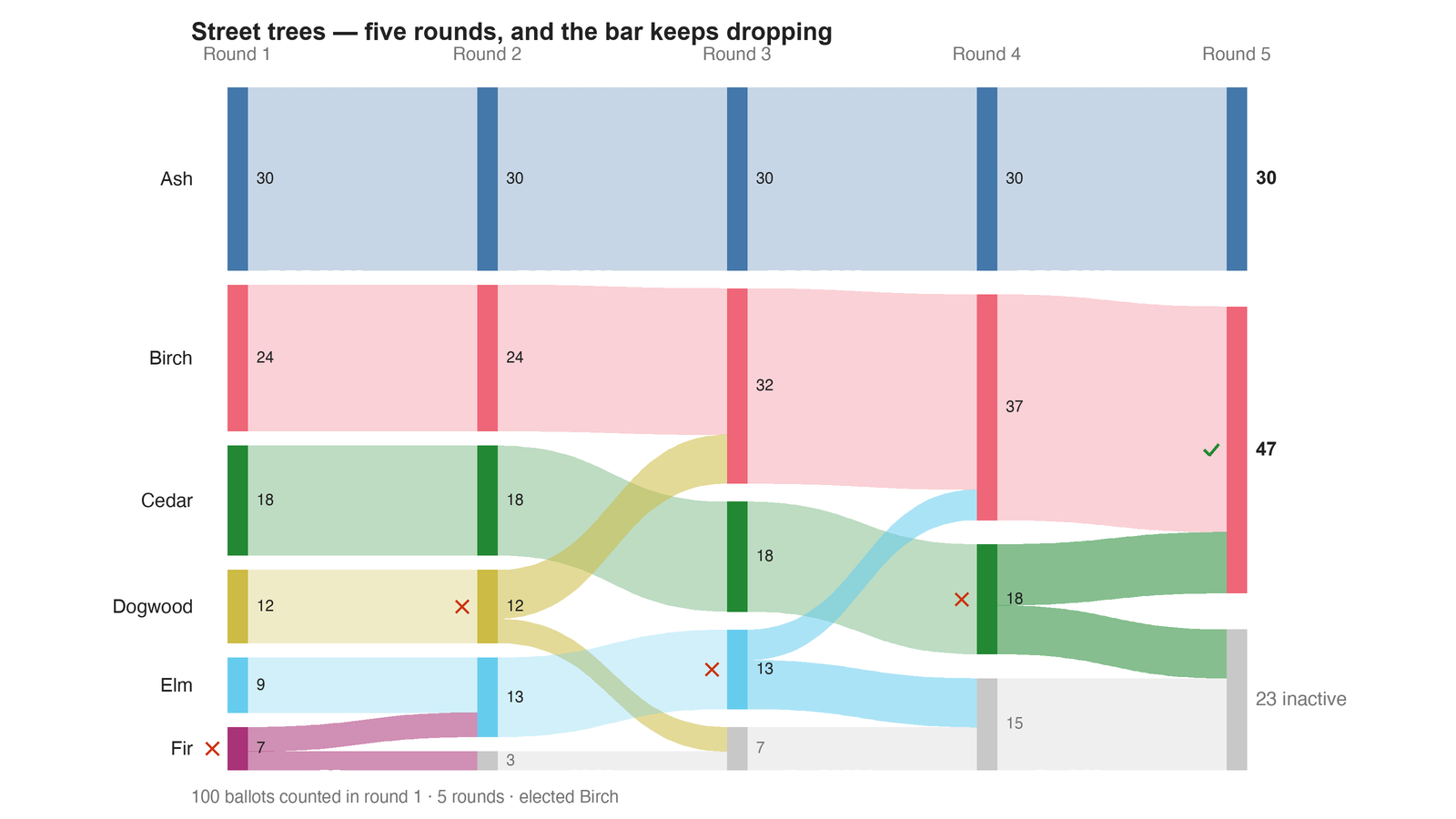
Where the votes went. Band thickness is votes; a band leaving an eliminated candidate lands on whoever that ballot ranked next, or on inactive if it ranked nobody who was left.
The count, step by step — the rounds and how the winner is reached:
--- RCV / Instant-Runoff Voting (single winner) ---
  Street trees — five rounds, and the bar keeps dropping
 Tabulating 100 ballots (ranked ballots).

ROUND 1
Candidate      Votes  Status
-----------  -------  --------
Ash               30  Hopeful
Birch             24  Hopeful
Cedar             18  Hopeful
Dogwood           12  Hopeful
Elm                9  Hopeful
Fir                7  Rejected

ROUND 2
Candidate      Votes  Status
-----------  -------  --------
Ash               30  Hopeful
Birch             24  Hopeful
Cedar             18  Hopeful
Elm               13  Hopeful
Dogwood           12  Rejected
Fir                0  Rejected
Blank Votes        3  Rejected

ROUND 3
Candidate      Votes  Status
-----------  -------  --------
Birch             32  Hopeful
Ash               30  Hopeful
Cedar             18  Hopeful
Elm               13  Rejected
Dogwood            0  Rejected
Fir                0  Rejected
Blank Votes        7  Rejected

ROUND 4
Candidate      Votes  Status
-----------  -------  --------
Birch             37  Hopeful
Ash               30  Hopeful
Cedar             18  Rejected
Elm                0  Rejected
Dogwood            0  Rejected
Fir                0  Rejected
Blank Votes       15  Rejected

FINAL RESULT
Candidate      Votes  Status
-----------  -------  --------
Birch             47  Elected
Ash               30  Rejected
Cedar              0  Rejected
Elm                0  Rejected
Dogwood            0  Rejected
Fir                0  Rejected
Blank Votes       23  Rejected


Winner(s) — RCV / Instant-Runoff Voting (single winner)
  Birch

--- Transfers and inactive ballots (what the round tables leave out) ---
The tables above give each candidate's round total but not where a
transferred vote came FROM, nor how many ballots stopped counting.
Both are recomputed from the ballots, using the eliminations the
count above actually made.

ROUND 1 — 100 of 100 ballots still active; majority = 51
   Fir eliminated with 7:
      → Elm                       4
      → (no continuing ranking)      3  ← these ballots go inactive

ROUND 2 — 97 of 100 ballots still active (3 inactive); majority = 49
   Dogwood eliminated with 12:
      → Birch                     8
      → (no continuing ranking)      4  ← these ballots go inactive

ROUND 3 — 93 of 100 ballots still active (7 inactive); majority = 47
   Elm eliminated with 13:
      → (no continuing ranking)      8  ← these ballots go inactive
      → Birch                     5

ROUND 4 — 85 of 100 ballots still active (15 inactive); majority = 43
   Cedar eliminated with 18:
      → Birch                    10
      → (no continuing ranking)      8  ← these ballots go inactive

FINAL ROUND — 77 of 100 ballots still active (23 inactive); majority = 39
   Birch                    47  (61.0% of the still-active)  ← elected
   Ash                      30  (39.0% of the still-active)
   Never exhausted, never transferred:
      20 ballots held by Ash carried a lower ranking that was never read
      (the count stopped here, so those preferences did nothing).

Inactive ballots at the final round: 23 of 100 (23.0%).
   Birch's 47 is a majority of the 77 still active but only 47.0% of all 100 cast —
   the 'majority' here is of a shrunken denominator. See
   06_Other/RCV_IRV/concepts/RCV_IRV_exhausted_ballots.md
Full audit — preference matrix, Condorcet, and score distribution
--- Smith Set (the generalized Condorcet winner) ---
The smallest group whose every member beats every candidate outside it —
the honest answer to "who is even in contention?".
   Smith set (1 of 6): Birch
   Outside (5):        Ash, Cedar, Dogwood, Elm, Fir
   One member ⇒ Birch is the Condorcet winner, beating every rival head-to-head.
   RCV-IRV winner Birch is INSIDE the Smith set. ✓
      Not guaranteed — RCV-IRV is not Smith-efficient — but it holds here.
   More: 07_Concepts/topics/smith_set.md
Everything in one file: the _tabulated mirror (regenerated on every run; every analysis forced on).
Run it yourself:
python STARVote_LH_tabulation_engine/starvote_larry_hastings.py 06_Other/RCV_IRV/cases/street_trees_five_rounds_c6_b100.yaml
See also
More cases in this set: RCV_ballot_example · batch_all_out_condorcet_c3_b3 · batch_all_out_cycle_c3_b3 · batch_all_out_round2_c4_b6 · put_two_universes_c3_b4