BV655 — "equal opposition" (all-0) mislabeled as Abstained
Method: STAR (single winner) · 1 seat · Expected winner: Option 1 · full count →
▶ Live on BetterVoting: vote · results ↗ (election jfrk9t) · issue Equal-Vote/bettervoting#1090
Reproduces the bug where an explicit all-zero ("equal opposition") ballot is treated and labeled the same as a true abstention. The BetterVoting election has two races built to contrast the two:
| Race 1 — "equal opposition" | Race 2 — "Abstain Vote" | |
|---|---|---|
| Ballot 1 | 0, 0 (scores both a 0) |
blank, blank (scores nothing) |
| Ballot 2 | 5, blank |
0, blank |
| Voter intent | actively rejects both | no preference (abstains) |
| BetterVoting label | "Abstained — No preference" ❌ | "Abstained — No preference" ✅ |
The two races produce the same "Abstained" label, but they mean different things — that's the bug. This page reproduces Race 1 as the tabulatable case; the raw export (_bv_export.json) contains both races.
What it teaches
- Explicit
0≠ abstention. Ballot 1's0,0is an active rejection of the field. The current STAR policy (bettervoting#884) treats an all-equal ballot as an abstention, and the UI/CSV then label it "Abstained." An all-0 ballot is not a blank ballot — collapsing them loses the voter's intent (bettervoting#1090). - The record keeps them separate in LH. LH tabulates both an explicit
0and an abstention marker (~/&) as 0, but stores them distinctly — so a report can tell "rejected everyone" from "didn't vote." BetterVoting stores only0/nulland has no explicit abstain mark, so it can't (see the abstain issue index and the lesson). - BV and LH diverge on the count. Both elect Option 1, but BetterVoting counts Ballot 1 (
0,0) as an abstention (nAbstentions = 1), while LH counts it as a real tally vote that registers as Equal Support in the runoff (nAbstentions = 0). Only a truly blank ballot abstains in LH. LH's treatment matches the view that an explicit 0 is a cast vote — the heart of the #884 dispute.
The ballots (Race 1)
Options: Option 1, Option 2. & = the BetterVoting null (left blank).
The ballots as marked — the filled bubble is the score given, and the score is the number in its column:
| # | Ballot as marked | Option 1 | Option 2 |
|---|---|---|---|
| 1 | 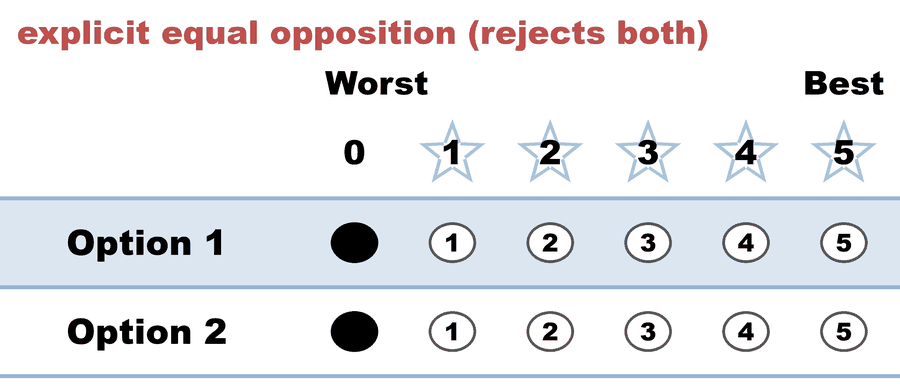 |
0 | 0 |
| 2 | 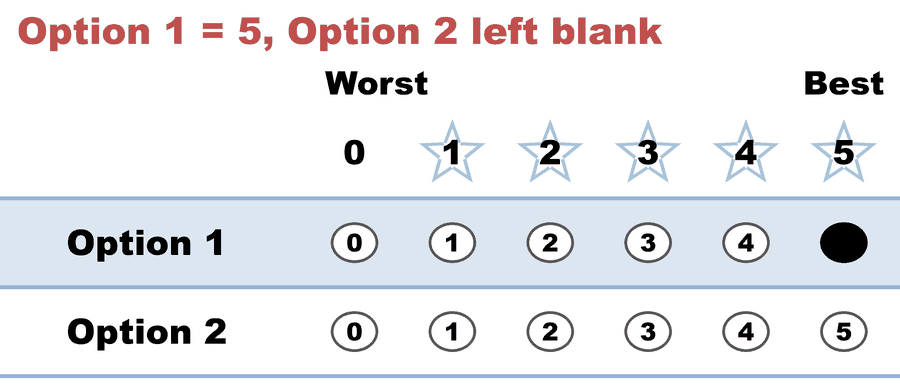 |
5 | & |
Ballot 1 marked both zeros deliberately; ballot 2 left Option 2 untouched. On the count they land in the same place — that's the bug.
The result
Option 1 is elected (score 5 vs 0; runoff 1–0). In LH, Ballot 1 (0,0) is a tally vote that shows as Equal Support in the runoff — not an abstention. (BetterVoting instead reports it as nAbstentions = 1.)
--- STAR Voting Method (single winner) ---

[STAR Voting]
 Tabulating 2 ballots.
Option 1,Option 2
       0,       0
       5,       &

[STAR Voting: Scoring Round]
 The two highest-scoring candidates advance to the next round.
   Option 1      -- 5 -- First place
   Option 2      -- 0 -- Second place
 Option 1 and Option 2 advance.

[STAR Voting: Automatic Runoff Round]
 The candidate preferred in the most head-to-head matchups wins.
   Option 1      -- 1 -- First place
   Option 2      -- 0
   Equal Support -- 1
 Option 1 wins.
   Runoff math:
     2  ballots cast
   − 1  Equal Support (no preference between the two finalists)
     ─
     1  voters with a preference  (majority = 1)
           Option 1 1 (100%)  ·  Option 2 0 (0%)

[STAR Voting: Winner — STAR Voting Method (single winner)]
 Option 1
(The Abs = 1 on Option 2 is Ballot 2's & — a per-candidate blank — not a whole-ballot abstention. LH's whole-ballot abstention count here is 0; BetterVoting's is 1.)
Full engine detail: bv655_jfrk9t_equal_opposition_tabulated.txt. Tabulatable source: bv655_jfrk9t_equal_opposition.yaml.
Part of the BetterVoting abstain/blank/zero cluster — see the issue index.