Ordered majority rule — the opposition decides the A-vs-B race (Toby Pereira's counterexample)
Generated from omr_opposition_decides.yaml — do not edit by hand. Regenerate: python STARVote_LH_tabulation_engine/tools_adam/scripts/build_yaml_pages.py.
Method: RCV-IRV (Instant Runoff) · 1 seat · Expected winner: B
Scenario
An abstract counterexample (bare A/B/C, because the mechanism is the whole lesson) to the plain-English selling point of "ordered majority rule" — the criterion the arXiv paper "A Majority Rule Philosophy for Instant Runoff Voting" (arXiv:2308.08430) uses to defend IRV. That summary claims IRV "ensures the election of a candidate from the majority coalition while PREVENTING opposition voters from influencing the choice of candidate from the faction they oppose." Here C is a third bloc that ranks A and B last; A leads on first choices (35 to B's 33). IRV eliminates C, and C's second preferences hand the A-vs-B contest to B (65-35). So the opposition voters DID decide which of the two frontrunners won — contradicting the sentence as worded. (Note: B is also the Condorcet winner here, so IRV is not misfiring on the outcome; the point is narrow and about the marketing claim, not a center-squeeze. The technical criterion permits this because C is "minor" — which is exactly the circularity cfrank flagged: minor/major is defined by the very ordering the criterion is supposed to justify.)
Ballots
Each row is one voter's ranking, most-preferred first (N: prefix = N identical ballots).
35:A>B>C
33:B>A>C
32:C>B>A
What the engine says
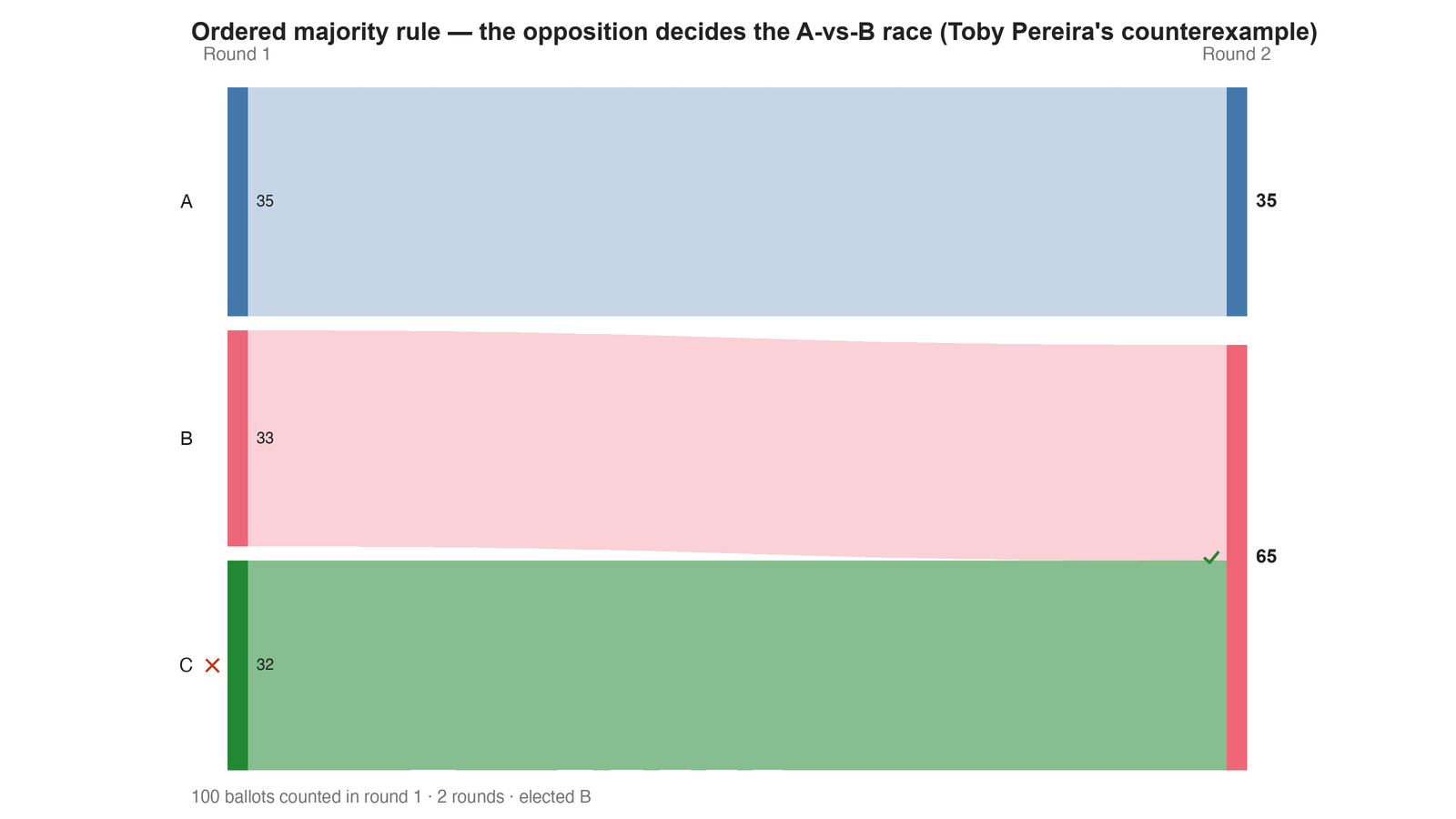
Where the votes went. Band thickness is votes; a band leaving an eliminated candidate lands on whoever that ballot ranked next, or on inactive if it ranked nobody who was left.
The count, step by step — the rounds and how the winner is reached:
--- RCV / Instant-Runoff Voting (single winner) ---
  Ordered majority rule — the opposition decides the A-vs-B race (Toby Pereira's counterexample)
 Tabulating 100 ballots (ranked ballots).

ROUND 1
Candidate      Votes  Status
-----------  -------  --------
A                 35  Hopeful
B                 33  Hopeful
C                 32  Rejected

FINAL RESULT
Candidate      Votes  Status
-----------  -------  --------
B                 65  Elected
A                 35  Rejected
C                  0  Rejected


Winner(s) — RCV / Instant-Runoff Voting (single winner)
  B

--- Transfers and inactive ballots (what the round tables leave out) ---
The tables above give each candidate's round total but not where a
transferred vote came FROM, nor how many ballots stopped counting.
Both are recomputed from the ballots, using the eliminations the
count above actually made.

ROUND 1 — 100 of 100 ballots still active; majority = 51
   C eliminated with 32:
      → B                        32

FINAL ROUND — 100 of 100 ballots still active; majority = 51
   B                        65  (65.0% of the still-active)  ← elected
   A                        35  (35.0% of the still-active)
   Never exhausted, never transferred:
      35 ballots held by A carried a lower ranking that was never read
      (the count stopped here, so those preferences did nothing).

Inactive ballots at the final round: 0 of 100 (0.0%).
   B's 65 is a majority of the 100 still active AND of all 100 cast (65.0%).
Full audit — preference matrix, Condorcet, and score distribution
--- Smith Set (the generalized Condorcet winner) ---
The smallest group whose every member beats every candidate outside it —
the honest answer to "who is even in contention?".
   Smith set (1 of 3): B
   Outside (2):        A, C
   One member ⇒ B is the Condorcet winner, beating every rival head-to-head.
   RCV-IRV winner B is INSIDE the Smith set. ✓
      Not guaranteed — RCV-IRV is not Smith-efficient — but it holds here.
   More: 07_Concepts/topics/smith_set.md
Everything in one file: the _tabulated mirror (regenerated on every run; every analysis forced on).
Run it yourself:
python STARVote_LH_tabulation_engine/starvote_larry_hastings.py method_comparisons/ordered_majority_rule/cases/omr_opposition_decides.yaml