Three brothers, one fruit — Approval lands on the utilitarian winner
Generated from bv2279_qywq7d_approval.yaml — do not edit by hand. Regenerate: python STARVote_LH_tabulation_engine/tools_adam/scripts/build_yaml_pages.py.
Method: Approval Voting · 1 seat · Expected winner: Orange
▶ Live on BetterVoting: vote · results ↗ (election qywq7d · test BV2279).
Scenario
Race 3 of 3 in the three-brothers election (BV2279, bvid qywq7d; BV-confirmed). The setup, the source and the x5/11 rescale are documented in the STAR race, bv2279_qywq7d_star.yaml.
The same three opinions as approvals: each brother approves every fruit he scored 3 or higher.
boy 1 (1, 3, 4) -> Orange, Banana boy 2 (1, 4, 5) -> Orange, Banana boy 3 (2, 5, 0) -> Orange
Orange 3, Banana 2, Apple 0. Approval elects ORANGE — the utilitarian winner, the same answer the STAR scoring round gives before the runoff overturns it.
This race is the one that was missing from the prose version of this example. The story is usually told as Score-versus-everyone-else; running it turned up a second method on the utilitarian side, and the LH engine reports it directly as [Divergence from STAR] Approval = Orange.
The reason is structural rather than a coincidence of this ballot set: Approval, like the scoring round, never takes a majority vote. It counts levels of support and stops. Every method here that finishes with a head-to-head — STAR's runoff, Ranked Robin's pairwise table — elects Banana. The two that don't elect Orange.
DISCLOSURE, because it is an editorial choice and not arithmetic: the 3-or- higher threshold is this file's, not the source's. It is the same cut the LH engine uses to derive its Approval comparison, which is why the two agree. A 4-or-higher cut gives Orange 2, Banana 2 — a tie, decided by lot, and the lesson evaporates. Say which threshold a number came from.
Ballots
The ballots as marked — a filled Yes is a 1 in that candidate's column, a filled No a 0:
| # | Ballot as marked | Apple | Orange | Banana |
|---|---|---|---|---|
| 1 | 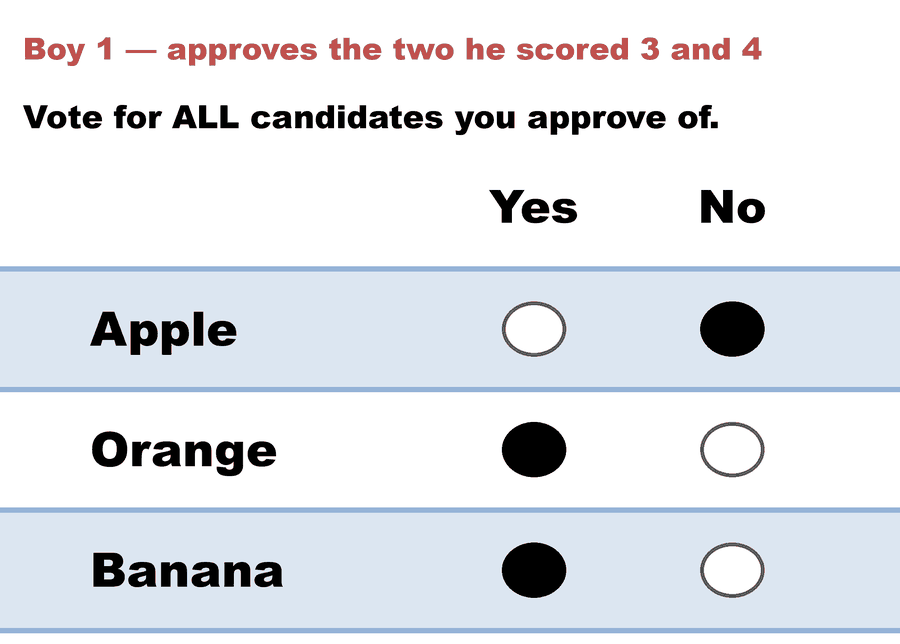 |
0 | 1 | 1 |
| 2 | 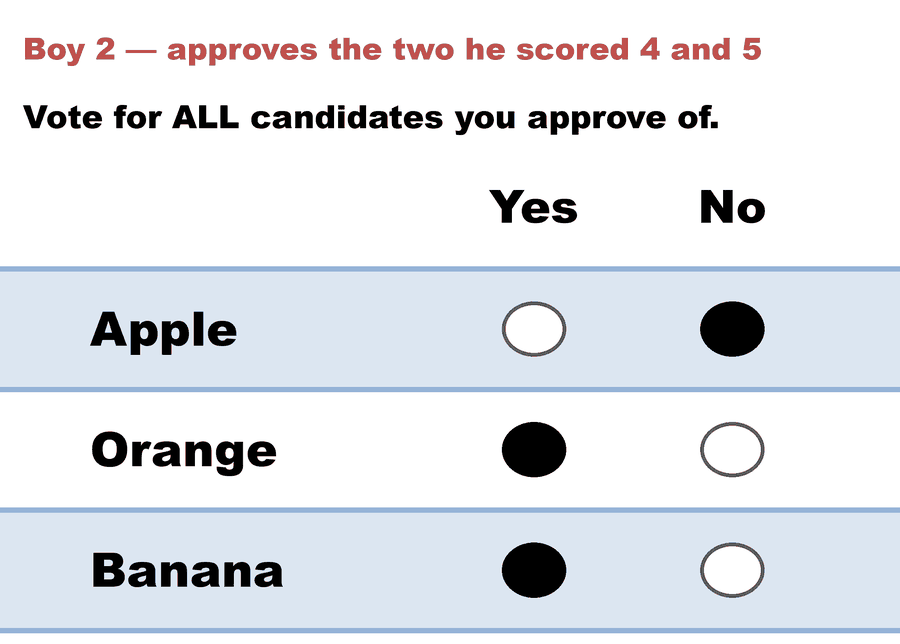 |
0 | 1 | 1 |
| 3 | 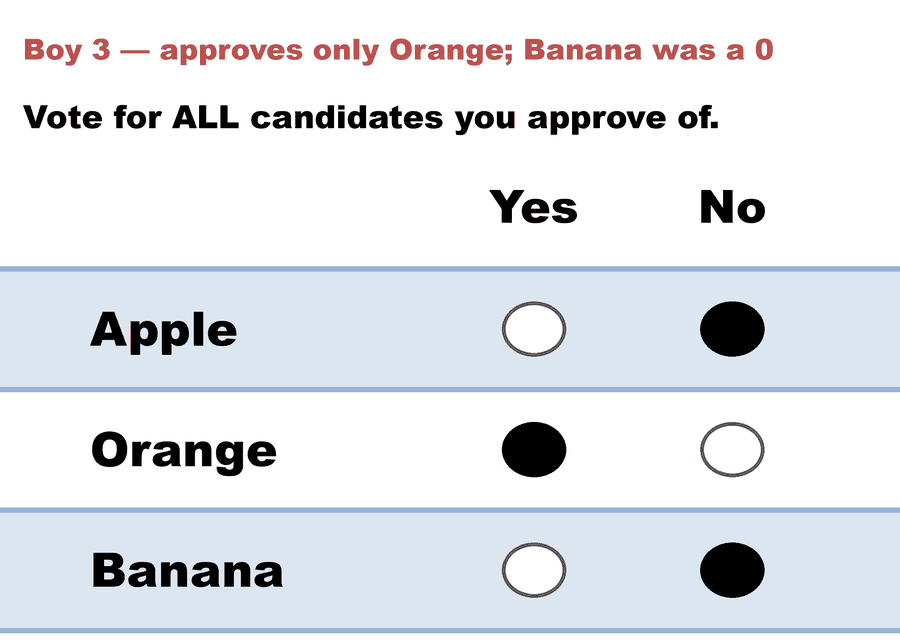 |
0 | 1 | 0 |
The same ballots as the file records them:
Row 1 = candidate names; each later row is one voter's approvals (1 = approve, 0/blank = not approved).
Apple,Orange,Banana
0,1,1   # Boy 1 — approves the two he scored 3 and 4
0,1,1   # Boy 2 — approves the two he scored 4 and 5
0,1,0   # Boy 3 — approves only Orange; Banana was a 0
What the engine says
Full report from the _tabulated mirror (regenerated on every run; every analysis forced on):
--- Approval Voting (single winner) ---
 Tabulating 3 ballots (any non-zero score = approval).

Ballots:
   columns = Apple, Orange, Banana      (1 = approve; 0 = not approved)
     2 × 0,1,1
     1 × 0,1,0

   Orange -- 3 (100%) -- Elected
   Banana -- 2 (67%)
   Apple  -- 0 (0%)

[Approval Distribution] (how many candidates each ballot approved)
   5 approvals across 3 ballots — average 1.7 of 3 (range 1–2).
     approved 1: 1 ballot
     approved 2: 2 ballots

[Co-Approval Matrix]
 Of the voters who approved the ROW candidate, the % who ALSO approved the COLUMN candidate.
           | Orange | Banana | Apple  |
   ------------------------------------
   Orange  |   --   |  67%   |   0%   |
   Banana  |  100%  |   --   |   0%   |
   Apple   |   ·    |   ·    |   --   |

Winner — Approval Voting (single winner)
  Orange
Run it yourself:
python STARVote_LH_tabulation_engine/starvote_larry_hastings.py method_comparisons/majoritarian_vs_utilitarian/cases/bv2279_qywq7d_approval.yaml
See also
More cases in this set: bv2279_qywq7d_ranked_robin · bv2279_qywq7d_star