Chamberlin-Courant can elect a Pareto-dominated committee
Generated from cc_pareto_dominated_c4_b2.yaml — do not edit by hand. Regenerate: python STARVote_LH_tabulation_engine/tools_adam/scripts/build_yaml_pages.py.
Method: Approval Voting · 2 seats · Expected winners: C, D
Scenario
The smallest counterexample in Lackner & Skowron's book: TWO voters, four candidates, two seats. Voter 1 approves A, C and D; voter 2 approves B, C and D.
Committee {C,D} gives EVERY voter two approved winners. Committee {A,B} gives every voter exactly one. So {C,D} dominates {A,B} in the book's sense (Definition 3.1): nobody is worse off and somebody is better off. A rule that can return {A,B} is electing a committee that every single voter would trade away.
Approval Voting - the count in this file - gets it right: C and D lead 2-2 against A and B at 1-1, so AV elects {C,D} outright. Chamberlin-Courant does not, because CC only asks whether a voter has AT LEAST ONE approved winner. Both voters are covered by {A,B} and both are covered by {C,D}, so CC scores the two committees equally at 2 and returns both - the dominated one included. That is Proposition A.1 in the book, and it is why CC is marked only WEAKLY Pareto efficient in Table 3.1 while AV is marked strong.
Reproduce the CC side with the axiom checker: python 06_Other/abcvoting_tabulation_engine/abc_axiom_check.py --verbose
Source: Lackner, M. & Skowron, P. (2023), "Multi-Winner Voting with Approval Preferences", SpringerBriefs, doi:10.1007/978-3-031-09016-5, Proposition A.1.
Ballots
The ballots as marked — a filled Yes is a 1 in that candidate's column, a filled No a 0:
| # | Ballot as marked | A | B | C | D |
|---|---|---|---|---|---|
| 1 | 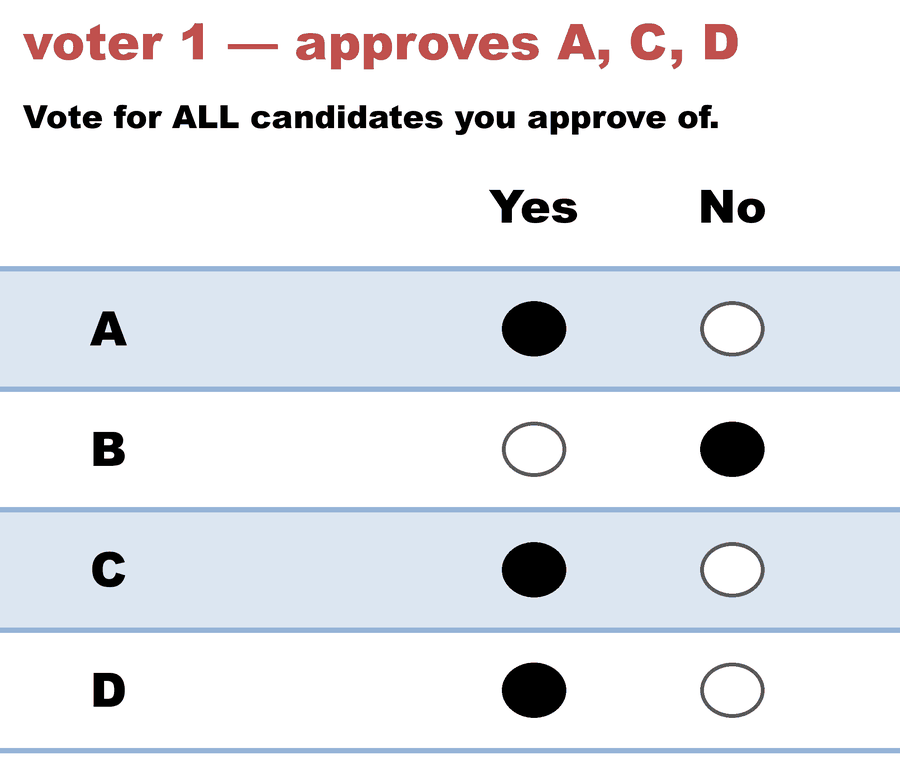 |
1 | 0 | 1 | 1 |
| 2 | 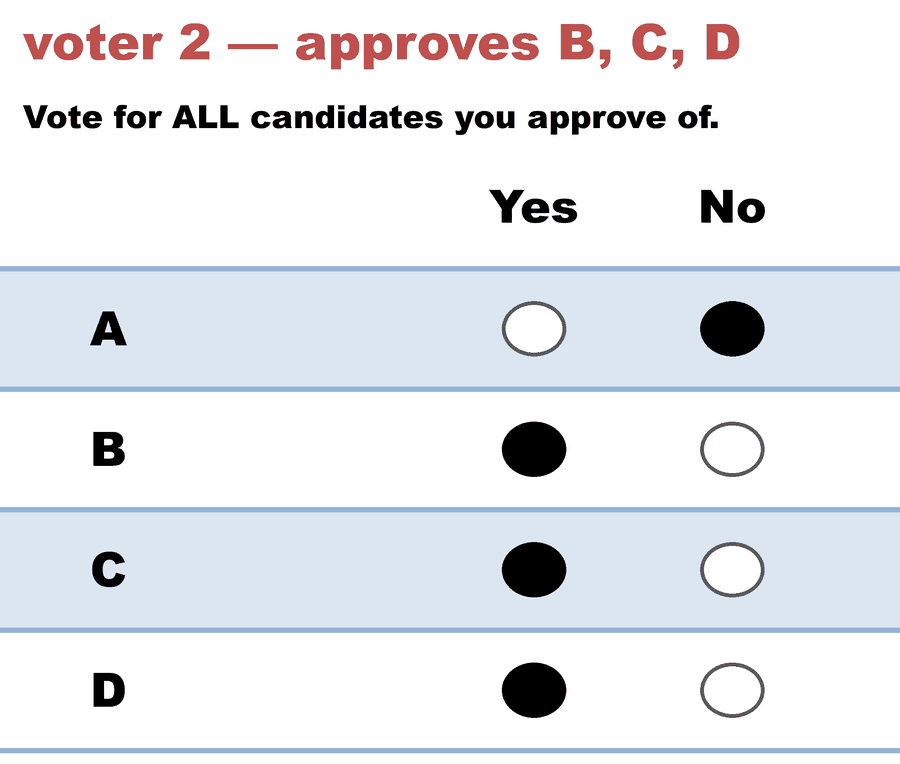 |
0 | 1 | 1 | 1 |
The same ballots as the file records them:
Row 1 = candidate names; each later row is one voter's approvals (1 = approve, 0/blank = not approved).
A,B,C,D
1,0,1,1   # voter 1 — approves A, C, D
0,1,1,1   # voter 2 — approves B, C, D
What the engine says
Full report from the _tabulated mirror (regenerated on every run; every analysis forced on):
--- Approval Voting (2 winners) ---
 Tabulating 2 ballots (any non-zero score = approval).

Ballots:
   columns = A, B, C, D      (1 = approve; 0 = not approved)
     1 × 1,0,1,1
     1 × 0,1,1,1

   C -- 2 (100%) -- Elected
   D -- 2 (100%) -- Elected
   A -- 1 (50%)
   B -- 1 (50%)

[Approval Distribution] (how many candidates each ballot approved)
   6 approvals across 2 ballots — average 3.0 of 4 (range 3–3).
     approved 3: 2 ballots

[Co-Approval Matrix]
 Of the voters who approved the ROW candidate, the % who ALSO approved the COLUMN candidate.
      |   C    |   D    |   A    |   B    |
   ----------------------------------------
   C  |   --   |  100%  |  50%   |  50%   |
   D  |  100%  |   --   |  50%   |  50%   |
   A  |  100%  |  100%  |   --   |   0%   |
   B  |  100%  |  100%  |   0%   |   --   |

Winners — Approval Voting (2 winners)
  C, D
Run it yourself:
python STARVote_LH_tabulation_engine/starvote_larry_hastings.py 04_Approval/03_Criteria/cases/cc_pareto_dominated_c4_b2.yaml
See also
More cases in this set: abc_committee_monotonicity_1seat_c3_b10 · abc_committee_monotonicity_2seats_c3_b10 · monroe_pareto_dominated_c4_b24 · resign_av_holds_after_kai_c6_b5 · resign_av_holds_c7_b5 · resign_rrv_after_hana_c4_b5 · resign_rrv_seated_c5_b5 · resign_star_pr_after_bruno_c3_b5 · resign_star_pr_seated_c4_b5 · sav_strategy_bullet_vote_c5_b2