Brams 1982 — twenty-one voters, and the Condorcet winner goes out second
Generated from bv2282_hf3ckp_brams_irv.yaml — do not edit by hand. Regenerate: python STARVote_LH_tabulation_engine/tools_adam/scripts/build_yaml_pages.py.
Method: RCV-IRV (Instant Runoff) · 1 seat · Expected winner: B
▶ Live on BetterVoting: vote · results ↗ (election hf3ckp · test BV2282).
Scenario
A 21-voter, 4-candidate profile from Stephen J. Brams, "The AMS Nomination Procedure Is Vulnerable to 'Truncation of Preferences'," Notices of the American Mathematical Society 29:2 (February 1982), 136-138 — reproduced via rangevoting.org, which cites it as an RCV-IRV example.
Counted by Hare: B leads on 7 first choices, F (3) is eliminated and sends 3 to N, then G is eliminated on 6 and sends all 6 to B, who wins 13 of 21. But G beats B head-to-head 14-7, and beats N 13-8 and F 18-3 — G is the Condorcet winner, and is eliminated one round before the finish.
It is the smallest example in this folder: 21 ballots, checkable on paper in about a minute, which is what makes it the one to hand someone who does not want to take a 303-voter profile on trust.
PROVENANCE, STATED CAREFULLY. The profile is Brams's; the RCV-IRV reading is rangevoting.org's. Brams's paper is about vulnerability to PREFERENCE TRUNCATION — voters ranking only some candidates — which is a different argument from the Condorcet failure shown here, and we could not confirm from the abstract whether the AMS procedure of the day was Hare specifically. So: cite Brams for the ballots, and cite this file for what Hare does with them. Do not write "Brams showed that IRV..." — he did not, in this paper.
Candidate labels B, G, N, F are Brams's own and are kept for traceability to the source, which is why they are neither alphabetical nor in reading order.
BV-CONFIRMED. Race 1 of live election hf3ckp (Test ID BV2282) is these 21 ballots counted by BetterVoting's own IRV tabulator, and it elects B, matching this file exactly; race 2 is the same ballots under Ranked Robin and elects G. tieBreakType 'none' in both. Frozen export: bv2282_hf3ckp_bv_export.json.
Live on BetterVoting: https://bettervoting.com/hf3ckp Live results: https://bettervoting.com/hf3ckp/results
Ballots
Each row is one voter's ranking, most-preferred first (N: prefix = N identical ballots).
7:B>G>N>F
6:G>B>N>F
5:N>G>B>F
3:F>N>G>B
What the engine says
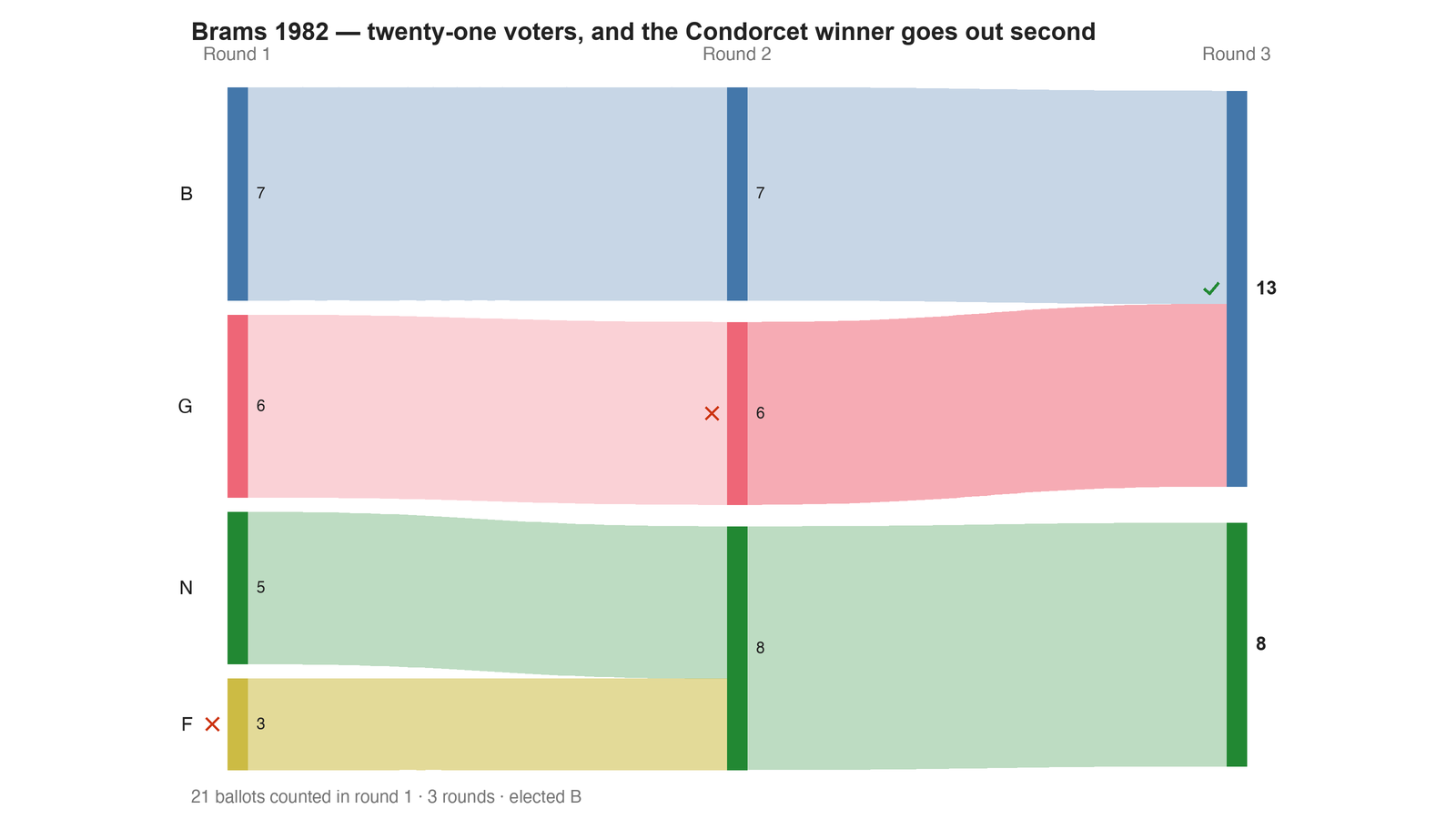
Where the votes went. Band thickness is votes; a band leaving an eliminated candidate lands on whoever that ballot ranked next, or on inactive if it ranked nobody who was left.
The count, step by step — the rounds and how the winner is reached:
--- RCV / Instant-Runoff Voting (single winner) ---
  Brams 1982 — twenty-one voters, and the Condorcet winner goes out second
 Tabulating 21 ballots (ranked ballots).

ROUND 1
Candidate      Votes  Status
-----------  -------  --------
B                  7  Hopeful
G                  6  Hopeful
N                  5  Hopeful
F                  3  Rejected

ROUND 2
Candidate      Votes  Status
-----------  -------  --------
N                  8  Hopeful
B                  7  Hopeful
G                  6  Rejected
F                  0  Rejected

FINAL RESULT
Candidate      Votes  Status
-----------  -------  --------
B                 13  Elected
N                  8  Rejected
G                  0  Rejected
F                  0  Rejected


Winner(s) — RCV / Instant-Runoff Voting (single winner)
  B

--- Transfers and inactive ballots (what the round tables leave out) ---
The tables above give each candidate's round total but not where a
transferred vote came FROM, nor how many ballots stopped counting.
Both are recomputed from the ballots, using the eliminations the
count above actually made.

ROUND 1 — 21 of 21 ballots still active; majority = 11
   F eliminated with 3:
      → N                         3

ROUND 2 — 21 of 21 ballots still active; majority = 11
   G eliminated with 6:
      → B                         6

FINAL ROUND — 21 of 21 ballots still active; majority = 11
   B                        13  (61.9% of the still-active)  ← elected
   N                         8  (38.1% of the still-active)
   Never exhausted, never transferred:
      8 ballots held by N carried a lower ranking that was never read
      (the count stopped here, so those preferences did nothing).

Inactive ballots at the final round: 0 of 21 (0.0%).
   B's 13 is a majority of the 21 still active AND of all 21 cast (61.9%).
Full audit — preference matrix, Condorcet, and score distribution
--- Smith Set (the generalized Condorcet winner) ---
The smallest group whose every member beats every candidate outside it —
the honest answer to "who is even in contention?".
   Smith set (1 of 4): G
   Outside (3):        B, N, F
   One member ⇒ G is the Condorcet winner, beating every rival head-to-head.
   RCV-IRV winner B is OUTSIDE the Smith set. ✗
      Every member of the set (G) beats B head-to-head, yet
      RCV-IRV elected B anyway. RCV-IRV is not Smith-efficient (nor
      Condorcet-efficient) — this is the shape a center squeeze leaves behind.
   More: 07_Concepts/topics/smith_set.md
Everything in one file: the _tabulated mirror (regenerated on every run; every analysis forced on).
Run it yourself:
python STARVote_LH_tabulation_engine/starvote_larry_hastings.py method_comparisons/rangevoting_irv_examples/cases/bv2282_hf3ckp_brams_irv.yaml
See also
- Condorcet efficiency (topic hub)
- Ties & tie-breaking (topic hub)
- The tie-breaking ladder (full chain)
- Glossary · all cases by method
More cases in this set: bv2281_qycpbx_ossipoff_irv · bv2281_qycpbx_ossipoff_ranked_robin · bv2282_hf3ckp_brams_ranked_robin