Winner highlighting is positional, but elected is identity¶
Status: FILED upstream as #1480, 2026-08-04. Confirmed on production with a purpose-built election, 8h4bvh (BV2270). CLOSED as by-design 2026-08-20 — which relocates the defect to the backend; see the closure section. Backend fix written and parked (PARKED §7).
Split out of #1166 deliberately. #1166 is a good first issue about a hard-coded 1; this is a different defect that the #1166 fix (PR #1479) does not touch and was never meant to.
The claim¶
Every results viewer that uses ResultsBarChart's stars prop or ResultsTable's winningRows prop highlights the first N rows of summaryData.candidates. But the winners are results.elected, which is built by a different mechanism. When the two disagree, the page names one candidate in its heading and puts the star and the gold row on another.
components/ResultsTable.tsx:34—style={i < winningRows ? winningStyle : {}}components/ResultsBarChart.tsx:57—((i < stars || d['star']) ? "⭐ " : "")
Both are row-index tests. Neither component knows which candidates won.
Why they can disagree in Ranked Robin¶
Two orderings, produced independently:
| Built by | Ordered by | |
|---|---|---|
summaryData.candidates |
getSummaryData → sortCandidates(candidates, 'copelandScore'), once, up front |
copelandScore desc, then tieBreakOrder asc |
elected |
runBlocTabulator → singleWinnerRankedRobin, one round at a time |
the tiebreak ladder |
Ranked Robin passes no evaluate callback to runBlocTabulator, so the summary array is never re-sorted into round-win order. That leaves the ladder free to disagree with the sort — and its second rung does exactly that:
// singleWinnerRankedRobin, RankedRobin.ts
const [left, right] = winners.slice(0, 2);
if (winners.length===2 && left.winsAgainst[right.id] != right.winsAgainst[left.id]){
  const [winner, loser] = left.winsAgainst[right.id] ? [left, right] : [right, left];
winners preserves the sorted order, so left is the row that sorts first. The rung then picks the pairwise winner, which may be right.
tieBreakOrder comes from shuffleCandidatesForRandomTiebreak.ts — a TinyRand shuffle seeded on (rawVoteCount + hash(raceId)) >>> 0. It is deterministic and it is published in the export, but it is a function of the ballot count and the race id, never of how anyone voted. So it carries no information whatsoever about who beat whom, and it agrees with the head-to-head result about half the time.
Not hypothetical¶
The head-to-head rung is ordinary. It fired in the very poll #1166 was reported against — qq6qkp, round 1:
round 0: Baldur's Gate wins round with highest number of wins.
round 1: Dragon Age preferred over Mass Effect and/or KOTOR in runoff.   ← 7.5 – 7.5 tie
round 2: Mass Effect and/or KOTOR wins round with highest number of wins.
Nothing is visible there, for two independent reasons: Dragon Age also sorts first (tieBreakOrder 0 vs 3), and at num_winners: 3 both tied candidates are elected anyway. Neither reason is a property of the code — both are luck.
Reproduction¶
A four-candidate Ranked Robin, one winner, built so exactly two candidates tie at the top of the Copeland table with a decisive match between them.
Ballots — three voters:
1 × Alder  > Birch  > Cedar  > Dogwood
1 × Birch  > Cedar  > Dogwood > Alder
1 × Dogwood > Alder > Birch  > Cedar
Pairwise: Alder>Birch 2–1, Alder>Cedar 2–1, Dogwood>Alder 2–1, Birch>Cedar 3–0, Birch>Dogwood 2–1, Cedar>Dogwood 2–1.
Copeland: Alder 2, Birch 2, Cedar 1, Dogwood 1.
So winners = {Alder, Birch}, exactly two, and Alder beats Birch head-to-head → Alder is elected, deterministically, from the ballots alone. Where Alder and Birch sit in the table is decided by the seeded shuffle instead. When the shuffle puts Birch first, the page reads:
⭐ Alder wins ⭐ … and the star, and the gold row, are on Birch.
The shuffle re-rolls on every ballot cast ("This ensures the tiebreak priority is reset after every vote"), so a pair of mirror-image ballots — which cancel exactly, leaving every pairwise winner and every Copeland score untouched — re-rolls the display order without changing the election.
The live election¶
8h4bvh — BV2270, minted 2026-08-04, Ranked Robin, 1 winner.
Minted with the three ballots above; that draw put Alder first, so the page looked correct. Three mirror pairs were then cast — Alder>Birch>Cedar>Dogwood plus its exact reverse, which cancel on every one of the six matchups — and the third re-roll landed on a disagreeing order. Nine ballots now, tally identical to the three-ballot version: Copeland still 2/2/1/1, log still Alder preferred over Birch in runoff.
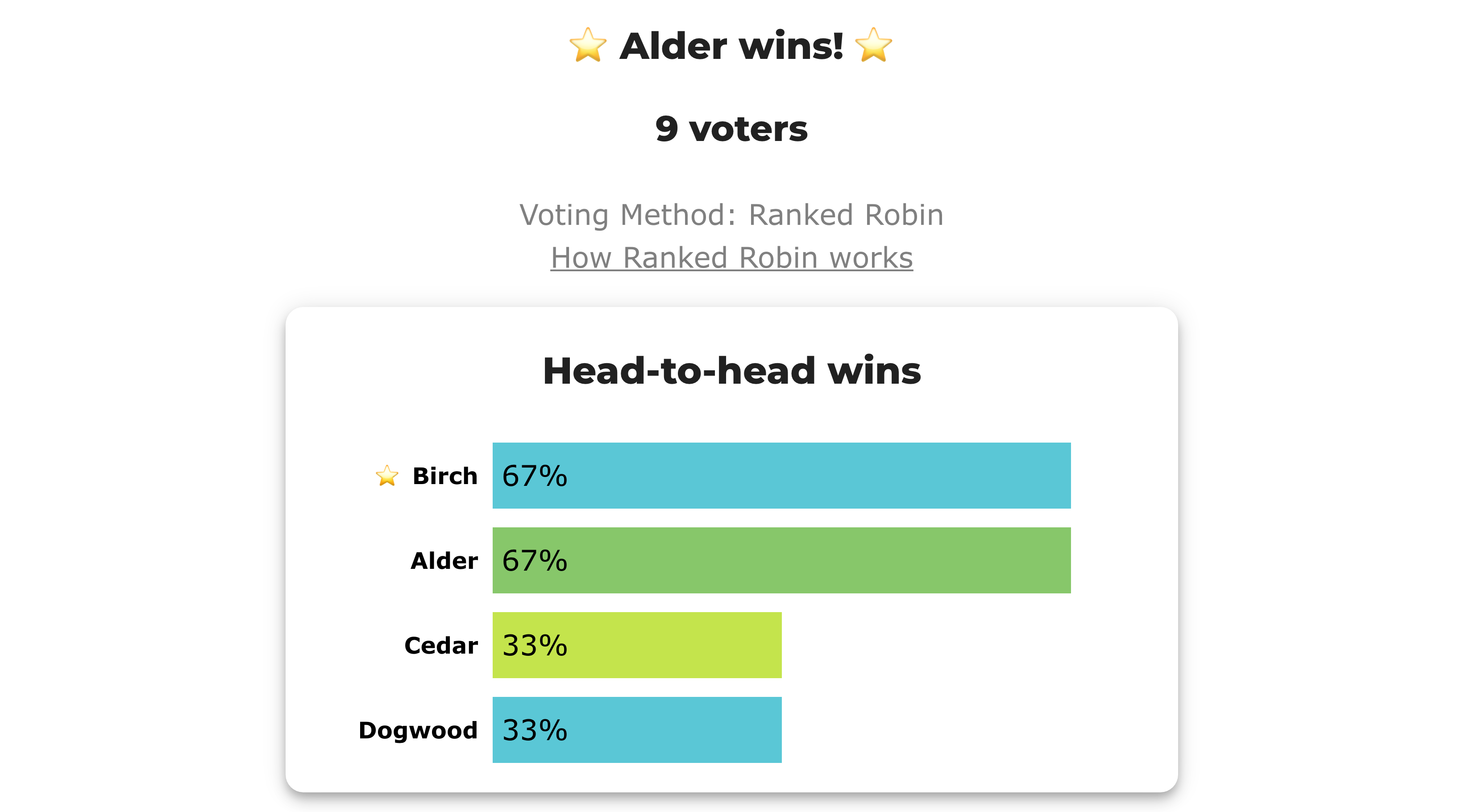
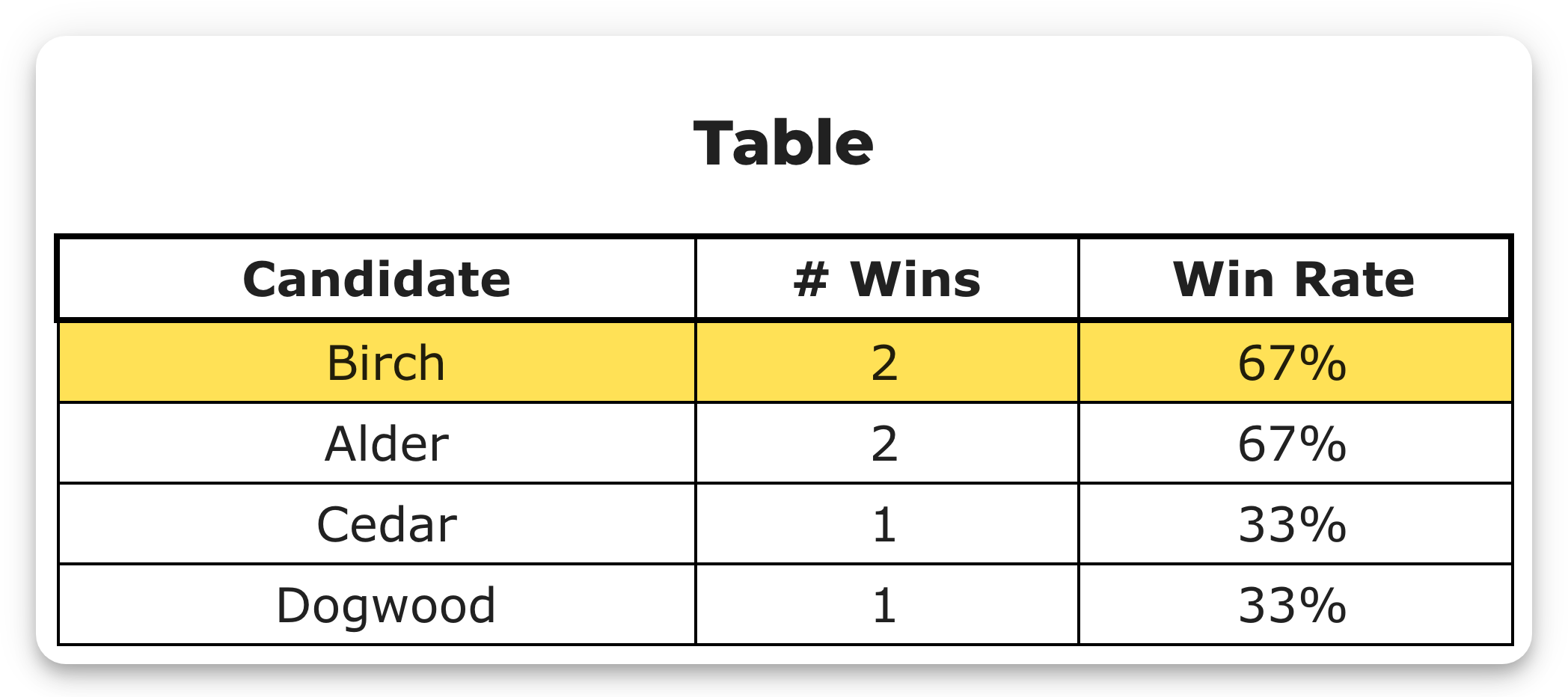
The heading names Alder. The star and the gold row are on Birch. Both candidates show 2 wins / 67%, so the page gives a reader no way to tell which of the two actually won — the two signals contradict each other and the wrong one is more prominent.
From GET /API/ElectionResult/8h4bvh:
elected  : ['Alder']
tieBreakType : none
  row 0: Birch    copeland=2  tieBreakOrder=1
  row 1: Alder    copeland=2  tieBreakOrder=3
  row 2: Cedar    copeland=1  tieBreakOrder=0
  row 3: Dogwood  copeland=1  tieBreakOrder=2
logs: ['Alder preferred over Birch in runoff.']
Note tieBreakType: none — this is not a random-tiebreak election. The winner is fully determined by the ballots. Only the row order came from the shuffle.
Scope¶
Ranked Robin is where it's demonstrable, because its ladder has a rung that ignores the sort key. The shape of the defect is shared: ApprovalResultsViewer — the viewer #1479 copies — highlights positionally too, and so will Ranked Robin and Plurality after #1479 lands. The fix is one prop, not one viewer.
Correction (2026-08-20): the paragraph above over-reached, and the over-reach probably invited the by-design close. Approval and Plurality highlight positionally but cannot produce the mismatch: their single-winner functions always elect remainingCandidates[0], so their first rows can't be wrong (Approval additionally passes an evaluate callback). The defect is one method's, not one prop's — Ranked Robin is the only tabulator whose ladder has a rung that can leave the sort order. Withdrawn in the reply below.
Suggested fix¶
Superseded (2026-08-20) — the maintainers' stated convention is that the frontend trusts the backend's order, which puts the fix in the backend instead; see the closure section. Kept for the record:
The bar chart already supports it. ResultsBarChartData carries an optional per-row star flag, and STARPRResultsViewer already uses it (star: winIndex(…) < page). So:
const electedIds = new Set(results.elected.map(c => c.id));
// …
data={candidates.map(c => ({name: c.name, votes: c.copelandScore, star: electedIds.has(c.id)}))}
ResultsTable needs one additive prop, keeping winningRows for the callers that don't care:
const isWinner = (i: number) => winningRowIndexes ? winningRowIndexes.includes(i) : i < winningRows;
Closed as by-design, which relocates the defect to the backend¶
Closed 2026-08-20 by the maintainer: tiebreaker edge cases are handled once, server-side, and "the frontend trusts the order from the backend by convention". That design is reasonable — and it is the reason this page's suggested frontend fix was the wrong end of the problem. It does not resolve the repro, though, because on 8h4bvh the backend's own two orderings disagree: the heading reads results.elected (Results.tsx:498) and announces Alder, while the star and gold row read row order and sit on Birch. Under the stated convention, the defect is that Ranked Robin's backend doesn't deliver an order worth trusting.
The convention is not aspirational — it is implemented, per method (all verified at main @ b089323f):
| Tabulator | How summaryData.candidates becomes winners-first |
|---|---|
| STAR | evaluate callback [winRound, runnerUpRound, score] re-sorts after the rounds (Star.ts:29, mechanism at Util.ts:321–338) |
| Approval | evaluate callback [score] (Approval.ts:30); also order-safe by construction |
| Plurality | passes no evaluate, but order-safe by construction — singleWinnerPlurality always elects remainingCandidates[0] (Plurality.ts:37) |
| IRV / STV | sortCandidates(candidates, 'hareScores', results.roundResults) (IRV.ts:164) — passing roundResults makes win-round the first sort key (Util.ts:190) |
| Allocated Score | its own elected-first permutation (AllocatedScore.ts:185–208), added by maintainer commit cd1c01d9 "sort candidates meaningfully on backend", whose comment says other consumers should get the elected-first ordering "for free" |
| Ranked Robin | nothing — and it is the only method whose ladder has a rung that can leave the pre-sort (the head-to-head at RankedRobin.ts:57 elects right while left stays in row 0) |
Three consequences, each verified:
- PR #1479 amplifies it. That fix (correctly) extends highlighting from 1 row to the first
num_winnersrows — still positional. Once it lands, a multi-winner Ranked Robin race can mislabel up to N candidates instead of one. - The parked #1469 ladder fix widens it. The 1st/2nd Degree rungs decide from pairwise margins the
copelandScore/tieBreakOrdersort knows nothing about, so with the method's own ladder implemented correctly,electedleaves the sort order more often, not less. - The fix is one line, in the codebase's own idiom, and it is written.
fix/1480-ranked-robin-summary-order@7d679ba5(worktreebv-1480, cut fromb089323f) capturesrunBlocTabulator's return and re-sorts exactly as IRV does:sortCandidates(results.summaryData.candidates, 'copelandScore', results.roundResults). Row order is the only thing that changes —elected, everytieBreakOrdervalue, andpermare untouched by construction: the shuffle stampstieBreakOrderand the controller snapshotsperm(getElectionResultsController.ts:141–146) before the tabulator is called, so a re-sort inside the tabulator cannot reach them. Tests: a regression test that fails onmainat exactly the defect (summaryData.candidates[0]is the pairwise loser), a value-preservation test, a no-tie control; RR suite 6/6 and full tabulator suite 55/55 green with the fix,tscclean. It is also the first test coverage of the head-to-head rung at all — the existing "Ties" test's pair has a drawn head-to-head and falls through to the random rung. Parked per the freeze and the closure (PARKED §7); it opens as a PR only if the reframe is accepted.
The reply was posted the same day — the comment, copied verbatim in 1480-comment-posted.md: it accepts the convention, withdraws the Scope over-reach, and offers the backend one-liner — reopen or a fresh backend-scoped ticket, maintainer's choice.
Related¶
- #1166 / PR #1479 — the hard-coded
1. Different defect, same two components. - BV2261 / BV2262 in star-voting-library — frozen exports built to exercise the same tiebreak ladder, and the source of the
perm/tieBreakOrderfacts used above.